

An impossible mission entrusted to an ordinary man
Ryland Grace wakes aboard a spacecraft light-years from Earth. He does not know where he is, why he is there or even who he is. The other crew members are dead. All he has are unfamiliar machines, scientific equipment and a problem of extraordinary proportions: recover his memories and find a way to prevent a catastrophe threatening humanity.
Project Hail Mary contains the recognizable ingredients of a major science fiction blockbuster. The Sun is under threat from a mysterious organism, a desperate mission crosses interstellar distances and one scientist must solve a problem that appears to exceed human knowledge.
Yet Phil Lord and Christopher Miller's film is not at its strongest when emphasizing the enormous scale of its stakes.
Its best scenes focus on a man attempting to understand something, making mistakes, revising his ideas and occasionally laughing at his own incompetence.
Adapted by Drew Goddard from Andy Weir's novel, the film develops an approach already central to The Martian: scientific problem-solving can create suspense without turning every discovery into a spectacular battle.
A failed experiment, a corrected calculation or a new hypothesis becomes a dramatic event.
The pleasure comes from understanding how an answer is reached, not merely from receiving the answer.
Where some science fiction films approach their discoveries with almost religious solemnity, Project Hail Mary embraces humor and accessibility.
The future of billions of people rests on someone who resembles an overwhelmed teacher far more than a conventional heroic astronaut.
That distinction is the movie's first major strength.
Ryan Gosling turns isolation into entertainment
A substantial portion of the movie depends on Ryan Gosling's ability to hold the audience's attention with few other human performers around him.
The role could easily have become an exhausting exercise in exposition, requiring the actor to explain every new development aloud.
Gosling finds a more interesting balance.
His Ryland Grace can be brilliant without appearing particularly impressive, courageous without possessing a natural appetite for heroism, and funny without losing his capacity for fear.
The actor can generate humor through a glance, hesitation or moment of physical uncertainty.
Surrounded by sophisticated equipment, Grace often seems like someone desperately searching for the instructions to a dangerous household appliance.
That comic approach does not undermine the danger.
It makes the character recognizable as an ordinary person overwhelmed by extraordinary circumstances.
RogerEbert.com's March 2026 review emphasized Gosling's ability to make the relationship with a non-human character emotionally credible.
That observation captures an essential element of the performance.
Gosling does not merely sustain the scenes in which he appears alone. He helps create the emotional identity of the partner who becomes central to the story.
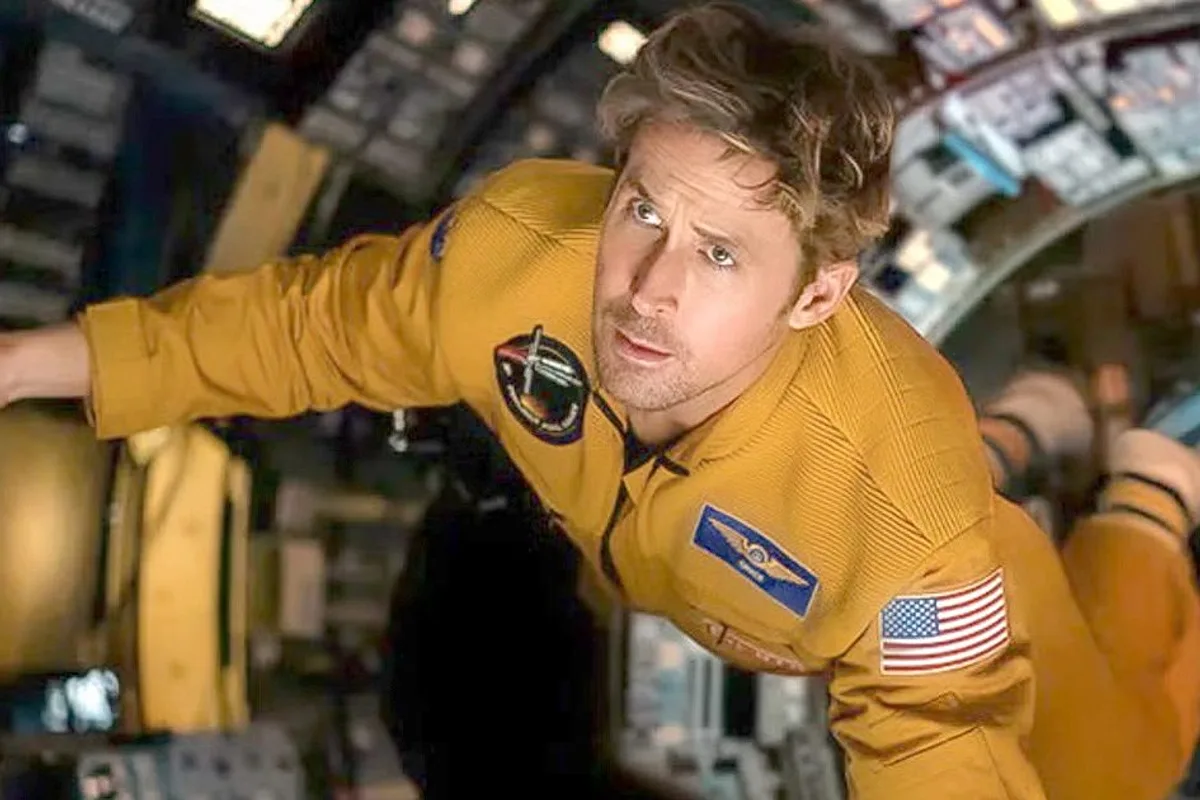
The character's gradually disordered appearance adds to the performance.
His hair, beard, awkward movements and visible exhaustion make his presence feel physical rather than abstract.
Ryland Grace does not resemble a man designed for a heroic space recruitment poster.
He looks like someone who would rather be somewhere else.
That is precisely why his journey becomes compelling.
Rocky is the film's greatest achievement
The emotional center of Project Hail Mary emerges when Grace discovers that he is not the only intelligent being confronting the interstellar catastrophe.
Rocky belongs to an extraterrestrial species whose physiology, perception and methods of communication differ radically from those of humans.
His rocky body, articulated limbs and lack of recognizable facial expressions could have made him difficult to integrate into an emotional story.
Lord and Miller turn those challenges into strengths.
The encounter does not begin with a conveniently universal conversation.
It requires observation, attempts at communication and a willingness to learn how another intelligence understands its environment.
Language becomes a scientific problem in its own right.
The physiological differences do not merely give Rocky an unusual appearance. They shape the conditions under which cooperation becomes possible.
That process makes the relationship convincing.
Their friendship develops through work, trust and risks accepted for one another rather than a simple declaration that two different beings should become friends.
Performed and voiced by James Ortiz, Rocky has a recognizable personality without depending on a human face.
Movement, sound and carefully timed reactions create a presence that feels greater than the special effects required to produce it.

The most enthusiastic reviews have particularly celebrated this relationship.
Even more reserved critics, including Robert Daniels at RogerEbert.com, identify its emotional effectiveness.
The film gradually becomes a kind of unlikely buddy comedy, but the shift is not a distraction.
It expresses the story's central idea: knowledge and survival do not depend exclusively on individual intelligence.
They also emerge from the ability to learn from someone who experiences reality differently.
Science becomes the engine of adventure
Andy Weir's fiction belongs to a tradition fascinated by material constraints.
His characters must understand the properties of their environments before they can act effectively.
The adaptation preserves much of that logic.
The mysterious threat to the Sun is not defeated through a supernatural revelation or the sudden discovery of a convenient weapon.
Grace must develop hypotheses, conduct experiments and accept that some of his assumptions are incorrect.
This approach has substantial cinematic advantages.
Scientific discoveries become active parts of the narrative.
A laboratory result can change the direction of an entire mission.
The directors frequently make complicated reasoning entertaining and visually understandable without demanding that viewers master every concept from the novel.
The compromise has a cost.
Several problems are simplified, and some solutions arrive with an efficiency that feels particularly convenient.
This is not automatically a logical error.
Adapting a dense science fiction novel requires compression, but reducing the intellectual process can also diminish the pleasure of reaching the solution.
The comparison with The Martian is instructive.
Both stories celebrate scientific thinking, but Project Hail Mary introduces a relationship between intelligent species that changes the experience.
Its protagonist must do more than survive through his own knowledge.
He must establish a working partnership with someone whose understanding of the world is fundamentally different.
Scientific problem-solving becomes a story of collaboration.
Spectacular filmmaking that sometimes tries too hard
Phil Lord and Christopher Miller possess a recognizable artistic identity.
Their films embrace tonal changes, comedy and the possibility that each narrative idea can inspire a new visual invention.
In Project Hail Mary, that energy supports an adventure built on enormous visual scale.
The spacecraft interiors, alien environments and cosmic distances create a convincing sense of an expedition far removed from ordinary human experience.
Greig Fraser's cinematography contributes to that scale through lighting, contrast and carefully composed environments.
However, the spectacle does not work equally well throughout the film.
Some sequences emphasize their own grandeur for too long.
Sweeping camera movements, intense lighting and emphatic music occasionally appear designed to instruct the audience to feel awe.
RogerEbert.com's review criticized precisely this tendency to underline the visual spectacle rather than allowing certain moments to speak for themselves.
The criticism is persuasive.
The movie's best scenes do not require monumental images.
A difficult exchange between Grace and Rocky or a modest scientific discovery can generate greater emotion than an extended cosmic panorama accompanied by a soaring score.
The visual achievement is substantial, but the direction would occasionally benefit from greater restraint.
Sandra Hüller gives the mission its moral weight
The Earthbound portions of the story unfold through Grace's recovering memories.
They gradually explain how a science teacher became involved in a mission of such extraordinary importance.
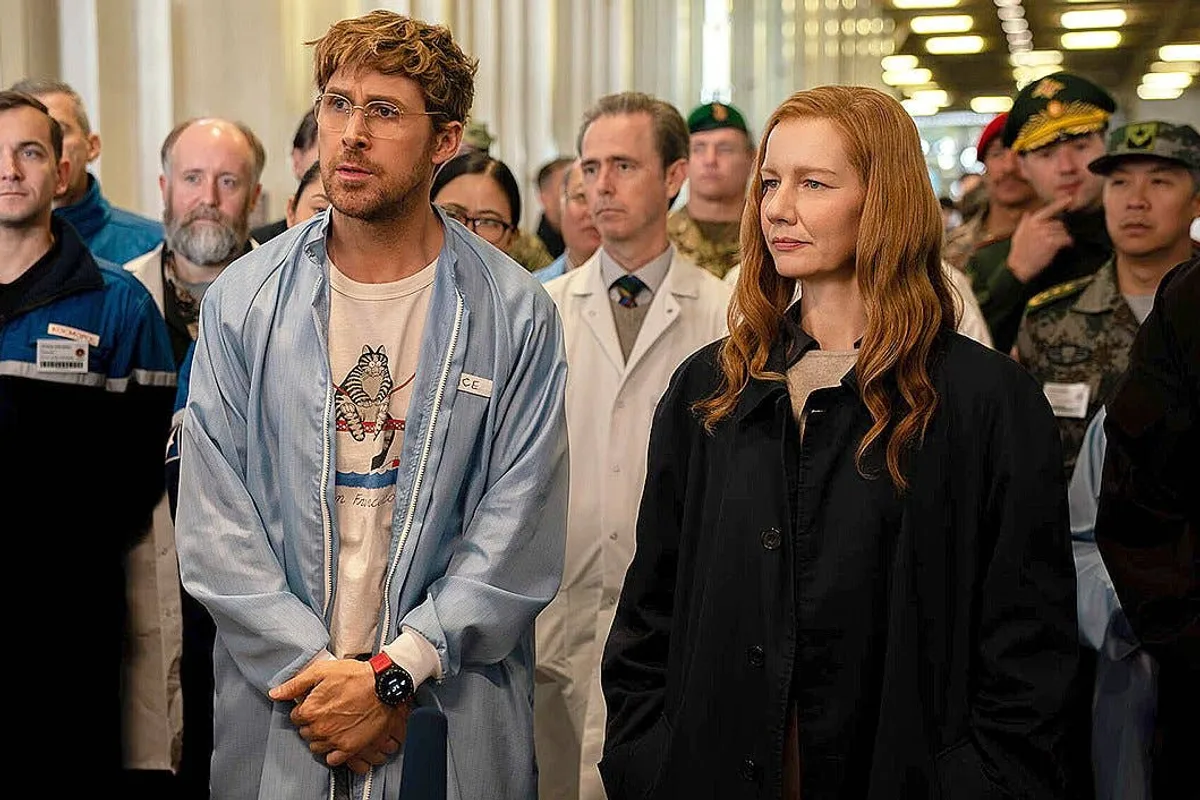
Sandra Hüller portrays Eva Stratt, the administrator responsible for organizing the international attempt to prevent disaster.
Her character cannot approach every decision as an abstract intellectual problem.
She must coordinate resources, impose priorities and make decisions whose consequences could affect the survival of humanity.
Hüller brings controlled severity to the role without reducing Stratt to a bureaucratic villain.
Her rigid approach becomes understandable in light of the responsibilities she carries.
The contrast between Grace and Stratt raises an essential moral question.
How far can an institution go when it believes collective survival depends on the actions of a very small number of people?
The film is most interesting when it allows that question to remain uncomfortable.
The flashback structure nevertheless creates pacing problems.
Earthbound scenes repeatedly interrupt the relationship with Rocky, which becomes the more engaging component of the film.
Some information might have been introduced more efficiently, particularly when the flashbacks function primarily as exposition.
Even so, Stratt remains essential.
Without her, Project Hail Mary might reduce a planetary crisis to a purely personal adventure.
Hüller's performance reminds viewers that scientific decisions also involve institutions, competing responsibilities and difficult moral choices.
A story of courage that challenges its own hero
Project Hail Mary has an unmistakably heroic premise.
One person must attempt the seemingly impossible to prevent catastrophe.
Yet Grace becomes interesting precisely because courage is not presented as one of his natural, permanent qualities.
He possesses extraordinary scientific knowledge, but he is not someone who eagerly volunteers to sacrifice himself for humanity.
His hesitation and fear make his eventual decisions more meaningful.
The film also develops an idea that many blockbusters mention without fully exploring.
Genuine courage can involve recognizing that one needs someone else's help.
Far from Earth, national prestige, professional identity and cultural traditions cannot independently solve the central problem.
Grace and Rocky must understand the limitations of their own knowledge.
This helps explain the strongly favorable emotional response identified across the critical corpus.
Rotten Tomatoes' reviews particularly emphasize the movie's combination of intelligence, humor and warmth.
There is still a limitation.
The film often knows exactly which feeling it wants to produce, and its methods of generating that emotion can become too insistent.
The optimism is sincere, but the presentation does not always trust the audience to reach its own emotional conclusions.
156 minutes and an ending that struggles to stop
At approximately two hours and thirty-six minutes, Project Hail Mary has sufficient time to establish its mystery, explore the scientific problems and make the relationship between its central characters convincing.
For much of the running time, that scope is beneficial.
The audience needs to understand the demands of the mission and experience the gradual development of Grace and Rocky's partnership.
The difficulty emerges as the story approaches its conclusion.
Several sequences appear designed to deliver major emotional resolutions, only for another development to extend the narrative.
The movie accumulates moments that might individually have provided satisfying endings.
Robert Daniels's review at RogerEbert.com makes this criticism particularly clearly.
He argues that the final stretch supplies so many uplifting conclusions that it weakens the effect of an earlier moment that had already achieved considerable emotional power.
This is the main reason the film falls short of an exceptional score without reservations.
Generosity becomes a weakness when a story cannot recognize that it has already reached its most effective ending.
Project Hail Mary is so determined to leave viewers satisfied that some of its final moments become less powerful than they might have been.
The problem does not erase the achievement, but it makes the ending less elegant than the best material preceding it.
A blockbuster built around cooperation rather than destruction
Comparisons with Interstellar, Gravity and The Martian are inevitable.
All involve dangerous journeys through space, isolated protagonists and stakes extending beyond individual survival.
But Lord and Miller do not attempt to reproduce Christopher Nolan's cosmic solemnity or Alfonso Cuarón's stripped-down survival experience.
They retain the lighter spirit of popular adventure, allowing humor and scientific intelligence to coexist.
That approach may disappoint viewers expecting an entirely serious philosophical science fiction drama.
The Guardian's March 2026 review raised precisely that concern about the movie's occasional silliness.
Other critics celebrated its ability to deliver accessible entertainment without abandoning stimulating scientific ideas.
The contrast explains why the favorable consensus should not be mistaken for unanimity.
Metacritic categorizes the overall response as generally favorable, while Variety and RogerEbert.com identify familiar narrative conventions and weaknesses more strongly.
This review broadly agrees with the favorable critical reception while retaining several of those reservations.
The film's greatest distinction is not that it invents an entirely new way to portray space.
It places cooperation between profoundly different intelligent beings at the center of a spectacular adventure.
In a genre frequently associated with interstellar warfare, that choice has considerable charm.
A successful adaptation with a substantial audience
Released theatrically in March 2026, Project Hail Mary achieved significant commercial success before becoming available on Prime Video.
In an article updated on July 3, Amazon MGM Studios reported that the movie had earned more than $680 million worldwide.
That figure describes theatrical revenue, not streaming consumption.
Amazon also confirmed that the film became available globally on Prime Video in July 2026.
The streaming release expanded the potential audience without changing the nature of its earlier theatrical achievement.
The project also benefited from the popularity of Andy Weir's novel, published in 2021 and widely read before the adaptation was released.
The production had an established literary property, an internationally recognized star and directors associated with major creative successes.
Those advantages help explain its visibility, but they do not independently account for the positive audience response.
The relationship between Grace and Rocky remains one of the strongest reasons for the film's lasting appeal.
Verdict: 8/10, a space adventure with a genuine heart
Project Hail Mary is an excellent piece of popular science fiction.
It combines substantial visual ambition with a strong central performance and an unusually effective understanding of how scientific reasoning can become dramatic entertainment.
Ryan Gosling gives an immensely engaging performance, while Sandra Hüller provides the Earthbound scenes with necessary moral seriousness.
But Rocky is what makes the experience special.
The friendship between the central characters is funny, intelligent and frequently moving.
It gives the story an identity stronger than the apocalyptic premise that begins it.
The weaknesses remain visible.
The film is overlong, its final act becomes excessively insistent and certain narrative conveniences reduce the pleasure of watching difficult scientific problems being solved.
The directors occasionally confuse wonder with the need to make every image more spectacular than the previous one.
Nevertheless, the overall experience succeeds because it believes in a simple idea.
When faced with the unknown, curiosity and cooperation may be more valuable than fear or violence.
Project Hail Mary does not reinvent science fiction.
It reminds us why the genre can be so moving.
By the end, the most memorable image is not a threatened star.
It is the connection between two beings who have learned how to understand one another.