
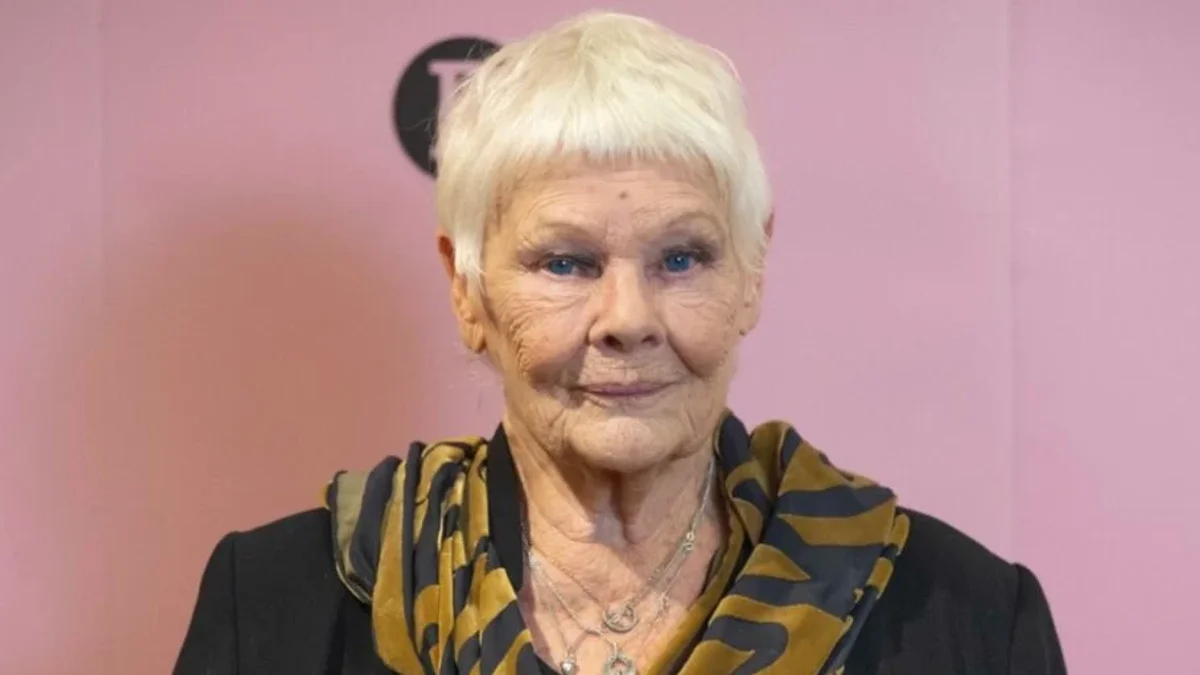
For much of her career, Judi Dench could transform a scene with the smallest movement of her eyes.
A skeptical glance, an almost imperceptible smile or a moment of silence could convey more than an extended speech.
Now her ability to see has deteriorated to the point that she says she can no longer continue performing in the way she once did.
During an interview on BBC Radio 4's Today programme on October 22, 2026, the British actress explained that she was no longer able to act on stage or in films.
She also said she could no longer read.
Dench, now 91, has been living with age-related macular degeneration for more than a decade.
The condition has progressively affected her central vision and made familiar everyday activities increasingly difficult.
Her remarks were reported by British outlets on October 22 and received further international attention the following day.
However, the significance of the interview is more precise than a simple headline about the end of a career.
Dench was describing what her eyesight currently prevents her from doing.
She was not announcing a formal retirement date or a complete schedule of future professional commitments.
Dench describes the practical impact of her vision loss
Speaking to presenter Emma Barnett, Dench explained that performing in a play or working on a film was no longer possible for her.
Reading has also become impossible.
One particularly striking detail concerned the interview itself.
Dench said she could not make out Barnett's face, even though the presenter was sitting directly in front of her.
She also described situations in which she approaches people she believes she recognizes, warmly greets them or attempts to hug them before discovering that she has mistaken them for someone else.
These experiences illustrate the everyday consequences of substantial vision loss.
The issue is not simply that distant objects appear less clear.
Reading words, identifying faces and interpreting details in the surrounding environment can become difficult.
For a professional actor, those changes can affect virtually every stage of working life.
Dench nevertheless spoke about adapting to her circumstances rather than dwelling constantly on them.
She acknowledged the restrictions while emphasizing the need to make allowances and continue living.
Her response was characteristically straightforward.
She did not deny the difficulties, but neither did she allow them to become the only subject of the conversation.
Macular degeneration has affected her for more than a decade
Dench publicly discussed her diagnosis of age-related macular degeneration in 2012.
The condition affects the macula, a part of the retina essential for detailed central vision.
Damage to this area can make activities such as reading and recognizing faces more difficult.
However, the condition varies considerably between individuals.
Its progression and consequences depend on several factors, including the form of the disease and the vision that remains.
Dench's experience should therefore not be treated as a universal description of everyone living with macular degeneration.
In her case, the difficulties developed over many years.
In 2014, she acknowledged that reading was becoming increasingly challenging but said she intended to continue working for as long as she could.
By 2023, the condition had begun to interfere significantly with the methods she had used to prepare performances.
She discussed needing assistance to learn lines that she could no longer read normally.
In 2025, she spoke about difficulties recognizing people and moving around independently.
Her October 2026 interview describes another stage in that gradual progression.
This is not a newly disclosed diagnosis.
It is an update about a long-standing condition whose consequences have become more severe.
Learning scripts became increasingly difficult
Dench's relationship with written language has always been central to her work.
Much of her theatrical career has involved plays in which rhythm, precise wording and shifts in meaning are essential.
She has previously described possessing an exceptionally strong visual memory.
That ability helped her learn scripts by remembering how words appeared on a page.
As her eyesight deteriorated, that approach became increasingly difficult.
In 2023, during an appearance on The Graham Norton Show, Dench discussed the challenge of learning dialogue without being able to see the written material.
She hoped to find equipment capable of helping her remember not only the words but also their placement within the script.
Friends and colleagues also helped by reading lines aloud so she could learn through repetition.
The challenge was not a lack of interest in acting.
It was the loss of access to methods she had relied on for decades.
That distinction is fundamental.
An actor's work begins long before the audience sees a performance.
Scripts must be read, dialogue memorized, movements rehearsed and relationships with other performers understood.
Performing also requires awareness of the surrounding physical environment.
Severe vision loss can affect each of those tasks.
Dench's account offers a personal illustration of these challenges without implying that every visually impaired performer experiences them in exactly the same way.
A theatrical career dating back to 1957
Dench's latest remarks carry particular weight because of the extraordinary length of her career.
She began working professionally on stage in 1957.
That year, she played Ophelia in Hamlet in Liverpool with the Old Vic company.
Theater became a defining part of her artistic identity.
Long before movie audiences around the world recognized her as M, she had established herself as one of Britain's most distinguished classical performers.
Her Shakespearean roles include Juliet, Lady Macbeth and Cleopatra.
Each character demands a very different interpretation.
Juliet belongs to a story of love, youth and family conflict.
Lady Macbeth explores ambition, guilt and psychological collapse.
Cleopatra combines political authority, personal relationships and the public performance of power.
Dench's work across these roles demonstrated remarkable range.
Her performances emphasized close attention to language alongside the ability to make emotional contradictions convincing.
She remained a major theatrical presence across several generations of British performance.
Her career also extended into comedy, television and a wide range of films.
The full scope of her work reaches far beyond the few characters for which she is most widely recognized internationally.
The unforgettable M of James Bond
For millions of moviegoers, Judi Dench will always be associated with M.
She first appeared as the head of MI6 in GoldenEye in 1995, opposite Pierce Brosnan.
Her version of the character immediately established a different relationship between James Bond and his superior.
M possessed authority without needing to demonstrate physical strength.
A short remark or an uncompromising expression could be enough to silence the famously confident spy.
Over time, the character became more than an institutional figure.
Her relationship with Bond gained emotional and dramatic complexity, particularly during Daniel Craig's tenure.
In Casino Royale, Quantum of Solace and Skyfall, her decisions had direct consequences for the protagonist.
Skyfall, released in 2012, gave M an unusually central role.
The film explored the consequences of her professional choices and her complicated relationship with an agent who frequently resisted authority.
Dench portrayed M across eight Bond films, including her appearance in Spectre.
That longevity allowed her to bridge two very different periods of the franchise.
Even as the cinematic style and characterization of Bond changed, M remained a recognizable presence.
Her association with the series explains why her latest comments have attracted attention well beyond British theater.
An Academy Award for Shakespeare in Love
Dench won the Academy Award for Best Supporting Actress in 1999 for Shakespeare in Love.
She portrayed Queen Elizabeth I.
Her appearance in the movie was relatively brief, yet the character left a lasting impression.
The performance demonstrated her ability to establish authority and personality without dominating the running time.
Other important film roles followed.
In Iris, she portrayed writer Iris Murdoch.
In Philomena, she played a woman searching for the son from whom she had been separated decades earlier.
Her filmography also includes Notes on a Scandal, Victoria & Abdul and numerous other productions.
These roles reveal a career extending across intimate drama, literary adaptation, historical material and mainstream entertainment.
Dench earned an Academy Award, a Tony Award and seven Laurence Olivier Awards, among many other honors.
Those achievements demonstrate the recognition she received across different media.
But the extent of her contribution is not captured entirely by awards.
The consistency of her work across more than seventy years is equally significant.
Shakespeare remains an enduring passion
Dench's BBC interview was not exclusively about the difficulties created by her eyesight.
She also spoke about Shakespeare and the pleasure she continues to find in his work.
She expressed particular affection for the sonnets.
Their ability to capture complicated human emotions through rhythm and relatively simple language remains deeply meaningful to her.
That attachment is especially poignant given her difficulties with reading.
Although she can no longer engage with printed text in the way she once did, the language remains part of her emotional and professional life.
Shakespeare has accompanied her since her earliest theatrical experiences.
She has spent decades studying, memorizing and performing his words.
Dench also recalled that acting never became entirely comfortable.
She described performing as something that could be frightening.
But that fear could become a source of energy during a performance.
Her remarks reveal an actress who never regarded her craft as something completely mastered.
Even after extraordinary success, she continued to see performance as an ongoing process of discovery.
That attitude offers one explanation for her artistic longevity.
Audiences could still hear her voice in a 2026 film
An important qualification concerns her recent film credits.
Audiences could still hear Judi Dench in The Magic Faraway Tree, released in 2026.
The fantasy film stars Andrew Garfield and Claire Foy and includes a voice performance by Dench.
She voices a technologically sophisticated refrigerator with intrusive surveillance capabilities.
That appearance illustrates why the release date of a movie should not be confused with the date a performance was recorded.
A film can reach audiences long after its actors have completed their work.
No verified information establishes that Dench recorded this contribution after the October 2026 interview.
The credit does not therefore contradict her comments about her current ability to work.
Equally, she has not announced a confirmed schedule of future voice-acting projects.
It would be premature either to promise additional performances or to describe every possible form of acting as permanently ruled out.
Her own statements concern the restrictions she is presently experiencing.
A new memoir accompanies the interview
The BBC conversation also took place around the publication of Dench's memoir, Is It Too Late to Make a Run for It?
The book was created with Brendan O'Hea, a longtime friend and theater director.
It provides an opportunity to reflect on a professional life spanning multiple generations.
A career of that length involves far more than a chronological list of famous performances.
There are collaborations, personal relationships and experiences that influence an artist's development.
The memoir allows Dench to revisit those elements of her life.
Its publication also demonstrates that she remains part of public cultural conversation.
Being unable to perform on stage does not necessarily mean withdrawing from public life.
She can still discuss her work, recall her experiences and share her thoughts about theater and film.
However, no comprehensive schedule of future activities has been announced.
Her comments should not be exaggerated into a formal retirement announcement
The language of retirement naturally appears in coverage of Dench's interview.
Her inability to act on stage or make films represents a profound professional change.
Nevertheless, it is important to distinguish that change from a formally announced retirement.
Dench did not provide an official final working date.
She did not identify a particular production as her definitive final performance.
Nor did she give a detailed account of every type of creative activity she might undertake in the future.
She described what her current eyesight prevents her from doing.
That is significant enough without extending the statement beyond its actual meaning.
The distinction also helps avoid reducing her identity to a medical condition.
Dench continues to speak about literature, her memories and her professional experiences with clarity.
Her vision loss has major consequences for some activities, but those limitations do not encompass the entirety of her life.
Respecting that difference is an important part of reporting her story accurately.
A legacy extending far beyond James Bond
The character of M will remain one of the most recognizable parts of Judi Dench's screen legacy.
But her wider contribution extends across Shakespearean theater, television drama and many different kinds of cinema.
She portrayed historical figures and contemporary women.
She worked in literary adaptations, intimate dramas, comedies and internationally successful franchises.
She also demonstrated an unusual ability to make even brief appearances memorable.
Across those different projects, her performances were characterized by precision, emotional intelligence and a close relationship with language.
Those qualities have made her a point of reference for generations of performers.
Her worsening eyesight does not change the work she has already completed.
It affects her present ability to continue creating new performances in the ways she once did.
At 91, she finds herself in a situation where her love of theater remains strong even as the physical conditions required to practice it have become increasingly difficult.
That contrast gives her latest interview its emotional significance.
What Judi Dench has confirmed about her eyesight
On October 22, 2026, Judi Dench told BBC Radio 4 that she could no longer act on stage or in films because of her deteriorating vision.
The 91-year-old actress has lived with age-related macular degeneration since at least 2012, when she publicly discussed the diagnosis.
Her condition now significantly affects her ability to read and recognize faces.
The latest comments describe the progression of difficulties she has spoken about over several years.
They do not include a formal declaration setting out a permanent retirement timetable or a complete list of future commitments.
The interview also accompanied a new memoir and offered further evidence of her enduring passion for Shakespeare.
For audiences who principally know her from James Bond, the news is a reminder of a much larger artistic life that began on stage in 1957.
And although Dench can no longer perform as she once did, her affection for acting, language and the theater remains unmistakable in the way she speaks about them.