Adapting La vie est un long fleuve tranquille in 2026 comes with an obvious problem: how do you modernize a film whose comedy depended so heavily on caricaturing the France of its own time? Rather than build a belated sequel, the new series returns to the central premise created by Étienne Chatiliez and Florence Quentin and moves it into the present day.
The same baby swap, with a new mechanism
This time, the Le Quesnoys and Groseilles live in Arcachon and already know each other when they discover that their children, Côme and Jordy, were switched at birth fourteen years earlier. Their class conflict also extends to work: Mr. Le Quesnoy runs the hypermarket where Mr. Groseille works as a forklift operator and trade unionist.
The series then introduces a device that gives the old premise a distinctly episodic shape. Unable to reach an agreement, the families are ordered by a juvenile court judge to try four months of shared custody. Both households subsequently fight to gain custody of the two teenagers. Instead of a single child suddenly entering an unfamiliar social environment, the clash can now move repeatedly between both homes.
Two familiar families, an entirely new cast
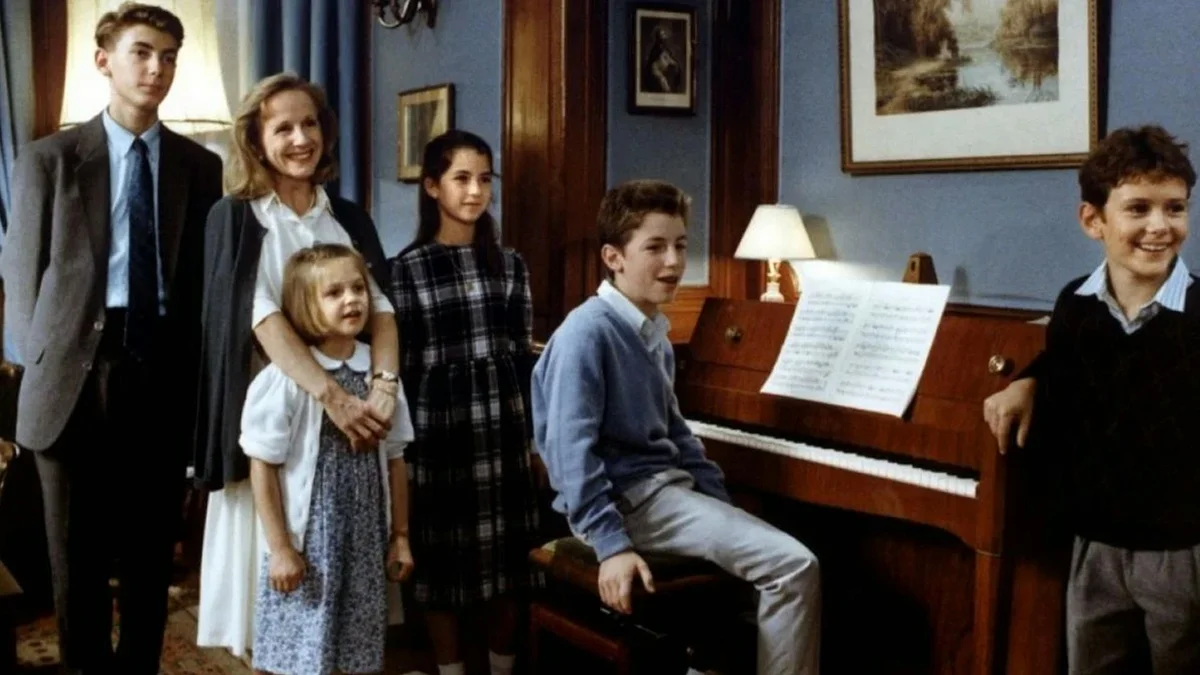
Ludivine Sagnier and Alban Ivanov play the Groseille parents, while Doria Tillier and Xavier Lacaille lead the Le Quesnoy household. The casting does not attempt to physically reproduce the 1988 ensemble, but it restores the two opposing family units that powered the original satire.
Clovis Cornillac is directing all six episodes. Estelle Koenig and Julien Teisseire created and wrote the series, with Augustin Amri and Alpha Diallo also contributing to the writing. ELEPHANT Story is producing, with STUDIO TF1 as co-producer.
Nostalgia is the easy part
Chatiliez's film worked because its social caricatures were exaggerated yet instantly legible. Manners, Catholic bourgeois respectability, money, education and working-class resourcefulness all fed the collision between two versions of France. Simply bringing back the Groseille and Le Quesnoy names would not recreate that chemistry.
Moving the story to Arcachon and making Mr. Groseille a unionized employee already suggests a more interesting approach. The adaptation appears to be rebuilding the social opposition rather than preserving the exact one designed for 1988. That is likely to be the real test: not whether the series can reproduce famous moments, but whether it can find contemporary social markers sharp enough to generate a similar friction.
Six episodes also create much more room than the original feature. The conflict can linger, alliances can shift and the teenagers themselves can occupy more of the story. The new shared-custody setup provides a practical engine for that expansion without simply stretching the movie's plot across several hours.
Netflix has not set a release date
Reports about the project had already surfaced during the summer, including comments from Alban Ivanov, but the production is now publicly underway. Filming is taking place around the Arcachon and Bordeaux area.
Netflix has not announced a release date. Any specific launch window circulating at this point therefore remains an estimate rather than a confirmed date. What is certain is that almost four decades after the film, the Groseilles and Le Quesnoys are heading back into battle — this time with six episodes to discover whether their class war can still bite.