
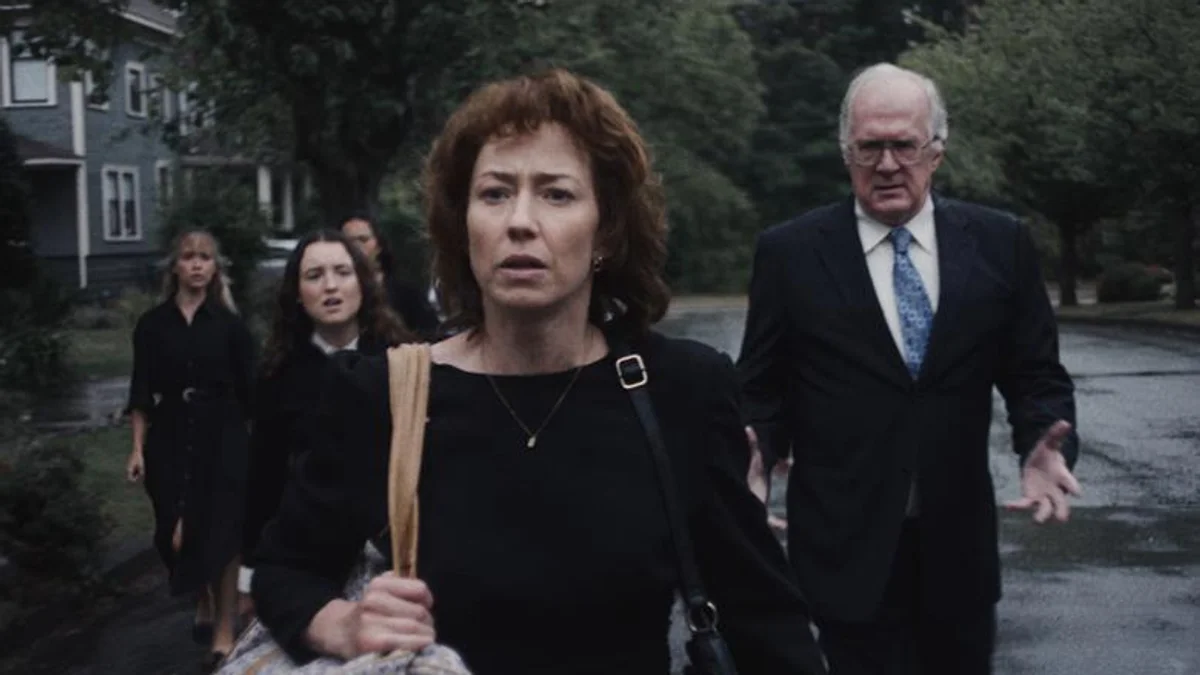
Rita does not necessarily want a different life. She wants to escape the pain that has never stopped defining the one she already has.
That distinction is central to The Liberation, the latest film from Guy Nattiv.
Bleecker Street released the first official trailer on Monday, November 2, 2026, introducing a psychological drama about trauma, persuasion and the fragile boundaries between personal freedom and manipulation.
Carrie Coon plays Rita, a mother whose past continues to haunt her.
Lily James portrays Ricki, a young spiritual leader who seems able to recognize suffering that other people fail to understand.
Their relationship gradually draws Rita away from her husband and daughters and into an isolated community.
But the story becomes more complicated when Rita's daughters arrive to bring her home.
The group that has captivated their mother may also begin to influence them.
The film has already screened at several international festivals and is scheduled for its main US theatrical release on January 8, 2027.
Carrie Coon plays a Holocaust survivor living with unresolved trauma
The story takes place in New Jersey during the 1980s.
Rita appears to have an ordinary family life.
She has a husband, two daughters and a job.
Yet her domestic stability conceals an emotional burden that has never fully disappeared.
Rita survived the Holocaust.
Decades later, she continues to live with the psychological consequences of what she experienced as a child.
Her suffering cannot simply be explained as dissatisfaction with marriage or a conventional midlife crisis.
The film presents it as the lasting impact of extraordinary historical violence.
This distinction matters because it changes how her choices are understood.
Rita is searching for something that her everyday environment has been unable to provide.
She wants relief from memories and emotions that continue to shape her identity.
When she meets Ricki, the young woman seems to offer an explanation for that suffering.
More importantly, she offers the possibility of escaping it.
The promise is powerful because it addresses a genuine need.
The central question is whether the person offering that promise can be trusted.
Lily James makes spiritual authority quietly unsettling
Ricki leads an all-female spiritual community known as Harmonia.
She presents the group as a place where women can free themselves from conventional expectations, emotional burdens and the pressures of everyday life.
Her language emphasizes nature, healing and personal transformation.
The trailer does not portray her as an obviously threatening figure.
Instead, James presents a character whose authority appears to grow through warmth, attention and emotional reassurance.
That approach makes Ricki's influence particularly unsettling.
She does not need to begin with visible intimidation.
Her power develops through the impression that she understands Rita better than anyone else.
The group gradually becomes a source of meaning that competes with the protagonist's existing relationships.
This is where the psychological thriller takes shape.
A person seeking support begins to depend on someone who claims to possess the answers.
The distinction between genuine care and control becomes increasingly difficult to identify.
Festival reviews have noted James' ability to portray that authority without constantly resorting to overt menace.
Those comments represent critical assessments rather than established conclusions about how every audience will experience the performance.
The trailer introduces the character's approach, while the completed film provides the fuller context.
Harmonia promises an alternative life
The commune is called Harmonia, which was also the project's working title during development.
It is presented as a secluded community where women can pursue a different way of living.
The group offers distance from ordinary social obligations and promises a more meaningful existence.
Its appeal is closely connected to Rita's circumstances.
She does not enter the community because she has no relationship with the world outside it.
She enters because the world she knows has failed to provide the emotional relief she seeks.
The story therefore avoids reducing the commune's attraction to a simplistic explanation.
Its members may have personal histories and emotional needs that make Ricki's promises persuasive.
That does not establish that the group is providing genuine healing.
The film's concern is the potential for authority to emerge from the language of freedom.
An organization can promise independence while gradually determining how its members think, behave and relate to the people outside it.
The Liberation explores that contradiction through a fictional community inspired by the director's family history.
It should not be interpreted as a claim that all spiritual groups or communal living arrangements operate in the same way.
Bella Ramsey and Odessa Young play daughters trying to rescue their mother
Bella Ramsey plays Ella, while Odessa Young portrays Jo.
The two young women travel to Harmonia after their mother abandons her previous life.
They hope to persuade Rita to return home.
That gives the film an apparently familiar dramatic situation.
Two daughters enter a dangerous environment to retrieve a family member.
But the official synopsis complicates the premise.
The sisters become exposed to the commune's seductive worldview.
What initially appears to be a straightforward rescue mission develops into a conflict involving several competing emotional needs.
The daughters understand the group primarily through the damage Rita's departure has caused.
Rita experiences it as a place that promises relief from suffering.
Ricki encourages the women to interpret their lives according to the community's principles.
These different perspectives create the possibility of a more complicated family drama.
The film is not simply asking whether Rita's daughters can find her.
It is asking whether they can understand what she believes she has discovered, and whether that understanding may place them at risk.
Tracy Letts portrays the husband left behind
Tracy Letts plays Rita's husband.
The actor and playwright is known for his work on stage and screen, including Lady Bird and Ford v Ferrari.
His character represents another part of the family disrupted by Rita's decision.
From his perspective, joining Harmonia means abandoning an established marriage and family life.
From Rita's perspective, remaining in that life may mean continuing to experience suffering she no longer believes she can tolerate.
The conflict is therefore more complicated than a simple disagreement about where someone should live.
It concerns the limits of responsibility between people who love one another.
How much can family members reasonably expect from someone struggling with unresolved trauma?
And when does a search for personal healing become destructive to the relationships that previously offered stability?
The trailer establishes those questions without revealing the film's ultimate resolution.
The fate of the family remains part of the story audiences will discover when they watch the feature.
Guy Nattiv drew inspiration from his grandmother's experience
The Liberation is deeply connected to the director's personal history.
Guy Nattiv has explained that his grandmother, a Holocaust survivor, left her husband and family to join a spiritual community during the 1980s.
He was a child when the event affected his family.
During a Deadline Contenders London discussion, Nattiv recalled attending gatherings connected with the group while he was still young.
He did not fully understand what the organization represented at the time.
Only later did he begin investigating what had happened.
He eventually returned to the subject through personal research and filmmaking.
His interest extended beyond the circumstances of his grandmother's departure.
He also wanted to understand what made the group's promises emotionally compelling to someone who had survived historical trauma.
That perspective shapes the film's moral complexity.
Nattiv is not merely presenting a case of an obviously malicious organization imposing itself on an unsuspecting person.
He is examining why a woman might perceive leaving her family as an opportunity to survive emotionally.
The film remains a dramatic fiction inspired by those experiences.
Its characters and incidents should not automatically be treated as exact historical representations of people in Nattiv's family.
The Holocaust's legacy is central to the psychological drama
Nattiv has previously explored the consequences of political violence, extremism and historical trauma.
His films include Golda, Skin and Tatami.
The Liberation continues that interest through a more intimate story.
Rita is not living through the Holocaust during the film's main timeline.
She is living decades after it ended.
The trauma of her childhood remains present in the relationships and decisions of her adult life.
The film therefore explores how suffering can continue long after the historical circumstances that caused it have disappeared.
That approach gives Rita's involvement with Harmonia a deeper context.
She is not seeking novelty for its own sake.
She wants to escape a psychological burden that conventional family life has not resolved.
The problem emerges when someone claims to possess a complete solution.
Ricki's promise is powerful precisely because Rita's suffering is real.
The film's psychological tension grows from the distance between that genuine need and the authority exercised by the person offering relief.
The trailer emphasizes attraction before danger
The first trailer introduces the relationship between Rita and Ricki before fully developing the threat surrounding Harmonia.
Rita encounters the spiritual leader, begins listening to her ideas and gradually moves closer to the community.
The promotional material then shifts toward the consequences for Rita's family.
This is a different approach from a thriller built primarily around immediate physical danger.
The threat is psychological before it becomes a matter of confrontation.
Ricki's influence develops through recognition and reassurance.
The contrast between Rita's ordinary domestic environment and Harmonia's natural surroundings also contributes to the story.
The commune appears to offer an escape from daily routines.
But an attractive setting does not guarantee meaningful freedom.
That tension appears to be central to the film's visual and dramatic approach.
The trailer offers an introduction to those ideas without establishing how every scene will function in the final feature.
It reveals the premise and atmosphere, not the resolution.
The Liberation has already screened at major festivals
Unlike many upcoming films releasing their first trailers, The Liberation is already completed and has been seen by festival audiences.
It premiered at the Telluride Film Festival in September 2026.
The movie subsequently screened at the Toronto International Film Festival and the BFI London Film Festival, among other events.
Its festival circulation means that several detailed reviews were available before Bleecker Street released the official trailer.
The Hollywood Reporter discussed the film's empathetic treatment of its characters and the nature of Ricki's influence.
The Playlist praised the performances, particularly those of Carrie Coon and Bella Ramsey.
Other publications expressed reservations about aspects of the film's structure and pacing.
It would therefore be inaccurate to describe the reception as universally positive.
The early response is better understood as a collection of critical assessments that recognize the strength of the premise and performances while differing over the execution.
The January theatrical release will allow audiences beyond the festival circuit to encounter the film.
Carrie Coon adds another complicated character to her filmography
Coon has built a career portraying people whose emotional lives cannot be reduced to simple explanations.
In The Leftovers, she played Nora Durst, a woman living with extraordinary grief and unresolved loss.
In The Gilded Age, she portrays Bertha Russell, whose social ambitions can threaten the relationships she values.
The Liberation offers another character defined by contradiction.
Rita loves her family but believes that leaving may be necessary to escape her suffering.
She seeks freedom through a community whose leader may ultimately restrict her ability to make independent decisions.
The role requires the audience to understand her emotional needs without assuming that every decision she makes is necessarily beneficial.
That balance appears central to Nattiv's approach.
Festival critics have highlighted Coon's portrayal of grief, vulnerability and emotional intensity.
The trailer offers a first look at the performance for audiences who did not attend those screenings.
A creative team built around an intimate psychological story
The screenplay is credited to Guy Nattiv and Noa Berman-Herzberg.
Tudor Vladimir Panduru and Fabian Gamper served as cinematographers.
Sabine Hoffman and Yuval Orr edited the film, while Dascha Dauenhauer composed the music.
The production involves companies including Sight Unseen, New Native and Spooky Pictures.
Producers include Julia Lebedev, Eddie Vaisman, Oren Moverman, Guy Nattiv, Jaime Ray Newman, Steven Schneider and Roy Lee.
These collaborators have helped create a film whose central conflict depends upon perception.
Rita's home must feel believable rather than purely oppressive.
Harmonia must appear attractive enough for her decision to make emotional sense.
The visual environment can then become part of the question the film asks about freedom and control.
That approach requires restraint.
If the commune looked obviously threatening from the first moment, Rita's attraction to it would become harder to understand.
The contrast between apparent comfort and growing dependence is therefore an important dramatic challenge.
Bleecker Street has scheduled a January 2027 release
The Liberation is scheduled for its main US theatrical opening on January 8, 2027.
Bleecker Street is also arranging earlier limited screenings in New York and Los Angeles beginning November 6, 2026.
Those engagements are connected with the film's awards-season eligibility.
The distributor has announced additional special screenings and discussions involving Nattiv and members of the cast.
The limited November run should not be confused with the main commercial opening in January.
As of November 3, the film has screened at festivals but has not yet begun its regular US theatrical rollout.
Release schedules outside the United States may differ.
The November 2 trailer announcement does not establish identical opening dates in every international market.
No confirmed digital or streaming premiere date was included in the official US release information.
The film asks what freedom means when someone else defines it
The Liberation is a title built around a contradiction.
Ricki promises Rita liberation from suffering.
She offers an alternative to family obligations, painful memories and the expectations of ordinary life.
But a freedom that requires obedience to another person's worldview may eventually become another form of confinement.
That is the unsettling idea at the center of the film.
Rita's daughters see Harmonia as a threat to their family.
Rita experiences the community as a possibility for healing.
Ricki presents her influence as guidance rather than domination.
These perspectives do not easily fit into a simple account of right and wrong.
Nattiv's personal connection to the subject makes the conflict especially meaningful.
He is dramatizing an experience that affected his own family while attempting to understand the emotional needs that made such a separation possible.
The first trailer gives wider audiences an introduction to that story.
Carrie Coon, Lily James, Bella Ramsey and Odessa Young lead a drama about family loyalty, psychological vulnerability and the seductive appeal of certainty.
After its festival premieres, The Liberation will reach its main American theatrical audience in January 2027.
Its most disturbing question may not be why Rita joined Harmonia, but what she would have to sacrifice to become free of it.