Some movie-set encounters are more surprising than others.
Elizabeth Debicki's first encounter with Alexander Skarsgård on Wicker was particularly unusual.
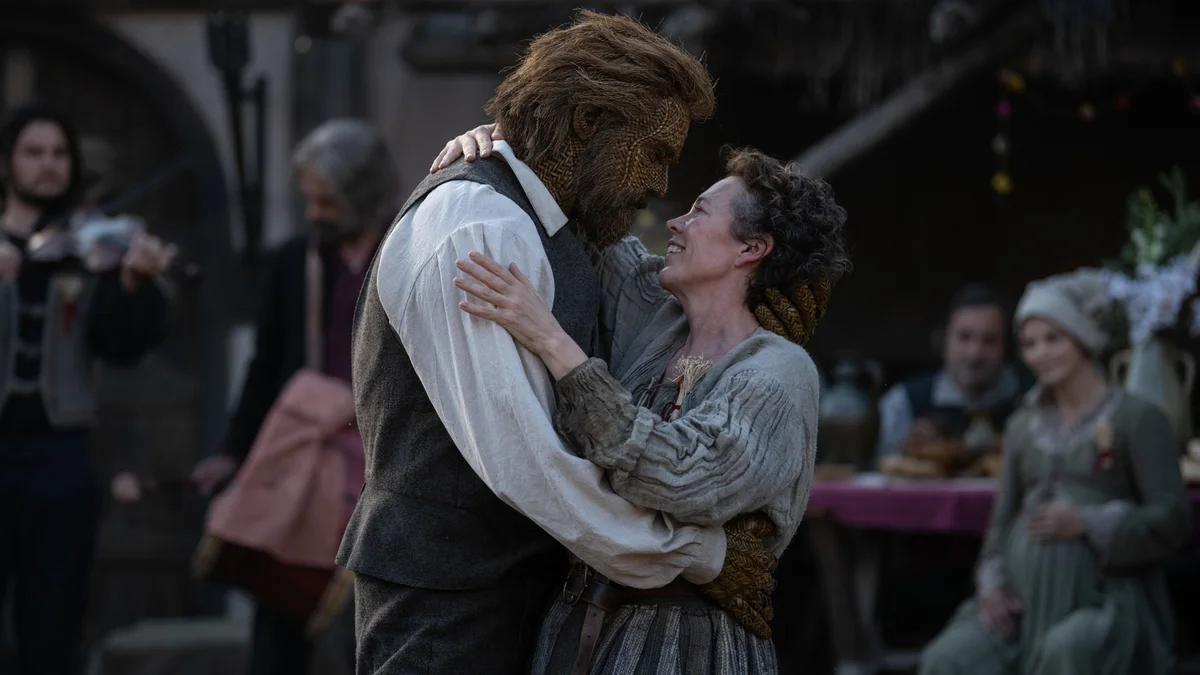
Arriving at the production in Budapest, she saw her co-star moving through water while dressed as a remarkably realistic man made entirely from woven material.
His costume reproduced the anatomy of a human body, leaving Debicki momentarily unable to process what she was seeing.
Olivia Colman had a different reaction.
After months of waiting to see the finished design, she was delighted when Skarsgård finally emerged in costume.
For Colman, the moment confirmed that the film's most unconventional element could actually work on screen.
A fisherwoman commissions a husband made from wicker
Wicker takes place in a coastal village that resembles the world of an old fairy tale.
Olivia Colman plays a single Fisherwoman who has become an outsider within her community.
The villagers ridicule her appearance, profession and refusal to conform to their expectations.
Eventually, she approaches the local Basketmaker, played by Peter Dinklage, with an extraordinary request.
She wants him to make her a husband.
The craftsman creates a figure from wicker. The creation comes to life as a man portrayed by Alexander Skarsgård.
Unlike the other men in the community, the Wicker Husband proves unusually considerate and attentive.
His relationship with the Fisherwoman offers her the possibility of a different life.
But the villagers find their happiness deeply unsettling.
Curiosity turns into resentment, jealousy and conflict as the unconventional couple challenges the community's assumptions about marriage.
Skarsgård's transformation relied on physical prosthetics
The filmmakers could have approached the Wicker Husband primarily through computer-generated imagery.
Instead, they collaborated with Wētā Workshop, the New Zealand company known for elaborate creature designs, costumes and practical effects.
The team developed an intricate costume and prosthetic makeup designed specifically around Skarsgård's features.
The transformation presented an important challenge.
According to the actor, an early test using a different performer did not look entirely convincing.
When the artificial facial features failed to align precisely, the resulting appearance became disturbing.
That was not the effect the directors wanted.
The Wicker Husband needed to seem strange without becoming a conventional horror monster.
Audiences had to believe that the Fisherwoman could develop sincere feelings for him.
The physical design therefore needed to preserve the actor's expressions beneath the prosthetics.
Skarsgård says wearing the finished costume helped him understand the character's movement and behavior.
The materials did more than create his appearance.
They influenced the performance itself.
The comedy is absurd, but its emotions are sincere
A woman falling in love with a handmade wicker husband sounds like a premise designed entirely for jokes.
The cast insists that Wicker is attempting something more complicated.
Olivia Colman credits writers and directors Eleanor Wilson and Alex Huston Fischer with finding the appropriate balance between comedy and emotional drama.
She explains that the screenplay allows scenes to move from ridiculous situations into moments of genuine sadness.
For Colman, that combination reflects real human experience.
People sometimes laugh during difficult periods. A situation that appears absurd can still reveal an authentic emotion.
The film uses its fantasy premise without treating the central relationship as something the audience should constantly ridicule.
Its characters may be unconventional, but their feelings are intended to remain credible.
That distinction separates Wicker from a straightforward parody of romantic storytelling.

Elizabeth Debicki sees a critique of patriarchal expectations
Elizabeth Debicki approaches the film through its social themes.
In her Variety interview, she argues that Wicker examines the expectations governing relationships between men and women.
The Fisherwoman does not fit the model of femininity accepted by her village.
She refuses to change her personality simply to gain approval.
By commissioning a partner specifically suited to her needs, she challenges the established social structure.
Debicki sees the story as an examination of patriarchal norms and the competitive pressures imposed on women.
The Fisherwoman's happiness becomes threatening precisely because she discovers a form of companionship outside the village's accepted rules.
The actress also connects the story to questions about bodily autonomy and women's freedom to shape their own lives.
These issues emerge through an exaggerated fantasy rather than a conventional political drama.
The unusual premise allows the filmmakers to explore familiar inequalities from an unexpected perspective.
Why does the Wicker Husband inspire jealousy?
The Wicker Husband's most important characteristics are not entirely physical.
He behaves with kindness and attentiveness.
He listens to the Fisherwoman, notices her needs and responds without constantly demanding something in return.
His behavior begins to alter how the villagers understand their own relationships.
Other women can compare his qualities with those of their partners.
The village's men encounter a form of competition they do not fully understand.
The creation therefore threatens the community's established hierarchy.
He demonstrates that relationships might function differently from the patterns everybody has learned to accept.
The fantasy element makes the contradiction immediately visible.
The least realistic man in the village may also be the one who behaves with the greatest consideration for his partner.
That paradox provides both comedy and emotional meaning.
The marketing campaign embraces the film's weirdness
Black Bear has made little attempt to conceal Wicker's eccentric premise.
The trailers prominently feature the unusual husband and jokes about his material construction.
The marketing campaign also includes unconventional promotional merchandise.
Cast members mention splinter-removal kits, accessories inspired by the character's body and popcorn containers modeled on his torso.
One poster deliberately imitates the covers of traditional romance novels.
It depicts Colman in the arms of her wicker partner in a composition designed to recall exaggerated romantic illustrations.
The campaign uses the film's strangeness as its primary identifying characteristic.
Rather than pretending the concept is ordinary, it invites audiences to enjoy how improbable it is.
That approach carries a risk.
Some viewers may expect a purely provocative comedy.
The cast wants audiences to discover that the humor supports a genuine emotional story.
The directors had unusual creative freedom
Skarsgård emphasizes the creative freedom enjoyed by the filmmakers.
He believes Wilson and Fischer were able to preserve the unusual qualities that made the screenplay appealing.
A story about a woman marrying a wicker creature could easily become the subject of repeated requests for simplification.
Financiers might seek a more conventional romance or a less peculiar central character.
Skarsgård says the directors were able to pursue their preferred artistic vision.
Colman shares his enthusiasm for the project's originality.
She argues that audiences have room for unusual stories alongside established franchises and familiar concepts.
Those statements reflect the actors' views rather than proving that every independent production enjoys comparable freedom.
Nevertheless, Wicker provides a concrete example of an unconventional concept reaching cinemas without abandoning its defining premise.
The film adapts The Wicker Husband
Wicker is based on The Wicker Husband, a short story by Ursula Wills-Jones.
Eleanor Wilson and Alex Huston Fischer wrote the screenplay and directed the adaptation.
The filmmaking duo previously collaborated on Save Yourselves!, a science-fiction comedy that premiered at Sundance in 2020.
Their new film continues their interest in extraordinary events disrupting ordinary human relationships.
Fantasy is not simply used to create spectacle.
It reveals social habits that characters would otherwise prefer to ignore.
In Wicker, the appearance of an artificial husband unsettles an entire community.
The villagers' reactions become as important to the narrative as the couple's romance.
Lol Crawley served as cinematographer, while Sofi Marshall edited the film.
The British Council lists a running time of 105 minutes.
From Sundance to American theaters
Wicker had its world premiere at the Sundance Film Festival in January 2026.
The screening introduced the project to critics and industry professionals several months before its commercial release.
Black Bear subsequently acquired its US distribution rights.
Variety reports that the acquisition was valued at approximately $2.5 million.
The distributor scheduled a limited American theatrical release for Friday, October 23, 2026.
A wider rollout is planned for October 30.
The film is therefore already playing in selected US theaters as of the October 26 interview, but its national expansion is still forthcoming.
The American release should not automatically be described as a worldwide opening.
No verified information from the sources reviewed establishes a precise French theatrical or streaming release date.
An encouraging opening weekend
Initial box-office figures provide an indication of the film's reception.
According to Variety, Wicker earned approximately $5.75 million during its opening American weekend across 1,471 locations.
The publication ranked it fifth for the weekend.
That result was characterized as a promising start for a relatively low-budget independent production.
However, theatrical revenue should not be confused with profit.
Cinema operators retain a share of ticket sales, and marketing and distribution expenses also affect financial performance.
The reported acquisition price does not necessarily represent the complete production budget.
These early numbers therefore cannot establish the film's ultimate profitability.
They do show that Wicker has attracted audiences beyond its initial festival screenings.
The planned October 30 expansion will provide another indication of how widely that interest extends.
A fantasy romance about choosing love differently
At its simplest, Wicker is about a woman who creates the relationship that her society has denied her.
But the film's ambitions extend beyond that situation.
It examines loneliness, the desire for acceptance and the reactions of people confronted with different forms of happiness.
Colman hopes audiences consider whether the relationships they choose genuinely improve their lives.
Debicki emphasizes how intimacy can change the way people understand themselves.
Skarsgård argues that the emotions remain meaningful even when the central character is fantastical.
The film's central contradiction makes those ideas accessible.
The Wicker Husband looks nothing like an ordinary human being.
Yet he may possess qualities that the village's supposedly respectable men have failed to develop.
That contrast becomes the foundation of the movie's romance.
Wicker is now opening across American cinemas
As of October 26, 2026, Wicker is playing in selected US theaters, with an expansion scheduled for October 30.
The film stars Olivia Colman, Alexander Skarsgård, Elizabeth Debicki and Peter Dinklage, under the direction of Eleanor Wilson and Alex Huston Fischer.
The cast's latest interviews clarify the intentions behind its extraordinary premise.
The filmmakers are not merely trying to generate laughs from a man made of woven material.
They want to tell a love story in which a fantastical creature exposes the contradictions of an apparently ordinary society.
Audiences may ultimately judge the results differently from the actors.
But Wicker is distinctive enough to deserve consideration beyond its unusual costume and provocative marketing.
In this village, the most considerate man may be the one nobody ever imagined could be loved.