

The video game industry was long organized around a relatively straightforward relationship: software was developed for particular platforms, and hardware manufacturers used their game libraries to attract customers.
That model has evolved through PC gaming, subscription services, cloud streaming and simultaneous releases across competing devices.
Xbox Labs enters this discussion from another direction: transforming existing software so that it can run in environments never anticipated by its original developers.
Microsoft Is Watching Innovation From Communities
Xbox Labs follows several experiments carried out by developers and enthusiasts outside traditional publishing structures.
Decompilation and recompilation projects have enabled certain older games to operate on more modern hardware.
Other experiments have explored adaptation to Apple Silicon and execution inside web browsers.
These initiatives do not necessarily originate from the original publishers. They demonstrate that communities can sometimes create new technical possibilities around existing works.
Microsoft now wants to study these methods through a dedicated organization.
Xbox Labs brings together specialists capable of evaluating emerging ideas and testing potential applications.
The group also plans to share tools with developers, potentially extending its influence beyond Xbox-owned games.
A Project That Could Change Platform Economics
For a hardware manufacturer, software availability contributes significantly to the value of its ecosystem.
Games available only on a particular device can help differentiate that platform from competitors.
Conversely, allowing software to run on more devices can expand its potential audience while reducing the need to purchase specific hardware.
Asha Sharma acknowledges that certain innovations may challenge established business models.
That does not mean Microsoft intends to abandon Xbox consoles.
The executive explicitly reaffirms the company's commitment to hardware, games, intellectual property and gaming communities.
Xbox Labs should therefore be understood as a complementary research initiative, not an announcement that Microsoft is leaving the console business.
Gaming Heritage Also Has Commercial Value
Game preservation is often discussed as a cultural challenge. It is also an economic consideration.
An older title can retain an audience and commercial potential long after its original platform disappears from stores.
When new technologies make adaptation easier, publishers may gain more options for distributing their older works.
These remain potential applications for Xbox Labs rather than confirmed future products.
Microsoft's separate Backward Compatibility on PC program provides a more concrete example of commercial access to historical games.
Since July 2026, four original Xbox titles have been available on supported PCs and handhelds.
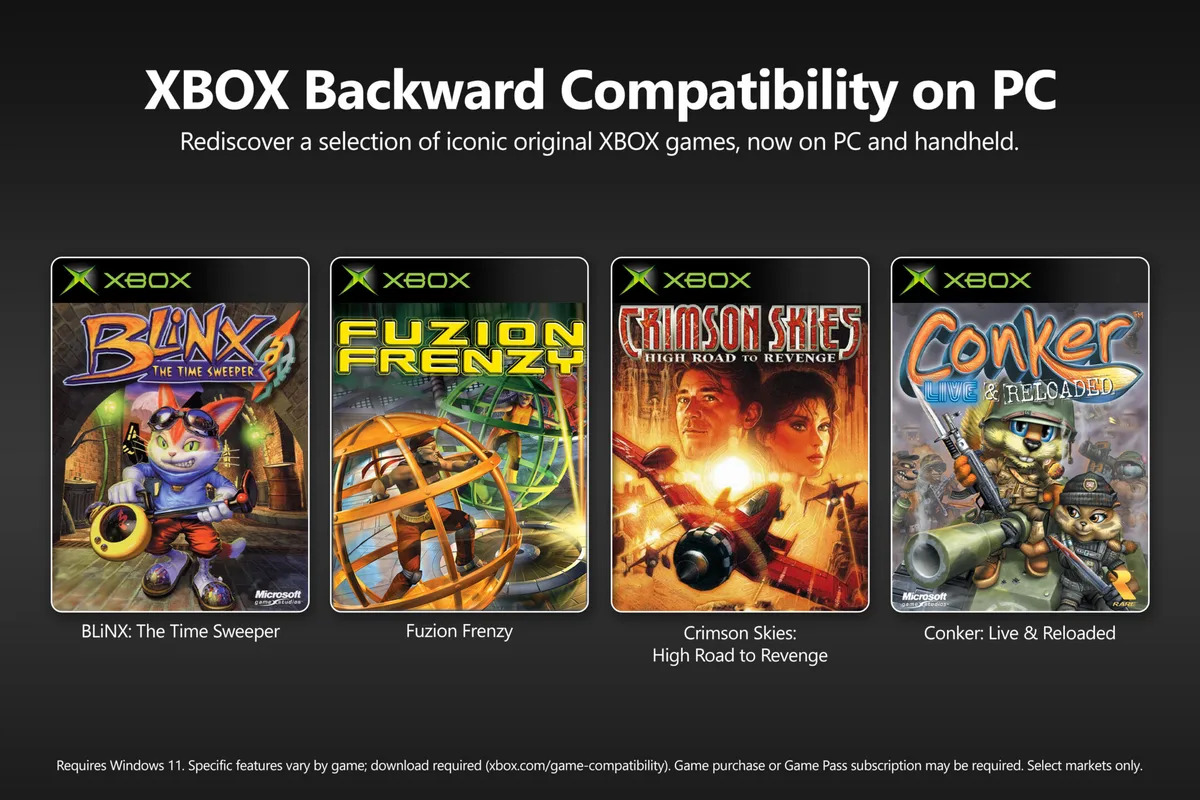
Their distribution illustrates how historical libraries can create value beyond the hardware for which they were originally developed.
Intellectual Property Remains a Major Boundary
Decompilation and recompilation immediately raise questions about rights and permissions.
Understanding how a program works does not automatically grant permission to redistribute protected content.
Video games can contain separately protected code, artwork, music, characters, brands and online services.
Microsoft says it intends to remain a responsible steward of its intellectual property and the communities surrounding it.
However, the announcement does not explain exactly how Xbox Labs will address unauthorized community projects involving proprietary content.
The initiative will therefore need to balance technical experimentation, creator interests and intellectual property protection.
AI Is a Tool Rather Than a Complete Strategy
Artificial intelligence features prominently in the technological environment inspiring Xbox Labs.
Modern coding tools can accelerate certain forms of software analysis, code generation and testing.
Asha Sharma notes that games are particularly relevant to techniques involving repeated execution and testing.
However, Microsoft does not describe Xbox Labs as a service designed to replace human developers.
The team specifically includes game makers and engineers whose stated goal is to turn experimentation into usable tools and experiences.
Its industrial impact will therefore depend on which projects are pursued and whether developers can put the results into practice.
Exploration Without a Commercial Roadmap
That is the principal limitation of the October 13 announcement.
Microsoft has introduced a team, a set of ambitions and several technological examples, but it has not provided a detailed commercial roadmap.
There is no announced product price, launch schedule or specific game officially ported through Xbox Labs.
The initiative therefore cannot yet be assigned projected revenue, measurable development savings or a confirmed increase in players.
Its launch primarily indicates Microsoft's intention to engage with innovations that sometimes emerge outside major corporate development structures.
The apparent contradiction is noteworthy: a company historically invested in its own ecosystem is now exploring technologies that could make software less dependent on individual platforms.
How far Xbox embraces that approach will become clearer when experimental ideas turn into actual commercial decisions.