
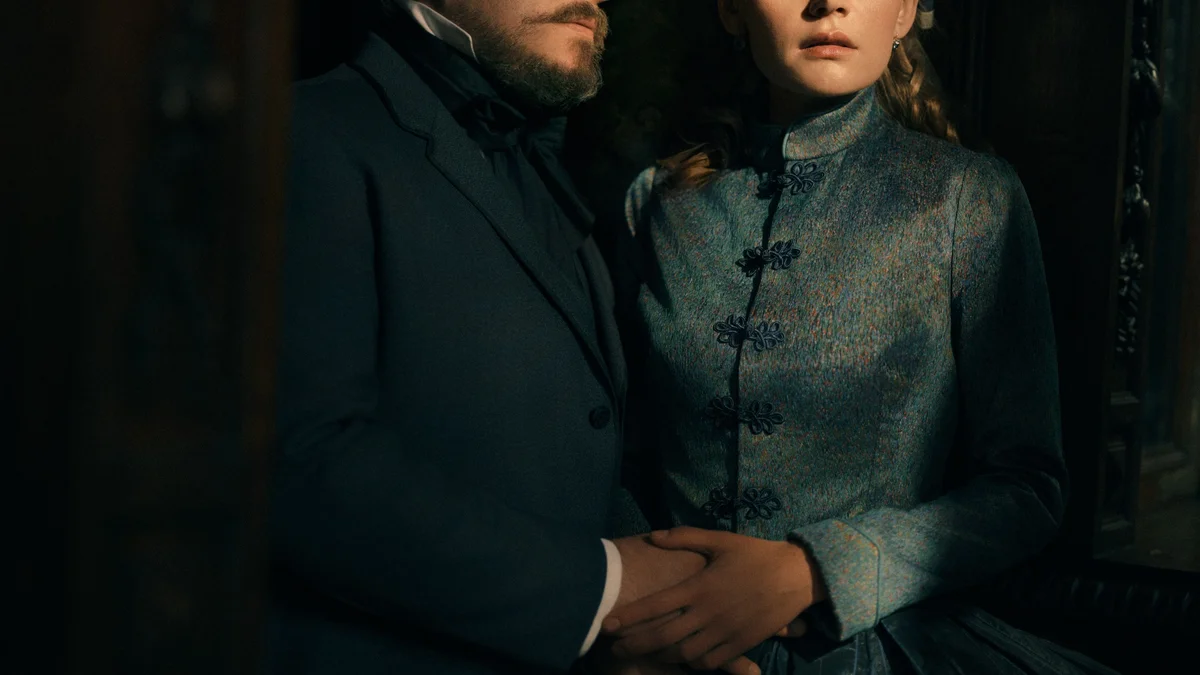
Izabela gets to occupy her own story
The most consequential change in this version of The Doll is not its scale or the contemporary energy injected into a nineteenth-century classic. It is the amount of narrative space given to Izabela Łęcka. Rather than leaving her primarily as the distant woman defined through Stanisław Wokulski's longing, the series lets her struggle directly with family expectations, money, social rank and the men who keep trying to determine the acceptable limits of her life.
Sandra Drzymalska makes that additional space count. Her Izabela can be entitled, frightened, calculating and unexpectedly fierce without those qualities being tidied into an easy rehabilitation. The point is not to prove that the character was secretly right all along. It is to make her contradictions as dramatically important as Wokulski's.
Money is the third lead
Tomasz Schuchardt's Wokulski has the weight of a man who has discovered that wealth can open a room without granting him membership in it. His money changes the way the aristocracy deals with him, but not the instinctive hierarchy beneath those conversations. That tension gives Schuchardt plenty to work with: ambition, wounded pride and romantic fixation keep feeding one another until it becomes difficult to say where one ends and the next begins.
That is also why the central relationship works better as a transaction charged with desire than as conventional romance. Wokulski treats social advancement as a route towards Izabela. Izabela sees him through the collapsing economics of her own family and the rigid world she has been raised to protect. Attraction never arrives on its own; status, debt and leverage are already in the room.
The imbalance between the two characters is not entirely solved by this approach. Izabela receives the cleaner arc, while Wokulski has to carry business ambitions, social resentment, personal history and obsession at once. Schuchardt remains compelling, but some of that material feels compressed rather than fully developed.
Warsaw looks expensive for a reason
The production design does more than advertise the budget. Rooms, clothing and public spaces constantly reinforce who is allowed to belong where. The period detail gives the class conflict a physical dimension, while the costumes and cinematography avoid reducing nineteenth-century Warsaw to an immaculate display case.
Director Paweł Maślona also keeps pushing against the stately rhythm usually associated with prestige period drama. Conversations can become confrontations, social gatherings carry the tension of traps, and some of the newly introduced threads lean towards crime or thriller territory. Baasch's music helps the series maintain that unease.
At its most effective, this makes the familiar material feel volatile. At other times the emphasis is so forceful that the series leaves little room for ambiguity. Class cruelty and modern resonances are sometimes underlined after the image or performance has already made the point.
Six episodes are both too many and not enough
The Doll has a peculiar pacing problem. Individual stretches can feel slow, particularly while the first episodes are arranging their pieces, yet the season as a whole is crowded. Romance competes with family secrets, commercial intrigue, social satire, revenge, questions of female autonomy and a large supporting cast.
The actors surrounding Drzymalska and Schuchardt repeatedly suggest stories the series could have spent longer exploring. Jacek Braciak, Magdalena Cielecka, Piotr Adamczyk and the broader ensemble establish alliances and resentments quickly, but several supporting figures function more as pressure on the leads than as complete arcs of their own.
This is where the limited-series format becomes restrictive. The adaptation wants the urgency of a compressed narrative while retaining the breadth of a major social novel. Sometimes it manages both. Sometimes the machinery is visible.
Better a risky adaptation than a decorative one
None of this looks like an attempt at neutral literary preservation. The series rearranges emphasis, expands characters and introduces material designed to make Prus's conflicts speak more directly to a contemporary audience. Viewers looking for close textual fidelity will find plenty to contest.
The risk is also the reason this adaptation has a pulse. Its strongest scenes are not simply those in which the production recreates another grand interior. They are the moments when Izabela and Wokulski face one another as two people trying to escape different versions of the same social prison, each mistakenly imagining that the other might provide the exit.
The Doll is consequently easier to admire than to call completely controlled. Its visual confidence exceeds the consistency of its pacing, and its appetite for themes sometimes overwhelms the six-episode structure. Drzymalska and Schuchardt keep pulling it back towards the human conflict at the center, which is where this bold, imperfect reinterpretation is at its best.