
Refn returns exactly where you expect him to
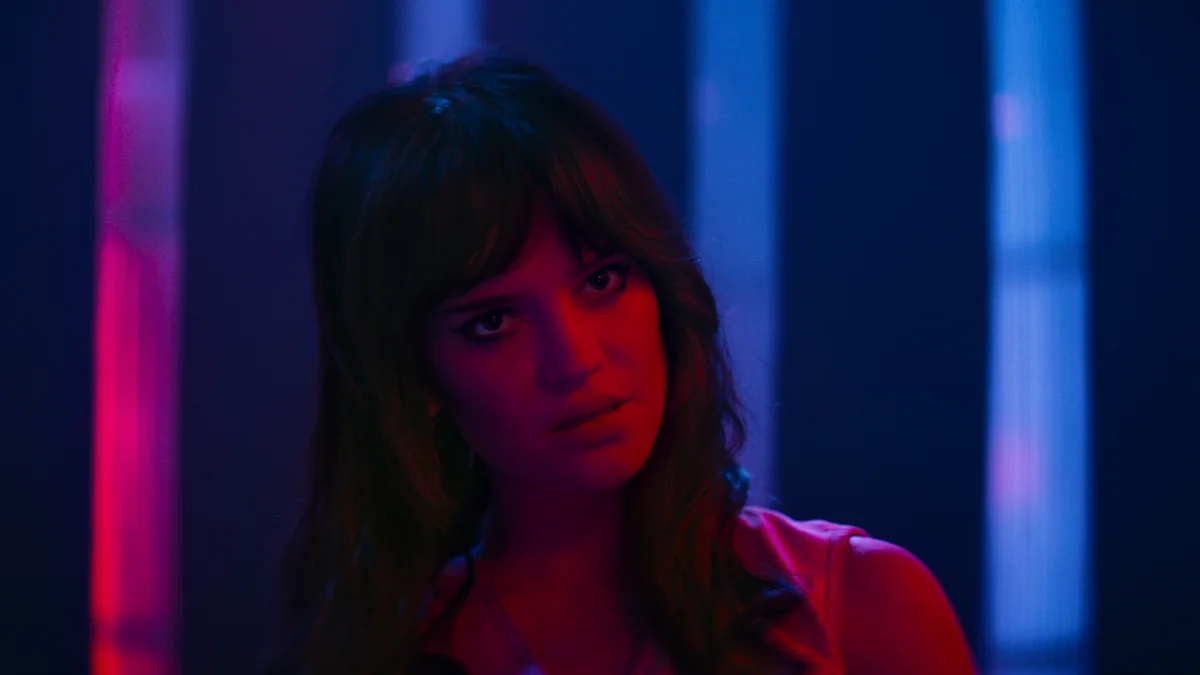
A metropolis drowned in mist. Monumental corridors. Faces frozen inside blocks of red, blue and purple. Characters who appear to speak from another level of reality.
It takes only a few minutes to recognize Nicolas Winding Refn.
Her Private Hell marks his return to feature filmmaking ten years after The Neon Demon, but it makes no attempt to court viewers hoping for another Drive. Refn instead follows the path of Only God Forgives, Too Old to Die Young and Copenhagen Cowboy: fragmented storytelling, elongated duration, ritualized violence and images constructed as tableaux.
There is something admirable about that consistency. Refn does not return by trying to catch up with what cinema did while he was away. He comes back as though the rest of the medium simply continued without him and he has little interest in adjusting.
A city designed like an art installation
Magnus Nordenhof Jønck photographs the film as a psychological space before treating it as a physical location.
The hotel occupied by Sophie Thatcher's Elle appears too large for the people inside it. Corridors swallow bodies. Nightclubs feel empty even when populated. The entire metropolis looks as if it were constructed after most of its population disappeared.
Refn still uses color as emotional signage rather than natural illumination. Red announces danger, blue turns bodies into sculpture and purple pushes characters into spaces that no longer belong completely to reality.
On those terms, Her Private Hell can be extraordinary. Whatever else one thinks of Refn, he retains a rare ability to produce an image recognizable before his name ever appears.
Sophie Thatcher has to perform inside the cold
Elle searches for her father while a mysterious fog consumes the city. On paper, that premise could support a relatively conventional thriller.
Refn has no interest in making one.
Thatcher spends much of the film playing through restraint and near-stillness. Her gaze, posture and presence matter more than exposition. The approach suits the movie's design, but it also limits the emotional architecture available to the performance.
She remains magnetic because the camera adores her face and because she knows how to make silence carry weight. Elle herself remains considerably harder to grasp.
Kristine Froseth, Havana Rose Liu and the film's other women occupy a similar world of desire, rivalry and representation. They are fascinating images and occasionally funny or threatening presences, but rarely become as complicated as the compositions surrounding them.
Charles Melton seems to inhabit another movie
The parallel storyline follows Private K, an American soldier played by Charles Melton who is searching for his daughter.
The movie then slips toward a postwar Japan that feels as though it emerged from memory rather than history. Its streets, fights and encounters combine samurai cinema, melodrama, pulp and nightmare logic.
Melton has the physical presence required for such a taciturn figure. He crosses the frame like someone taken from an old poster, more archetype than fully articulated man.
The separation between his journey and Elle's initially creates genuine curiosity. We wait for the moment when the two movements will mirror or collide.
Their eventual connection remains more thematic than dramatic. That can work if the movie is accepted as a dream about fathers, daughters, guilt and fear of loss. It is considerably less satisfying if one expects those parallel strands to become a precise narrative mechanism.
Pino Donaggio is almost the real protagonist
Her Private Hell's strongest achievement may not be visual at all.
Pino Donaggio brings music shaped equally by melodrama, giallo and his long association with Brian De Palma.
His strings give movement to images precisely when Refn refuses to give conventional movement to his characters. The score creates emotion that the screenplay often keeps outside the frame.
There is an interesting contradiction here. The music sometimes appears to tell a gigantic tragedy while the dialogue remains deliberately artificial and emotionally remote. Yet that friction is also one reason the movie rarely becomes completely inert.
Several critics have singled out Donaggio's work as one of the film's clearest strengths. It sustains tension and scale that the narrative alone would struggle to carry for nearly two hours.
The signature sometimes starts quoting itself
The problem is not that Her Private Hell looks like a Nicolas Winding Refn movie. That would be a strange criticism to make of such an identifiable auteur.
The problem comes when some of those images no longer seem to be evolving.
Neon, women transformed into icons, taciturn men, nearly empty clubs and explosive violence interrupting long passages of silence have already generated distinctive energy in Only God Forgives, The Neon Demon and Copenhagen Cowboy.
Here, those motifs can feel less rediscovered than repeated.
That distinction matters. A signature remains exciting when it allows an artist to see something new. It becomes formula when it begins primarily looking back at the artist's previous work.
Slowness is not the flaw, but it exposes the gaps
Calling Her Private Hell slow is not much of a criticism. Slowness is the movie's language.
Refn allows characters to enter a frame, stop, look, wait and then speak after a pause another filmmaker would have removed in editing.
That duration can turn sequences into ceremonies. When movement, violence or a lighting shift finally arrives, it acquires disproportionate importance.
The same method becomes much more fragile when the characters contain too little material. Some scenes then appear mysterious because information is being delayed, not necessarily because anything particularly profound is hidden beneath them.
That is probably the film's central dividing line. Some viewers will find interpretive space in those voids. Others will simply find beautifully illuminated emptiness.
A sadder film than its violence suggests
Refn has often been associated with spectacular, sexualized violence. Her Private Hell is unusual because that violence remains present without necessarily functioning as the emotional center.
Beneath the leather, fog and artificial light lies something much more melancholy: fear of losing a child, being unable to protect them and leaving them behind in a world that has become impossible to understand.
Refn has publicly connected the film to his experience of serious heart surgery and proximity to death. That context does not automatically decode every symbol, but it helps explain the unusual importance of parenthood and separation in this story.
Her Private Hell becomes more interesting once its plot is no longer treated as a puzzle to solve and instead as an attempt to give physical form to a fear.
Beautiful, infuriating and sometimes both in the same shot
Its sharply divided critical reception is unsurprising.
Some critics have defended its hypnotic strangeness, formal ambition and Thatcher's presence. Others see a hollow catalogue of Refn's familiar obsessions, or a succession of gorgeous images without characters substantial enough to inhabit them.
Both readings can almost exist simultaneously.
Her Private Hell is unquestionably a singular cinematic object. It is also repetitive, remote and occasionally exhausting. Its beauty does not erase the narrative weaknesses, but those weaknesses do not erase the obvious fact that an auteur is controlling every centimeter of the frame.
At 6 out of 10, it is difficult to recommend as a straightforward science-fiction thriller. As an exercise in cinematic form, however, it contains enough beautiful, bizarre and genuinely inexplicable moments to remind us why a new Nicolas Winding Refn film still feels like an event.