
A fool only if everyone else has accepted the rules
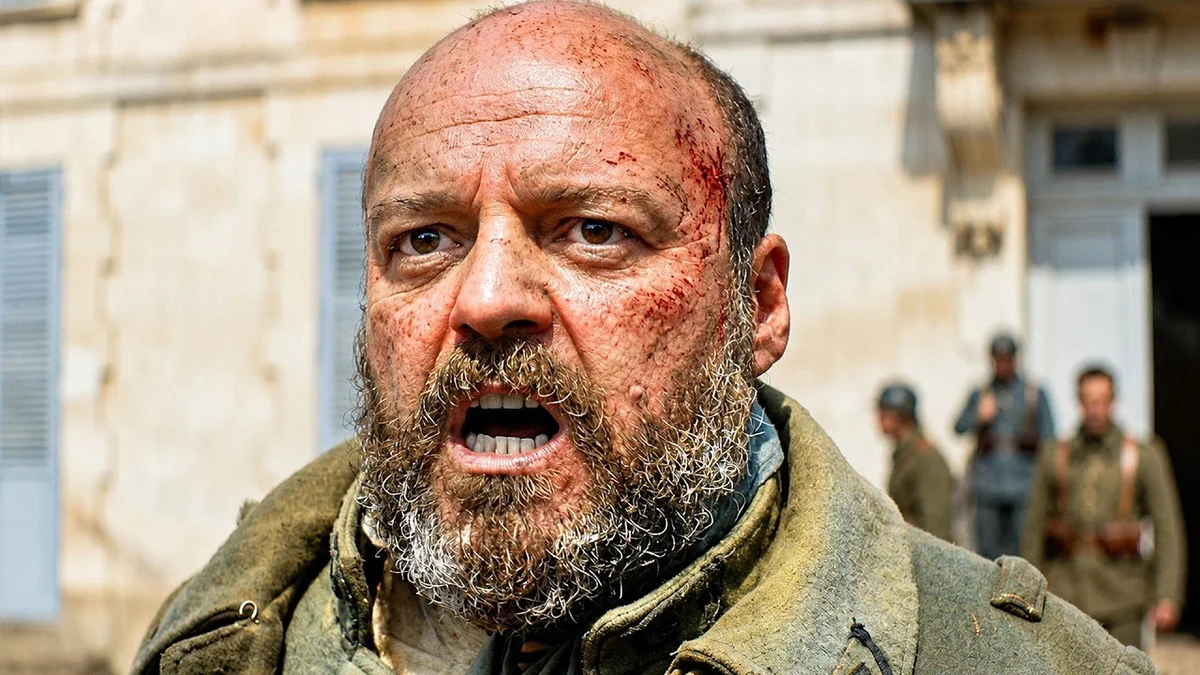
Justin enters the war without the vocabulary required to understand it. He is a poorly educated farmer removed from his land and told to fight men he has never met for reasons nobody can explain to him in terms that make sense. His apparently simple questions become the film's most efficient weapon because the answers increasingly sound absurd.
That setup could easily have reduced Alban Ivanov to an endearing innocent whose function was to soften the trenches with comic relief. Ivanov avoids the trap. Justin is naive without being empty, frightened without becoming pathetic, and stubborn without suddenly developing the political sophistication of a different character.
The performance works precisely because Ivanov does not spend every scene advertising a dramatic transformation in his own career. A trace of comic timing remains, but it belongs to Justin's strange angle on the world rather than to a comedian waiting for a punchline.
Basile gives the film its necessary second perspective
Birane Ba prevents the story from becoming a one-man moral awakening. Basile understands far more about war, hierarchy and prejudice than Justin does, yet the pair never settles into a simple teacher-and-student arrangement. Their friendship gives the film some of its funniest moments and much of its emotional credibility.
Justin initially sees Basile through the ignorance of a man whose world has barely extended beyond his farm. Basile, in return, discovers someone whose lack of education has an unexpected advantage: Justin has not yet learned to treat institutional contradictions as normal.
Their exchanges are strongest when the actors are allowed to carry that idea. The screenplay occasionally explains the friendship after the performances have already made its meaning perfectly clear.
Mud, fabric and exhausted bodies do a lot of the talking
Thierry Arbogast's deliberately desaturated photography gives the war a drained, physical quality. Production design and costumes follow the same logic. Uniforms feel worn rather than displayed, villages have texture, and the battlefield is made of water, dirt and obstacles that bodies have to struggle through rather than picturesque historical scenery.
Barbier generally keeps that material at human scale. The war is large enough to dwarf Justin, but the film does not need to convert every encounter with it into spectacle. A charge, a desperate escape or the sheer weight of a soaked uniform can communicate more than another speech about sacrifice.
This physical grounding also makes the comic and picaresque passages easier to accept. The story frequently bends plausibility, but danger never disappears completely beneath the whimsy.
The adventure gradually turns into an argument
The first movement is loose and lively. Justin is pushed from one situation to another, meeting strangers, misunderstanding rules, surviving through instinct and occasionally through astonishing luck. There is a road-movie energy inside the war film, even when the road is mostly mud.
As executions, military injustice and revolt become central, the narrative grows much more deliberate. Alexandra Lamy's Marie, a journalist, connects the soldiers' experience to the possibility of exposing what happens to them. The transition makes sense thematically, but the film's rhythm changes with it.
Justin the Just is not weakened by having a clear political and humanist position. It is weakened when the screenplay begins to underline that position after the dramatic situation has already done enough. The later confrontations with military authority also demand an increasingly generous tolerance for coincidence and narrative convenience.
The final stretch is where the divide in the critical response becomes easiest to understand. For some, the film's conviction carries its improbabilities. For others, the prolonged confrontation and its resolution push a sturdy humanist tale towards something more conventional and overextended.
The historical setting serves a fable
Barbier's approach makes more sense once the film is treated as the free adaptation it declares itself to be rather than as a reconstruction promising documentary fidelity. Considerable attention went into uniforms, sets and military texture, but Justin's journey is built as a political fable about ordinary people discovering the right to question an order.
That distinction does not excuse every shortcut. The optimistic shape of the story can sit awkwardly beside the historical brutality it invokes, and its villains occasionally become mechanisms rather than people. Yet the fable has a useful clarity when it stays close to Justin and Basile instead of trying to enlarge itself into a definitive statement about the Great War.
Ivanov and Ba carry that clarity through much of the 110-minute running time. The film becomes less subtle when it insists on securing its message, but its warmth, craftsmanship and odd mixture of comedy and violence leave considerably more behind than the conventional historical drama it sometimes threatens to become.