
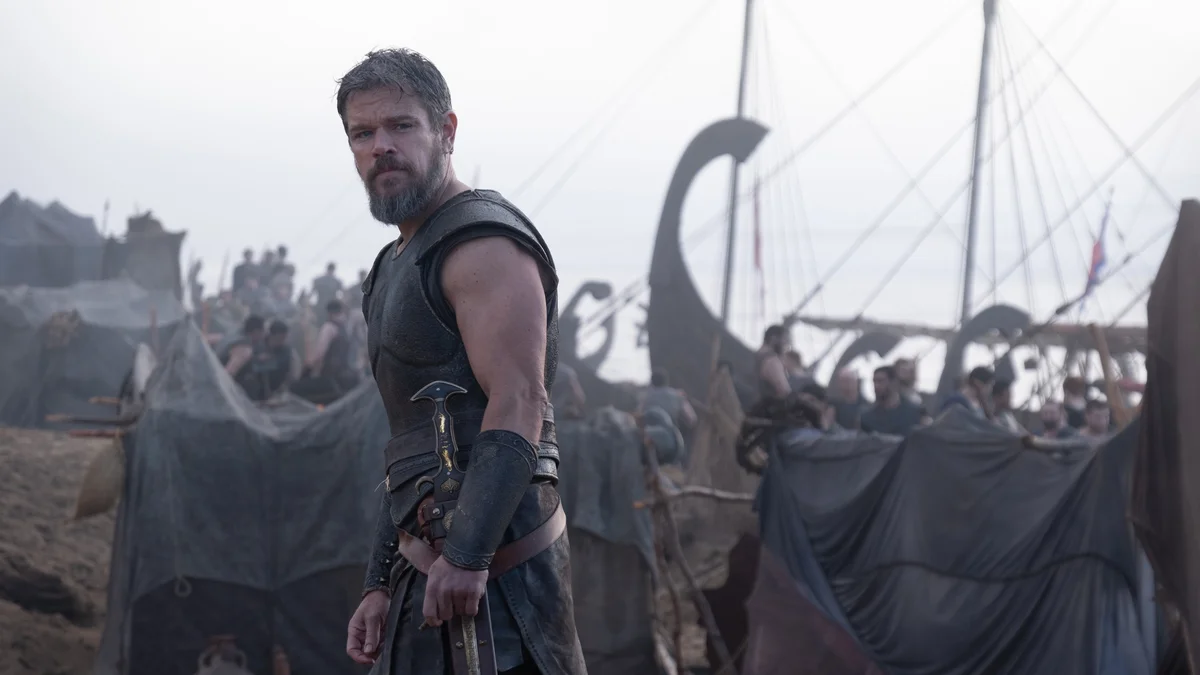
Christopher Nolan treats victory as the first disaster.
The Trojan Horse is presented with enough physical scale and tension to conclude a conventional historical epic, yet The Odyssey uses Troy as the wound from which everything else follows. Odysseus wins through deception and spends much of the film discovering that a successful strategy can still destroy the strategist.
A landscape can do what exposition cannot
Hoyte van Hoytema's IMAX photography constantly places human ambition against geography that does not care about it. Ships become small objects in enormous stretches of water. Soldiers disappear into fog, stone and smoke.
The Guardian's Peter Bradshaw sees the journey through the lens of postwar trauma, and that reading is strengthened by the imagery. Home is not merely far away. The world itself seems determined to keep expanding between Odysseus and Ithaca.
Spectacle arrives without waiting for permission
Variety praises the film's almost unreasonable supply of set pieces. The striking part is how little Nolan protects them. Troy, the Cyclops, storms, the underworld and the final violence are not separated by long stretches of blockbuster housekeeping.
One enormous sequence can simply end because another form of danger has arrived.
Matt Damon plays the clever man after cleverness stops being fun
Damon's Odysseus is less playful than Homer's famous trickster. His intelligence survives, but Nolan foregrounds the moral residue of using it.
That makes him fit naturally beside Nolan protagonists haunted by the consequences of their own abilities. It also explains a recurring criticism from classicists. Mary Beard and Daniel Mendelsohn both argue, in different ways, that the adaptation sacrifices some of Odysseus' humour, seduction and slipperiness.
The performance itself gains weight from that decision. Damon looks increasingly like a man carrying the voyage rather than leading it.
Ithaca is quieter and politically uglier
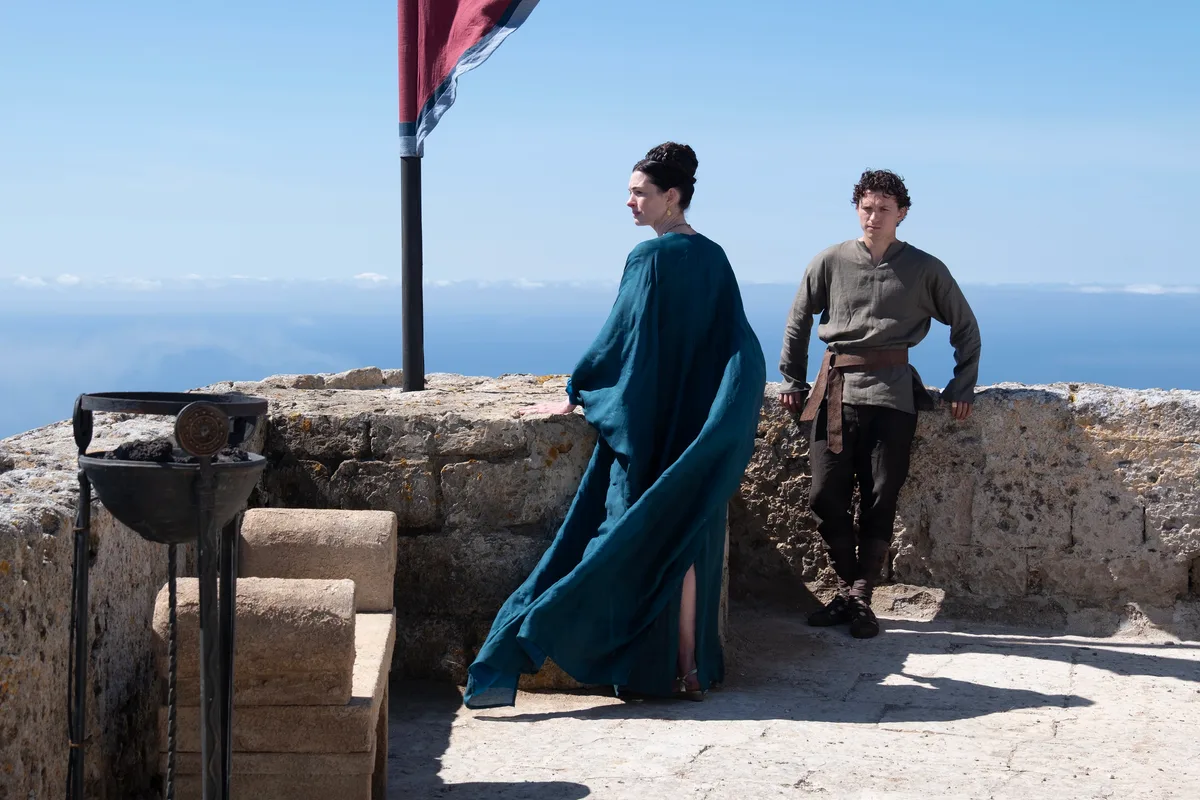
Anne Hathaway's Penelope exists within a different kind of siege. Her home fills with suitors whose entitlement becomes more dangerous as Odysseus' absence lengthens.
Robert Pattinson's Antinous is effective because he behaves like a man already becoming comfortable with ownership. Tom Holland's Telemachus is more divisive; The Hollywood Reporter questions both the casting and some of the conspicuously modern dialogue.
The adaptation reveals Nolan by what it removes
The film is far from a neutral translation of Homer. Critics and classicists have debated its reduced female agency, omitted characters and the transformation of Odysseus into a more recognisably modern, guilt-ridden hero.
Those changes narrow parts of the poem while making Nolan's purpose unusually visible. War, homecoming, time, guilt and men unable to escape the consequences of their own inventions have been recurring concerns throughout his career. Homer becomes a very large mirror.
The three-hour scale occasionally stops moving
Screen Daily admires the film's craft and monumental scope while finding it less nimble emotionally. Variety detects a similar aloofness. The Hollywood Reporter singles out some quieter passages, particularly the Calypso material, as interruptions that stall the narrative.
The criticism matters because most of the film moves exceptionally well for 172 minutes. Its problems appear when scale stops being movement and becomes weight.
Cinema as an unreasonable object
The Odyssey is not flawless adaptation, perfect Homer or even uniformly warm drama. It is something rarer in contemporary studio filmmaking: a gigantic production whose expensive machinery is directed toward images, rhythms and ancient mythology rather than toward maintaining a franchise timetable.
Nolan asks an audience to sit in the dark while a tiny ship crosses a very large sea. For most of those 172 minutes, that is enough.