
The most revealing thing Nolan does to Homer has nothing to do with a monster. He turns the Trojan Horse into a wound.
Odysseus wins the war by imagining something nobody else could, then spends much of the movie living inside the consequences of that intelligence. The Los Angeles Times identified the obvious connection to Oppenheimer, but Matt Damon keeps the comparison from becoming a simple mythological reskin. His Odysseus is too proud, too commanding and occasionally too self-serving to become a saint suffering for his brilliance.
Nolan makes scale feel heavy rather than decorative
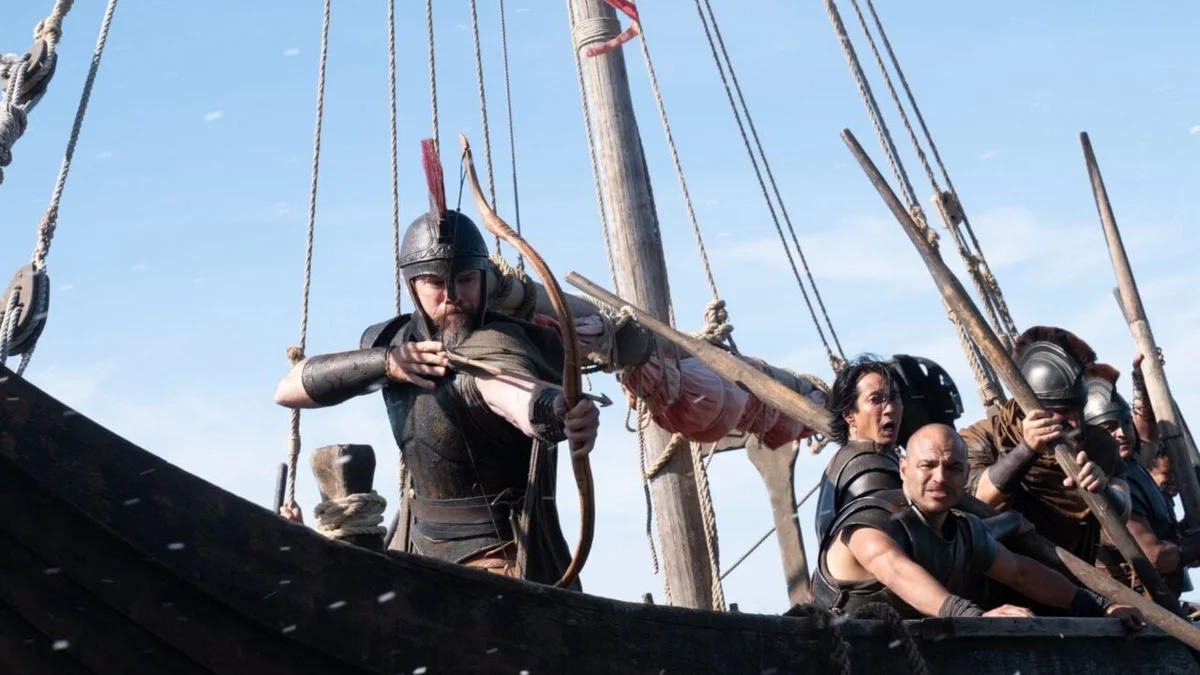
The production's technical statistics are absurdly large: IMAX film throughout, real vessels, international locations and a 91-day shoot across six countries reported by the Associated Press. What matters is that the labor survives on screen.
Water behaves like water rather than a digital surface actors have been composited onto. Ships resist movement. Armor seems unpleasant to wear. Landscapes swallow people.
That physical philosophy also shapes the fantasy. Polyphemus is not presented as a pristine creature showcase. Shadows, mass and practical effects make the Cyclops encounter ugly and frightening. RogerEbert.com's later piece arguing that The Odyssey is effectively one of the year's strongest horror films is not as eccentric a reading as it initially sounds.
The structure prevents the poem from turning into a checklist
A lesser adaptation could have approached Homer as a sequence of famous attractions. Nolan instead fragments the voyage, allowing stories to be remembered, retold and occasionally understood differently once more information arrives.
That instinct suits the source better than it might appear. The Odyssey has always been interested in storytelling, identity and the stories Odysseus tells about himself. RogerEbert.com's review makes that aspect central to its praise of the film.
The opening is where the machinery becomes audible. Forbes found the first third difficult to enter, with dialogue and editing moving at an aggressive pace. Screen Daily praised the towering spectacle while arguing that the emotional and thematic movement can be less nimble.
The largest adaptation choice is Odysseus himself
Homer's hero is difficult to sanitize. He is brilliant and dishonest, brave and vain, faithful to the idea of home while hardly behaving like a modern model of marital fidelity.
Nolan selectively narrows those contradictions. The Los Angeles Times argues that the movie reduces his ego and lust, while the Financial Times similarly notes that Damon is playing a more conventional hero than Homer's slippery trickster.
The trade is substantial, but Damon gives it dramatic weight. At 55, he looks like somebody who has actually accumulated the years the story demands. Fatigue becomes part of the performance rather than makeup applied between action sequences.
Home is quieter than the monsters and almost as dangerous
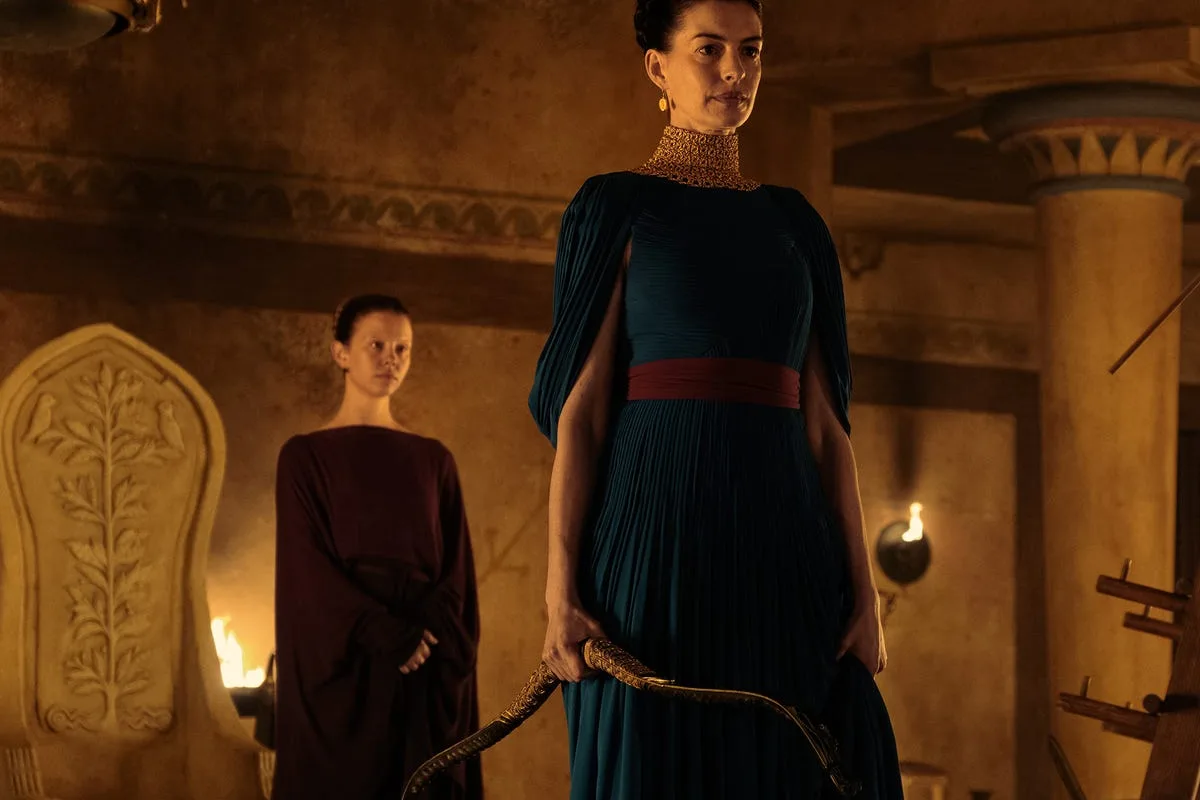
Anne Hathaway's Penelope works in a different register. Ithaca is not an intermission from the adventure; it is a political space being occupied by men waiting for Odysseus to remain dead.
Robert Pattinson benefits enormously from that setting. His Antinous does not need divine intervention to become threatening. Entitlement is sufficient.
Tom Holland's Telemachus is functional and sympathetic, although he can appear comparatively light beside performers with sharper roles. The scale of the ensemble rarely turns into stunt casting, which is an achievement in a film whose billing looks almost comically expensive.
Fidelity is not the film's strongest argument
Nolan removes, combines and rewrites extensively. The gods retreat from the foreground. Athena remains, while Zeus and Poseidon become far less directly visible. The Cyclops encounter loses some of Homer's verbal gamesmanship. Other characters and episodes disappear.
The result is coherent cinema, but it is not a neutral delivery system for the poem. Classicist and translator Emily Wilson has been substantially more critical of Nolan's choices than the film-review consensus, a useful counterweight to the idea that technical grandeur settles every question about adaptation.
The critical consensus itself is unusually strong. Metacritic currently lists an 88 score from 63 reviews, with no negative reviews in that sample, while Rotten Tomatoes shows 94% across more than 500 reviews.
Those numbers fit the film on screen. The Odyssey is occasionally too recognizably Nolan in the way it reorganizes Homer around guilt, memory and destructive ingenuity. It is also one of the rare modern blockbusters where scale is not merely visible. You can almost feel the inconvenience of it.