
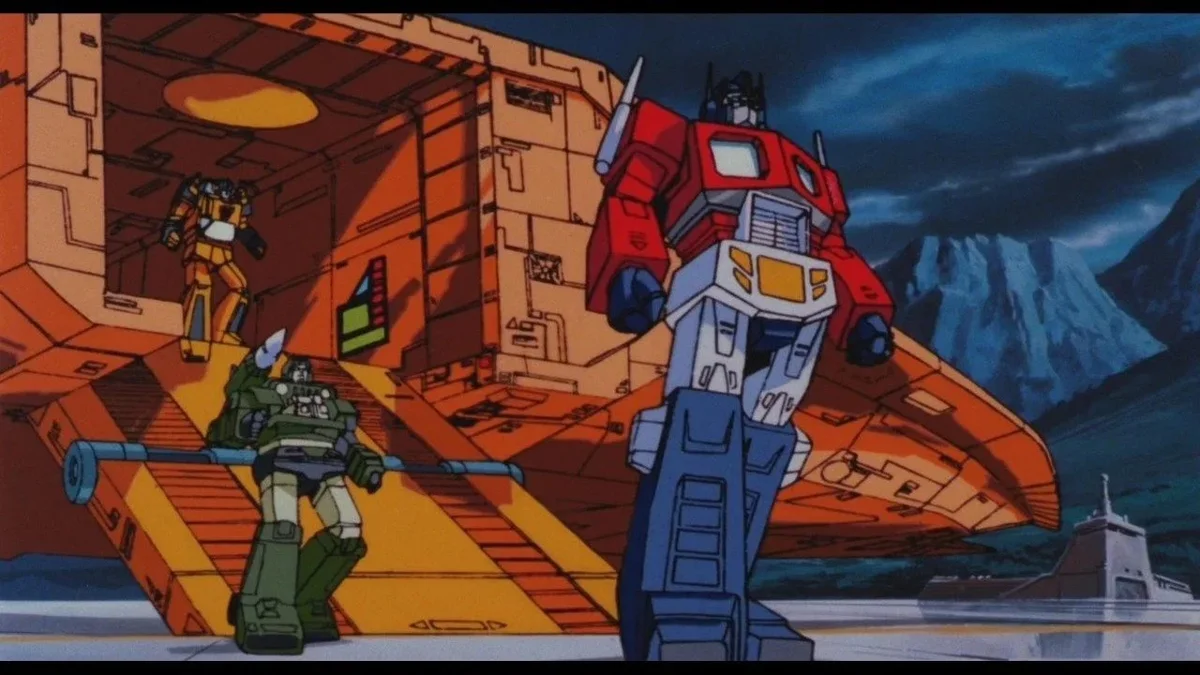
Autobot City barely gives you time to process what just happened
The Transformers: The Movie opens with Unicron devouring an entire planet and somehow still manages to increase the pace from there. Within minutes, an Autobot shuttle has been intercepted, familiar characters have disappeared with remarkably little ceremony and the Decepticons are using the captured ship to reach Autobot City. The movie has barely established itself before behaving like a season finale running at maximum speed.
It is also the strongest stretch of the film. The assault on Autobot City remains surprisingly readable despite the sheer number of robots, laser blasts and transformations. Hot Rod recognizes the threat, defenses activate, the Decepticons approach from multiple directions and the city gradually becomes a mechanical fortress under siege. Bold color blocking keeps dozens of silhouettes legible.
Nelson Shin has a straightforward sense of motion. A robot crosses the frame, transforms, redirects and hits something. Animated camera movement can follow the action without the environment disappearing beneath a permanent cloud of particles. It is not subtle, but it is unusually clear.
Contemporary critics did not all see that intensity as a virtue. The Los Angeles Times complained about repetitive battles, constant movement and frantic cutting. Time Out was more sympathetic, finding the anime-influenced appearance generally impressive. Both reactions remain recognizable: this is a film in perpetual motion, and that motion can be exhilarating or exhausting depending on the viewer.
Then Optimus Prime arrives
The movie possesses a quality surprisingly rare in toy adaptations: it knows how to stage an entrance. Optimus needs almost no introduction. Peter Cullen supplies the gravity, the red-and-blue silhouette appears among the ruins, and a few decisive movements reorganize the entire battle around him.
His confrontation with Megatron is relatively short and enormous in the film's cultural memory. It works because the characters briefly stop feeling like two units inside a catalogue containing dozens of products. The framing tightens. Impacts become heavier. Frank Welker and Peter Cullen give every threat a history the screenplay does not need to summarize.
And the film commits to the consequence. Optimus Prime's death became so notorious that Hasbro built part of its fortieth-anniversary campaign around humorously apologizing to the audience traumatized in 1986. Beneath the marketing joke remains something structurally unusual: the story does not put every piece back in its original box when the scene ends.
The movie sells toys and then holds funerals for them
The easiest criticism of The Transformers: The Movie is also impossible to dismiss. The feature participates in a major product-line transition. Established characters disappear while Hot Rod, Ultra Magnus, Kup, Arcee, Springer and other newer figures move into the foreground. Charles Solomon's 1986 Los Angeles Times review essentially treated the entire feature as an 86-minute toy commercial.
That explanation accounts for a great deal, but not everything. A pure catalogue could have introduced the replacements cleanly, supplied heroic poses and retired older characters somewhere between episodes. The movie chooses the most violent possible method. Commercial necessity almost accidentally becomes a story about replacement.
Children expecting the television status quo instead watch heroes fall, a leader die, another villain get rebuilt and a younger generation inherit roles before it is ready. Hot Rod is defined by that discomfort. He does not enter as an obvious successor to Optimus. He is impulsive, inexperienced and visibly overwhelmed by the legacy he eventually receives.
Industrial cynicism and genuine emotion do not cancel each other out here. Their collision is part of what gives the movie its strange power.
Visually, these robots have rarely been easier to read
The improvement over television is not simply a matter of more drawings. Characters retain strong blocks of color, distinct silhouettes and transformations whose mechanical movement can be followed. An arm becomes bodywork, a cab folds inward, a vehicle rises into a humanoid shape. The motion has graphic logic.
With Toei Animation involved in the production, the environments also reach for much greater scale. Autobot City, Cybertron, Quintessa and the interior of Unicron do not share one visual language. The movie wants the journey to feel cosmic and is never shy about allowing a mechanical planet to consume half the frame.
Not every technique has aged equally well. Some optical and early computer-assisted effects belong unmistakably to the 1980s. Ironically, the traditional drawings often survive better. Movement can be uneven, but the shapes remain confident.
The September 2026 4K theatrical return gives the rerelease a straightforward visual justification. There is enough detail, color and scale in this animation to benefit from a cinema screen without reanimating the original feature into something it never was.
After the battle, somebody tips the entire toy box onto the table
The main structural problem begins once the movie leaves Autobot City. Megatron becomes Galvatron under Unicron's control, the Autobots scatter, Hot Rod and Kup encounter the Quintessons, another group meets the Junkions, Ultra Magnus carries the Matrix and several separate storylines begin racing toward Cybertron.
Time Out noted that the opening could be bewildering for viewers unfamiliar with the television series before the movie became more engaging. Four decades later, the inverse can also feel true. The early battle has a brutally clear objective; the middle suddenly asks the audience to absorb new planets, species and multiple separated groups.
Some ideas are weird enough to survive the clutter. The Quintessons and their grotesque justice system belong perfectly in this universe. Wreck-Gar and the Junkions create an almost Dadaist interruption, assisted by Weird Al Yankovic. But every detour consumes time Hot Rod could have used to become the narrative center more organically.
The movie runs roughly 85 minutes. It can feel like 140 minutes of story compressed without supervision.
Orson Welles plays a planet because apparently 1986 allowed this sort of thing
The voice cast still looks like an administrative error. Peter Cullen and Frank Welker arrive from the series, but the film adds Leonard Nimoy as Galvatron, Robert Stack as Ultra Magnus, Eric Idle as Wreck-Gar, Judd Nelson as Hot Rod and Orson Welles as Unicron.
Welles does not need elaborate characterization. His voice makes each line from Unicron sound like a cosmic decree. The contrast is delightful: an actor permanently associated with Citizen Kane brings near-Shakespearean gravity to a planet-sized robot intended to establish a threat bigger than Megatron.
Leonard Nimoy similarly understands that Galvatron should not simply sound like Megatron inside new bodywork. He brings a colder edge. Judd Nelson's more restless performance suits Hot Rod even when the screenplay skips stages of the character's development.
The celebrity casting therefore becomes more than trivia printed on a poster. It helps a film packed with mechanical characters create sharply differentiated presences.
The soundtrack has never encountered a reasonable volume
No element divides opinion more efficiently. Vince DiCola piles on synthesizers while Stan Bush turns major action beats into arena-rock events, and the movie still finds room for Weird Al Yankovic's "Dare to Be Stupid." Several contemporary critics found the music oppressive. Time Out's response to the power rock was considerably less affectionate than the fan culture that later made the soundtrack part of the movie's identity.
Pretending it shows restraint would be ridiculous. It has none. An Optimus transformation can trigger a song as though the film has suddenly entered a stadium. Action sequences become music videos before anyone has the opportunity to object.
Yet removing that music would make the movie almost unrecognizable. The synthesizers and guitars supply rhythm, period texture and absolute commitment to excess. Subtlety missed the shuttle to Cybertron. Enthusiasm arrived early.
Forty years later, the commercial outlived the products it was selling
The movie's critical life is almost as strange as its plot. American reviews in 1986 were frequently cool or openly hostile. Rotten Tomatoes now records a modestly positive critical aggregate, while more recent reassessments tend to emphasize the animation, the brutality of the opening act, the soundtrack and the disproportionate emotional impact created by what began as a commercial franchise transition.
The fortieth-anniversary 4K theatrical return launched by Hasbro and Fathom Entertainment in September 2026 makes the transformation especially obvious. What once looked disposable enough to some critics to dismiss as advertising is now being treated as franchise heritage. The event even adds a new animated chapter after the original credits.
The original film itself has not been recut into something tidier. That is probably for the best. The Transformers: The Movie remains too fast, too crowded and too dependent on an audience already familiar with its universe. Its commercial objectives can sometimes be seen from orbit.
But the animation does not feel like packaging. Autobot City has weight. Unicron has scale. Optimus and Megatron have voices and silhouettes the frame knows how to honor. Even the flaws belong to a movie constantly choosing to become larger than it reasonably should.
Forty years later, many of the toys it was designed to replace have themselves been replaced several times. The movie is still playing in theaters.