
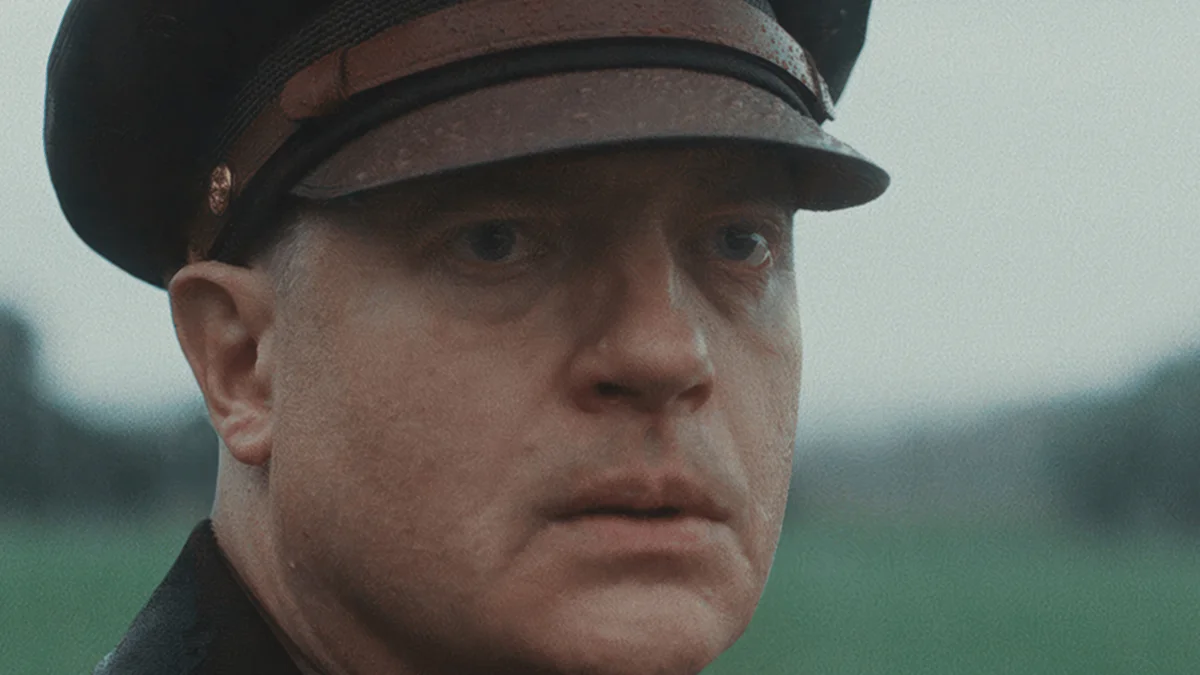
Pressure's smartest move is barely showing the war at all
D-Day is one of the most filmed events of the twentieth century, yet Pressure looks somewhere far less familiar: weather charts, telephones, pressure systems and the people deciding whether a storm will allow hundreds of thousands of soldiers to cross the Channel.
That shift is the film's great advantage. The broad critical consensus responds positively to the freshness of the perspective, with Rotten Tomatoes summarizing it as a cerebral war drama whose thrills come largely from Andrew Scott rather than conventional battlefield spectacle.
Andrew Scott turns uncertainty into a character
James Stagg is not written like a traditional war hero. He does not lead a charge or deliver a speech designed for history books. His job is to walk into rooms full of men who have already mobilized an armada and tell them the weather may ruin everything.
Scott is exceptionally well suited to that kind of tension. The Financial Times, Time Out and The Independent all respond strongly to a performance built around listening, hesitation and contained anxiety rather than grand declarations.
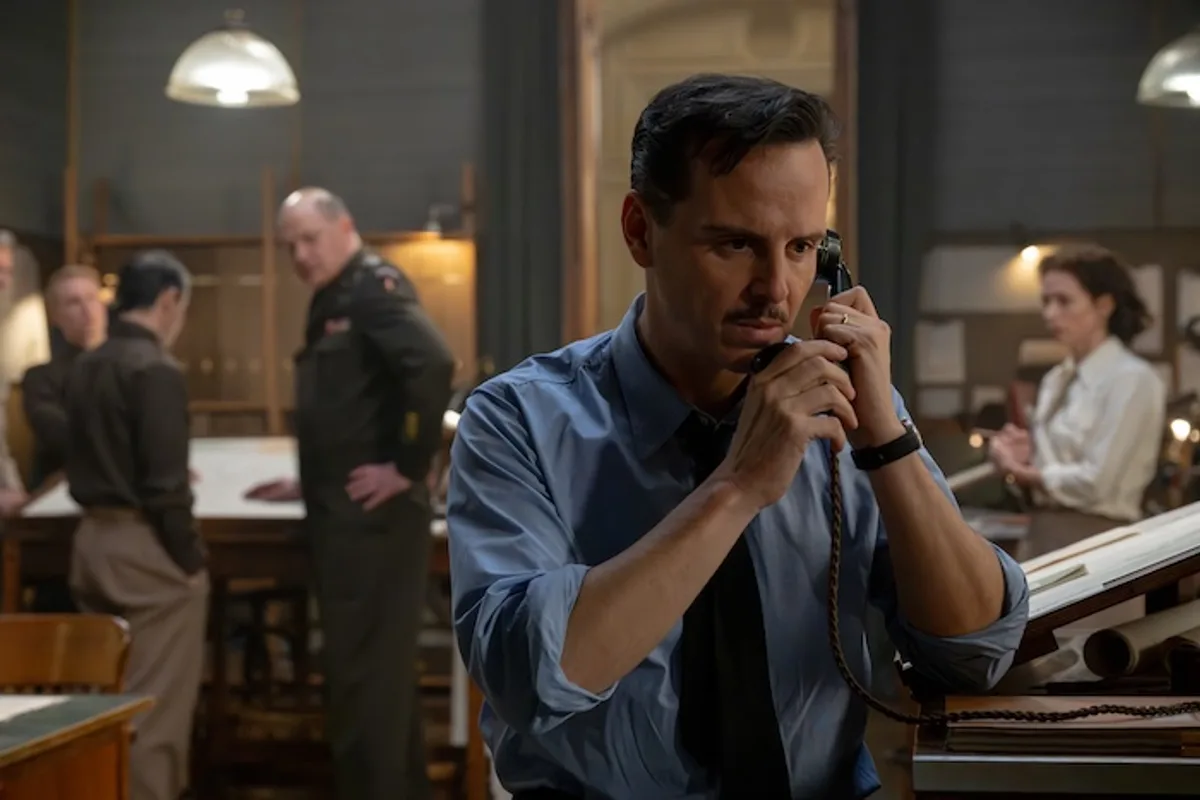
More importantly, Scott avoids turning Stagg into an infallible genius surrounded by fools. He plays a scientist who understands the limits of his evidence. His conviction matters because he knows certainty is impossible, while some of the men around him behave as though confidence can replace probability.
Knowing June 6 is coming does not kill the suspense
No viewer needs Pressure to reveal when D-Day happened.
The suspense lives in the margins instead. How long can Eisenhower delay? What happens if the narrow weather window closes? How much of an invasion machine can be stopped after it has already started moving?
The film works because a change in atmospheric pressure is treated as information with immediate human consequences. A forecast becomes dramatic not because clouds are inherently thrilling, but because thousands of lives are attached to every interpretation.
The stage play never entirely disappears
This is the criticism that appears most consistently in the more mixed reviews.
David Haig originally wrote Pressure for the theatre, and the film retains that architecture: rooms, officers, arguments and a limited group of people cycling through a command center.
Anthony Maras adds exterior material, military machinery, archival textures and scenes away from Southwick House. Some of those expansions are effective, but others feel like visible attempts to make inherently theatrical material appear more cinematic.
The Guardian finds the result too stodgy and repetitive, while The Independent praises the disciplined hundred-minute runtime without suggesting the adaptation ever completely escapes its origins.
The science-versus-instinct conflict works best when it is not oversimplified
Chris Messina plays American meteorologist Irving Krick, whose forecast is considerably more optimistic than Stagg's.
Their disagreement gives the film its intellectual engine: competing methods, incomplete information and commanders who understandably prefer the forecast that allows an enormous military timetable to proceed.
Pressure occasionally pushes that contrast too neatly. Stagg begins to represent rigorous expertise and methodological doubt, while Krick risks becoming the man whose confidence simply happens to deliver the answer authority wants.
The larger point about listening to expertise is powerful. The actual process of scientific disagreement is inevitably messier than the drama sometimes allows.
Brendan Fraser is where the reviews disagree most
Fraser's Eisenhower divides critics more sharply than Scott's Stagg.
Some respond to the weariness and responsibility he brings to the commander, presenting Eisenhower less as a historical monument than as a man who knows every available choice can end catastrophically.
Others, including the Financial Times, regard Fraser as less convincing and too mannered beside Scott's tightly controlled performance.
The contrast is certainly noticeable. Scott compresses emotion until it leaks through tiny gestures. Fraser externalizes authority and exhaustion. At their best, the approaches complement one another. At weaker moments, they seem to belong to slightly different films.
Kerry Condon keeps the war room from becoming a room full of statues
Kerry Condon's Kay Summersby and Damian Lewis' Montgomery provide some of the strongest supporting texture.
Condon brings a human warmth the film needs whenever the debate threatens to become purely procedural, while Lewis gives the military impatience surrounding Stagg's warnings a sharper edge.
Not every attempt to expand the characters works equally well. Pressure is often most distinctive when it trusts meteorology to carry the drama and most conventional when it adds private subplots simply to make the story feel more traditionally cinematic.
One hundred minutes is almost exactly the right length
This material could easily have become a worthy, overlong history lesson.
Instead, the film remains tightly focused on the final seventy-two hours before the invasion. Several critics specifically praise that restraint.
The limited runtime also prevents the basic pattern of briefing, argument, hesitation and revised forecast from becoming exhausting. Pressure understands that even existential weather discussions have a maximum dramatic shelf life.
Its real subject is the courage to deliver the wrong answer to powerful people
Pressure does not need Omaha Beach for its strongest idea.
The entire film is built around an expert entering a room full of men more powerful than he is and telling them that the data refuses to support the plan they desperately want to execute.
Many war movies translate courage into action. Pressure finds it in contradiction.
That does not make Anthony Maras' film a masterpiece. It remains conventional, visibly adapted from the stage and occasionally too tidy in the way it arranges its arguments. But Andrew Scott is so precise at the center that a meteorological forecast acquires the weight of a battlefield order.