EA is a private company now
The biggest Electronic Arts event of 2026 did not ship on a console. On August 4, the company completed its acquisition by a consortium consisting of PIF, Silver Lake and Affinity Partners. The merger consideration was approximately $55 billion, EA became a wholly owned subsidiary of the acquisition parent, and trading in EA shares ended.
Andrew Wilson remains Chairman and CEO. EA has reorganized senior management around him, with Cam Weber serving as President and Chief Studios Officer and David Tinson as President and Chief Operating Officer. The buyout therefore changed ownership without replacing the executive at the top.
The financing structure matters. Regulatory filings describe multiple multibillion-dollar term loans and bond issues used by the parent company to fund the transaction and refinance existing obligations. EA guarantees portions of that financing and some obligations are secured against assets of the guarantors. It would be misleading simply to add every facility together and call the result new standalone operating debt sitting at EA, but the post-buyout capital structure is unquestionably heavier.
Visibility is changing too. EA requested delisting from Nasdaq and said it intended to terminate the public reporting obligations associated with its former shares. The quarter ending in June is therefore the latest detailed public financial snapshot verified before the company entered this private phase.
The last public numbers were not the numbers of a collapsing publisher
EA generated $7.531 billion in net revenue for fiscal 2026 and a record $8.026 billion in net bookings, up 9 percent. Global football, Battlefield and American football were the major booking drivers.
The composition is just as important as the total. Live services and other revenue reached $5.383 billion, compared with $2.148 billion from full games. More than 70 percent of annual revenue therefore came from the broad live-services side of the business, which includes extra content, subscriptions, advertising and certain licensing revenue.
There was pressure underneath those records. GAAP operating income fell 24 percent to $1.162 billion. EA employed approximately 14,600 people as of March 31, 2026, with 71 percent of them located internationally.
For the following quarter, EA reported $1.986 billion in revenue and $1.349 billion in bookings. EA SPORTS FC, Apex Legends and American football were the biggest booking contributors, while Battlefield 6 helped drive full-game growth.
EA also says its games and services reached more than 120 million players each month during fiscal 2026. Scale is not currently the scarce resource. The more interesting question is how many genuinely independent businesses sit underneath that audience.
A broad catalog does not mean every franchise works the same way
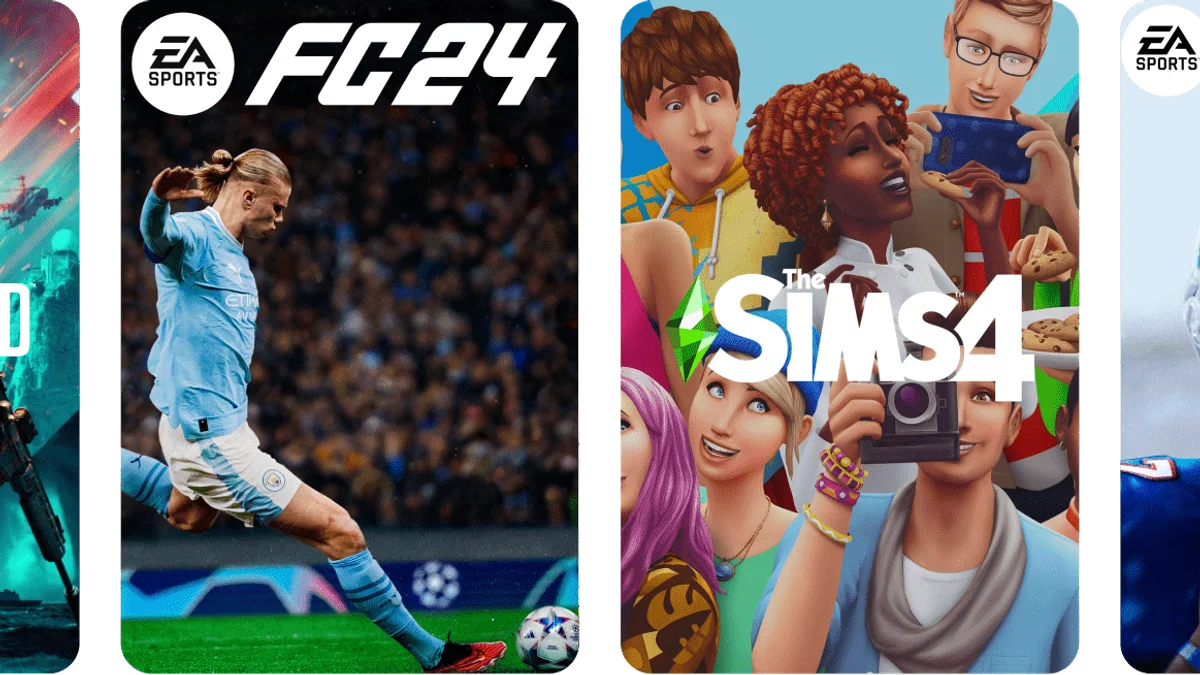
EA's corporate portfolio spans Battlefield, Apex Legends, The Sims, Need for Speed, Dragon Age, Titanfall, Plants vs. Zombies and the EA SPORTS machine. That corporate list should not be mistaken for a legal ownership chart.
Battlefield provides a useful clean example. Motive explicitly referred to Battlefield as “wholly-owned EA IP” when contrasting its Battlefield work with its licensed Marvel project, Iron Man. EA therefore has major entertainment properties that do not require renewal from a sports league or film studio simply to keep using the underlying universe.
Yet the business remains concentrated. EA's final annual filing says a significant portion of revenue historically comes from a small group of popular titles, specifically naming EA SPORTS FC, College Football, Madden NFL, Apex Legends, Battlefield and The Sims. Global football on its own has historically represented a significant portion of net revenue.
EA SPORTS FC is a licensing network, not a license-free successor to FIFA
FC 27 makes the new structure unusually visible. EA advertises more than 21,000 players, over 800 clubs and national teams, 140 stadiums, more than 35 leagues and support from more than 300 global football partners.
That network includes the Premier League, Bundesliga, LALIGA EA SPORTS, major women's leagues, CONMEBOL Libertadores and UEFA club competitions including the Champions League, Europa League and Women's Champions League.
The FIFA name is no longer the product brand, but removing that name did not remove licensing from the business. Modern EA SPORTS FC is an aggregation of many agreements with competitions, leagues, clubs, players and other rights holders.
That structure spreads one kind of risk while creating another. One lost agreement does not necessarily erase the entire football product, but preserving the level of authenticity EA sells requires maintaining a very large licensing network year after year.
Madden's exclusivity is real, but specific
EA and the NFL renewed and expanded their relationship in October 2025 through a new exclusive multiyear agreement.
The wording matters: Madden NFL remains the exclusive authentic NFL action simulation game. That is not the same as saying every possible interactive NFL experience belongs exclusively to Electronic Arts.
Madden also combines different rights layers. League and team assets, player rights and the John Madden name are not all EA-owned property. The franchise feels inseparable from Electronic Arts after decades of releases, but legally it remains a product assembled from both EA technology and third-party rights.
The NFL agreement also supports new experiences around EA SPORTS College Football. College Football 27 is active in 2026 with thousands of current athletes represented in the game, in an era where player identity and NIL rights are a major part of the authenticity equation.
F1, NHL and UFC are all active, without identical contract visibility
EA's Formula 1 business is not winding down. The publisher describes its current plan as a multiyear strategic investment supported by Formula One Management and the teams. F1 25 received a 2026 season expansion, while the next full F1 game is planned for 2027.
That confirms continuity without giving the public a precise expiration date for the wider relationship.
NHL 27 is also on the market in 2026, representing all 32 teams and arenas and using NHL EDGE data in parts of its on-ice systems. The public sources reviewed for this snapshot do not establish a definitive end date for EA's NHL rights.
UFC is similarly active. EA SPORTS UFC 6 launched in June and continues to receive updates. That confirms current exploitation of the UFC property, but it does not justify inventing a contract expiration date that EA has not publicly provided in the material reviewed here.
Star Wars and Marvel show what licensed entertainment looks like outside sports
EA's own annual filing is explicit that its Star Wars products use rights licensed from Disney. That relationship remains active in 2026: EA published Star Wars Zero Company, developed by Bit Reactor in collaboration with Lucasfilm Games, in August.
Marvel remains active at Motive as well. The studio still lists its Iron Man project among its current projects and describes the game as being developed in collaboration with Marvel Games.
A licensing relationship does not guarantee that every announced game survives development. EA canceled its Black Panther project and closed Cliffhanger Games in May 2025. Iron Man continuing at Motive means Marvel has not disappeared from EA's slate, but the licensed pipeline has already been narrowed once.
This is where licensed IP differs from an internally controlled universe. EA must make its own production decisions while also operating inside rights, approvals and commercial terms belonging to another company.
That $2.058 billion commitment figure is not a sports-license bill
As of March 31, EA reported approximately $2.058 billion in unrecognized commitments to content licensors, independent developers and co-publishing or distribution partners whose performance was still outstanding.
The number is useful only if it is described correctly. It is not $2.058 billion of sports-rights spending. EA says its content-license royalties can cover sports organizations, movie studios and other owners of trademarks, copyrights, publicity rights and intellectual property, while the broader commitment total also includes developers and publishing or distribution partners.
EA is nevertheless unusually clear about the underlying business risk. Its annual filing says competition for licenses is intense and warns that losing or failing to acquire important rights could hurt successful product development, revenue, profitability and cash flow.
That does not make the licensing model inherently weak. EA combines internally controlled franchises, huge existing communities and hundreds of outside partnerships. The burden is continuous rather than binary: enough of those rights have to be renewed at economics that still make sense.
The new EA is less transparent, not less complicated
By the time the buyout closed, EA had record annual bookings, a resurgent Battlefield, enormous live-service revenue and a sports portfolio operating at global scale.
It also had two distinct engines that are easy to blur together. One engine builds value around EA-controlled games and communities. The other turns footballers, teams, leagues, racing championships, movie universes and superheroes owned by somebody else into long-running EA businesses.
Private ownership adds a third layer. The buyout brings long-term capital but also significant transaction financing and fewer public disclosure obligations. Future studio decisions, licensing costs and portfolio shifts will be harder to inspect quarter by quarter than they were when EA traded on Nasdaq.
The important franchises are already visible in the company's own financial disclosures: FC, Madden, College Football, Battlefield, Apex Legends and The Sims. Electronic Arts does not need to choose between owned IP and licensed properties. Its business works precisely because it has spent decades learning how to monetize both.