The numbers stopped moving in the same direction
Microsoft's Xbox business generated $21.79 billion in fiscal 2026 revenue, down 7% year over year. Hardware revenue fell 29%, while content and services declined 5% for the full year. Game Pass growth offset part of that weakness, but the final quarter still ended with Xbox content and services revenue down 10%.
Ubisoft's latest full year sits much further down the spectrum. Fiscal 2025-26 net bookings fell 17.4% to €1.525 billion. IFRS operating loss reached €1.322 billion and free cash flow was negative €442.7 million. Those figures came with a strategic reset rather than the usual promise that a stronger release slate will fix everything next year.
Elsewhere, Sony's first fiscal quarter told a nearly opposite story. Game & Network Services revenue was essentially flat, yet operating income rose from ¥148 billion to ¥202 billion. Capcom opened its year with revenue up 54.7% and operating profit up 66.9%. Nintendo reported ¥142.6 billion in quarterly operating profit, more than twice the prior-year figure.
Some of those jumps include temporary tailwinds. Tariff refunds benefited the Japanese platform businesses, while Nintendo is simultaneously warning about higher memory, component and tariff costs over the full year. Still, the contrast is substantial. Parts of the AAA business are discussing how much profit an existing audience can generate; others are deciding which studios and projects should continue to exist inside their current structures.
Xbox and Ubisoft are restructuring the machine itself
On September 22, Xbox announced another 268 role reductions across Halo Studios, other first-party teams and central management functions. That follows the much larger plan announced in July to remove roughly 3,200 roles during fiscal 2027. Microsoft now says it is around three-quarters of the way through the restructuring previously announced.
The more consequential part is what happens around those cuts. Activision is taking a broader remit that includes World’s Edge and Rare, while a dedicated team under Activision is developing the next Halo with support from a smaller Halo Studios group. Playground Games and Turn 10 are being brought together. Bethesda is taking on Obsidian. Compulsion, Double Fine and Undead Labs have moved into different management arrangements, while separate processes have affected Ninja Theory and Arkane.
This is why Xbox's situation is larger than one weak hardware cycle. Microsoft is redrawing an organization assembled through years of acquisition. In the July restructuring announcement, Xbox leadership itself acknowledged that the studio system had become overextended and that the business was producing operating margins well below comparable companies.
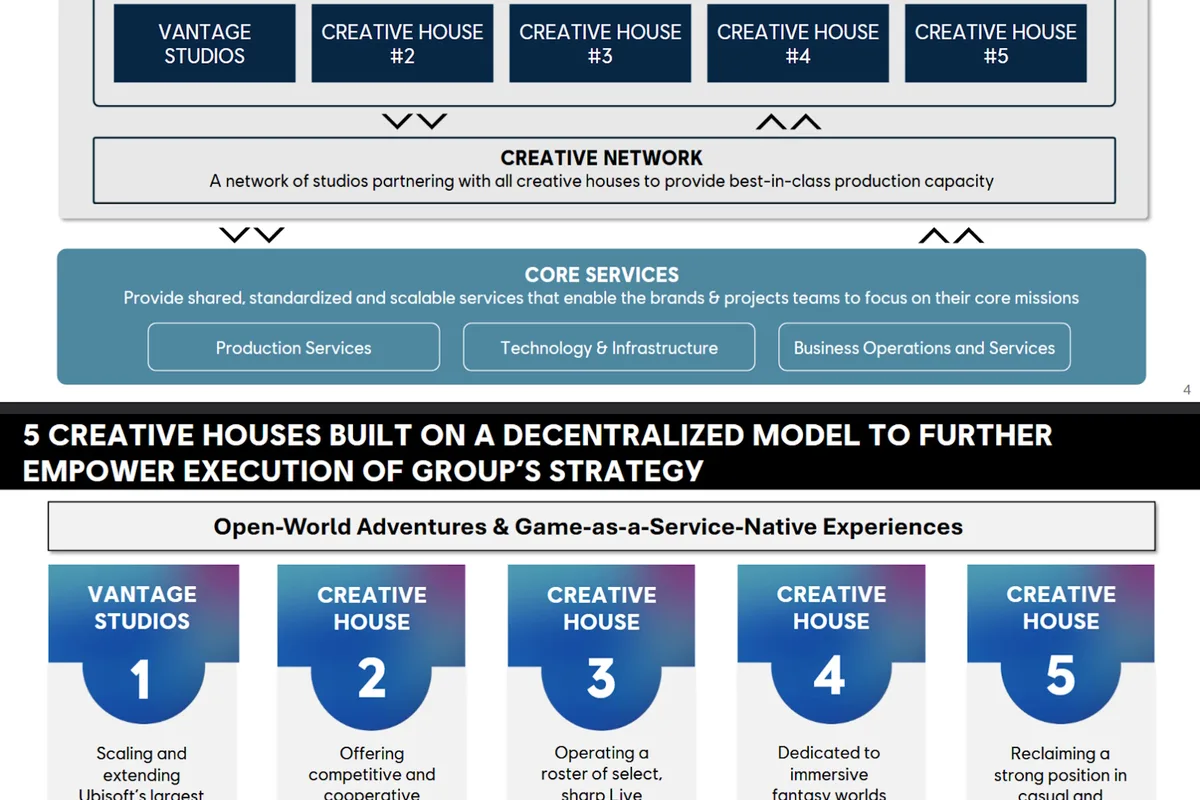
Ubisoft is trying its own version of structural compression. Development has been reorganized around five Creative Houses. Six projects were cancelled, including the Prince of Persia: The Sands of Time remake, while seven games were given additional development time. Studio closures, local restructurings and further cost reduction sit alongside that plan.
There are early signs to watch, but not enough evidence to declare the turnaround complete. First-quarter fiscal 2026-27 net bookings were €255.8 million, down 9.2% year over year but slightly above Ubisoft's guidance. Assassin's Creed Black Flag Resynced reached 3.5 million sell-in units within 14 days, ahead of the company's annual expectations. That is useful evidence for the new slate. It does not erase the €1.3 billion IFRS operating loss reported for the previous year.
Sony, Nintendo and Capcom are extracting more value from what they already own
PlayStation's most revealing first-quarter number may be network services revenue. It climbed from ¥172.6 billion to ¥208.6 billion even as hardware revenue declined. Sony reported 125 million monthly active PlayStation users in June, a record for that month, and in July raised its full-year Game & Network Services operating-income forecast to ¥660 billion.
The business is already spending on the next platform generation and carrying restructuring costs. It nevertheless increased gaming operating income by 37% in the quarter. A slower hardware line no longer translates automatically into weaker profitability when subscriptions, digital spending and an enormous installed base remain active.
Nintendo has another kind of cushion. Switch 2 had reached 23.68 million cumulative hardware sales by June 30, while Mario Kart World stood at 15.39 million copies. The original Switch had passed 156 million units. That gives Nintendo two very large software audiences at the same time it is dealing with more expensive memory and other components.
Capcom's advantage is visible in the shelf life of its games. The company sold 23.81 million software units during its first fiscal quarter, up from 14.16 million a year earlier. New IP PRAGMATA had passed 2.5 million units, while older Resident Evil titles continued contributing to catalog sales. A new release does not have to carry the quarter alone when years of previous releases are still moving in volume.
EA changed owners while Take-Two put November at the center of the year
Electronic Arts crossed a different line on August 4. The roughly $55 billion acquisition by a consortium including Saudi Arabia's Public Investment Fund, Silver Lake and Affinity Partners closed, taking EA private while Andrew Wilson remained chief executive.
The timing matters because this was not a rescue of a collapsing publisher. EA finished fiscal 2026 with record net bookings of $8.026 billion, up 9%. Before the transaction closed, its first fiscal 2027 quarter produced $1.349 billion in net bookings, up 4%, with EA Sports FC, Apex Legends, American football and Battlefield among the businesses cited as contributors.
What has changed is the capital structure around those games. The original financing package included roughly $36 billion in equity commitments and $20 billion in debt commitments, with approximately $18 billion expected to be funded at closing. EA entered private ownership with a healthy operating business and a very different financial framework attached to it.
Take-Two remains public, but one date dominates its current outlook. First-quarter fiscal 2027 net bookings came to $1.39 billion, and the company reiterated full-year guidance of $8.0 billion to $8.2 billion. Its latest financial communications continue to put Grand Theft Auto VI on November 19.
Recurrent consumer spending still represented 84% of Take-Two's quarterly bookings, giving the company substantial activity outside a single launch. NBA 2K, GTA Online, Zynga and the rest of the portfolio do not disappear while everyone waits for GTA VI. Even so, few releases are large enough to visibly shape the financial expectations of a publisher this diversified.
Scale protects franchises better than it protects organizations
The September snapshot does not support a clean choice between “AAA is in crisis” and “AAA is healthy.” Installed bases help Sony and Nintendo. Long-tail catalog sales strengthen Capcom. Subscriptions and recurrent spending give Microsoft, EA and Take-Two revenue that no longer depends entirely on selling a fresh boxed game every quarter.
Scale also accumulates management costs of its own. Xbox is cutting and redistributing a studio network that became too broad. Ubisoft is trying to shorten decision-making through its Creative Houses. EA has moved into private ownership with a significant debt package attached to the deal. Nintendo is confronting component inflation precisely while Switch 2 production is accelerating.
The AAA model is not disappearing. It is becoming more concentrated around assets that can keep working for years: recurring franchises, back catalogs, subscription relationships, established communities and a smaller number of launches capable of moving billions of dollars. When those pieces line up, Sony, Nintendo and Capcom show how profitable the sector can still be. When the organization behind them becomes too expensive or too complicated, sheer corporate size does not prevent another restructuring.
The next checkpoints are already close. Nintendo is due to report its half-year results in early November, Ubisoft follows with its own half-year update later in the month, and November 19 currently carries one of the industry's largest commercial tests of 2026: Grand Theft Auto VI.