
This was never primarily a player shortage
Newzoo expects the global games market to generate $213.9 billion in 2026, up 6.1 percent year over year. Mobile, PC and console are all forecast to grow.
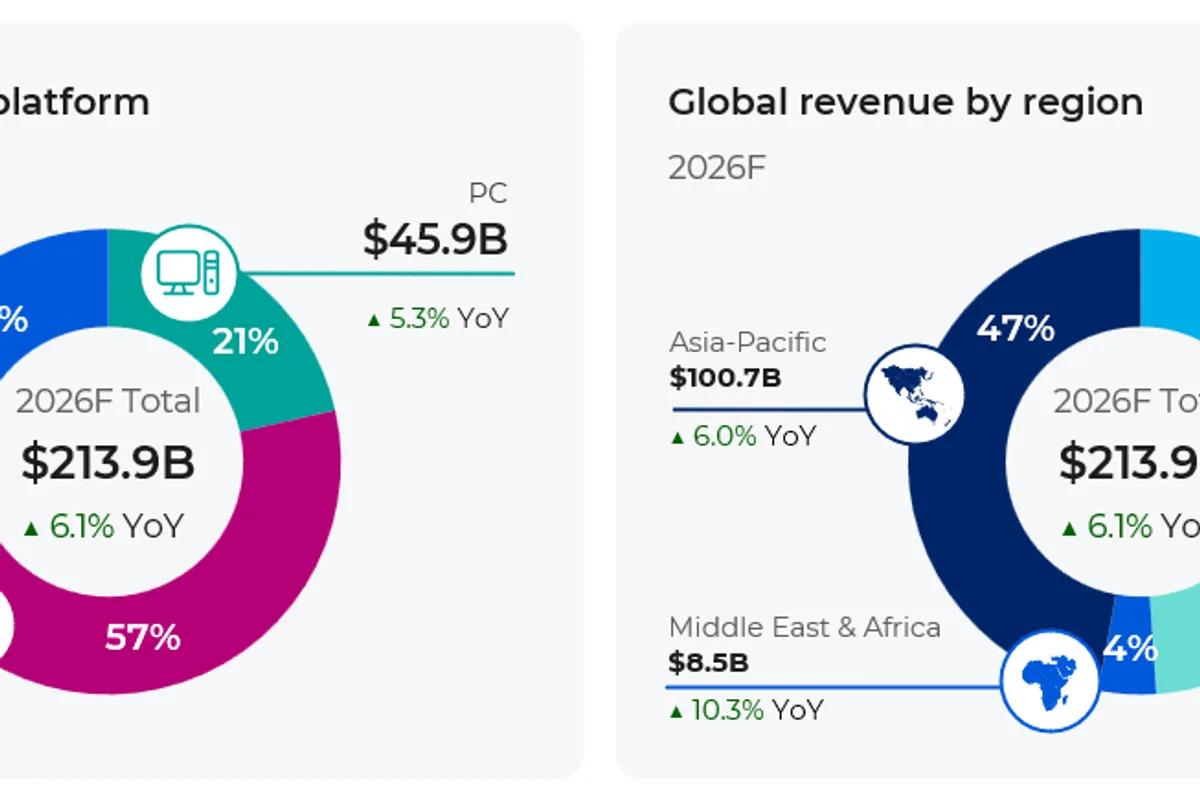
Around 3.7 billion people are expected to play games this year.
The employment crisis therefore cannot be explained by an audience suddenly abandoning the medium. The underlying causes sit elsewhere: pandemic-era expansion, increasingly expensive production structures, investor expectations and a mature market in which player time is difficult to increase.
Pandemic expansion left behind very large organisations
Publishers spent the boom years expecting engagement growth to last. Hiring accelerated, acquisitions multiplied and project portfolios expanded.
The correction has been severe. GDC's 2026 industry survey found that 28 percent of respondents had personally experienced a layoff during the previous two years.
Half said their current or most recent employer had cut staff during the past year.
Xbox is an unusually clear example of the new discipline
Microsoft announced 4,800 job cuts in July, with roughly 3,200 affecting Xbox. The gaming business was simultaneously reorganised, with several studios moving outside its previous internal structure.
The strategic reversal is striking. Microsoft spent extraordinary sums assembling one of the world's largest collections of game developers, including the acquisition of Activision Blizzard.
The new priority is extracting sustainable returns from that scale rather than simply increasing it.
Known intellectual property has become financial insurance
Newzoo's Gamescom observations describe publisher portfolio strategies as increasingly defensive. Sequels, remasters and established properties reduce at least one major uncertainty because an audience already recognises the name.
That does not make established franchises creatively worthless.
It does make original projects harder to defend when a single commercial miss can lead to restructuring.
The mid-market is reopening
At the same time, the industry is rediscovering a model smaller than traditional AAA. Newzoo identifies the $30 to $50 premium segment as one of the fastest-growing price bands.
It provides room for projects that can be substantial without requiring blockbuster-scale sales merely to justify their existence.
PC is particularly relevant here. Engagement outside the platform's Top 20 games has expanded, while more lower-priced titles are reaching meaningful revenue thresholds.
Consolidation is still moving
The acquisition cycle has not disappeared. In September, Reuters reported that Saudi Arabia's Public Investment Fund was considering combining Electronic Arts with Savvy Games after EA's move into private ownership.
Such a deal would unite major traditional franchises with a group deeply invested in mobile publishing and global expansion.
Modern consolidation is increasingly about combining catalogues, distribution, data, monetisation expertise and long-lived communities rather than simply collecting studios.
The most valuable games increasingly refuse to end
Many of today's largest games are old. Roblox and Garry's Mod reach twenty years in 2026. Minecraft is fifteen. Dead by Daylight, Pokémon GO and Overwatch are ten. GTA V remains a major product thirteen years after launch.
That longevity is excellent for incumbents and intimidating for anyone launching something new.
A newcomer is not only competing with a better-known franchise. It is asking people to abandon friends, progression histories, purchased cosmetics and established habits.
Workers are responding to instability collectively
The same period has accelerated labour organisation. GDC reports that 82 percent of US respondents support unionisation in the game industry.
In September, roughly 1,900 unionised Blizzard employees secured a contract containing layoff protections and formal mechanisms for discussing issues including artificial intelligence.
Collective bargaining in large US game studios is moving from unusual to structurally relevant.
A mature business gets mature-business problems
Gaming can no longer assume that mistakes will be absorbed by tens of millions of entirely new consumers entering the market every year.
Its problems increasingly resemble those of other mature entertainment industries: concentration, labour negotiations, portfolio management, slower audience expansion and a constant attempt to turn existing hits into longer-lived businesses.
Record revenue and painful production conditions can exist simultaneously.
In 2026, they clearly do.