
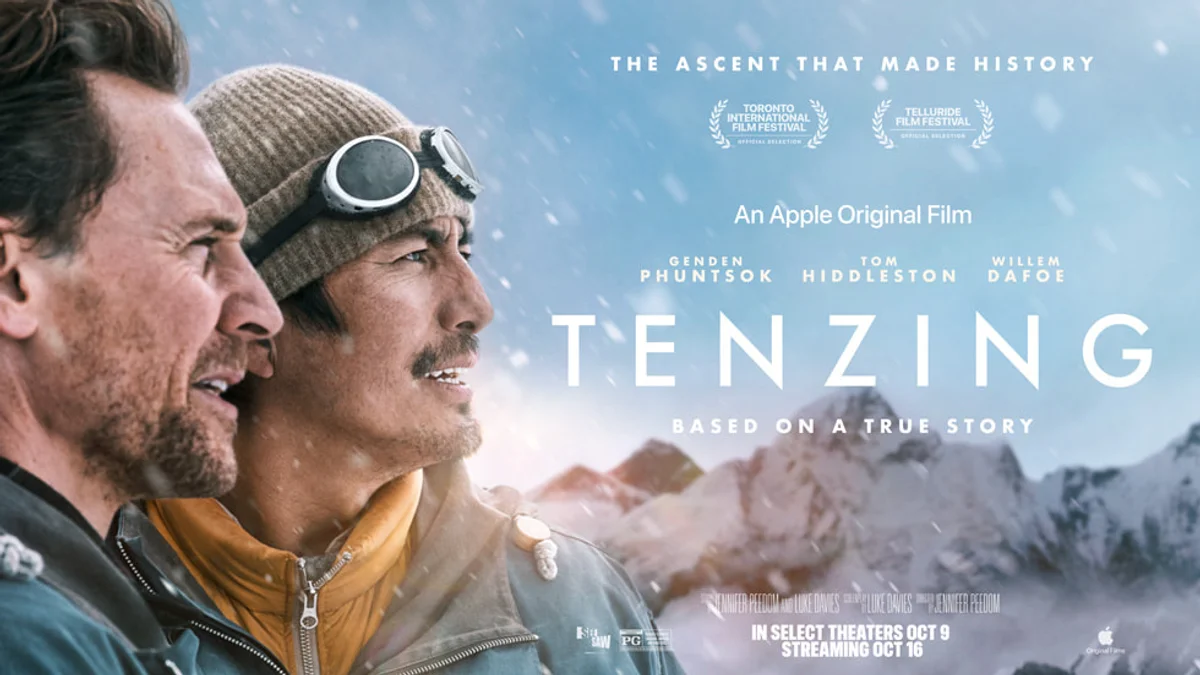
Tenzing makes its global streaming debut on Apple TV
Apple Original Films released Tenzing globally on its streaming service on Friday, October 16, 2026.
The feature had previously opened in selected theaters beginning October 9, including limited engagements in the United States and United Kingdom.
The release strategy combines the spectacle of a mountain adventure on the big screen with the international reach of subscription streaming.
October 16 is not the film's first public presentation. Tenzing had already screened at festivals including Telluride and Toronto before beginning its commercial rollout.
Directed by Jennifer Peedom and written by Luke Davies, the film dramatizes the 1953 expedition during which Tenzing Norgay and Edmund Hillary reached the summit of Mount Everest.
The historical achievement is immediately recognizable, but the film's most significant creative decision concerns the perspective from which it is told.
The title makes that intention clear.
Hillary is played by an internationally famous actor, yet the central story belongs to Tenzing, whose personal journey provides the narrative foundation.
The 1953 summit was a shared achievement
On May 29, 1953, Tenzing Norgay and Edmund Hillary reached the summit of Mount Everest, approximately 8,849 meters above sea level.
Their climb is recognized as the first confirmed ascent of the highest mountain on Earth.
The distinction matters because the achievement belonged to both men. It was not a case of one individual reaching the summit while the other merely carried equipment.
The expedition was led by British mountaineer John Hunt and depended on a complex team of climbers, guides, porters and people whose experience of the Himalayan environment made the attempt possible.
However, historical accounts of such expeditions often gave greater prominence to the Western figures who occupied formal positions of authority.
The contribution of Sherpa mountaineers could be characterized as supporting work, even when their technical skills and knowledge of the terrain were essential.
Peedom's film examines that unequal distribution of recognition.
Its aim is not to diminish Hillary's achievement in order to enlarge Tenzing's. Instead, it restores attention to the experience and capabilities that allowed Norgay to become one of the two men standing on the summit.
This changes the meaning of the adventure.
Rather than following a Western expedition encountering a difficult mountain, the audience follows someone whose relationship with the Himalayas is personal, cultural and spiritual.
Genden Phuntsok gives Tenzing Norgay his own story
Genden Phuntsok portrays Tenzing Norgay.
An actor of Tibetan heritage, Phuntsok takes on a role demanding both physical credibility and the ability to carry a historical drama whose outcome is already familiar.
The story moves through different stages of Tenzing's life, connecting his early fascination with the Himalayas to his eventual participation in the 1953 expedition.
The ascent is therefore not presented as an extraordinary event that suddenly enters his life.
Instead, it becomes the culmination of years spent developing experience, relationships and a deep understanding of the mountain environment.
One of the central dramatic conflicts concerns recognition.
In Apple's official synopsis, Tenzing must persuade the expedition's leaders that he deserves to participate as a full member of the climbing team rather than simply serve its Western participants.
His ambition has two dimensions.
He wants to reach a mountain that possesses immense personal meaning, but he also wants his abilities to be recognized as those of a skilled mountaineer.
This makes Phuntsok's performance particularly important.
The actor must convey determination and courage while also communicating a relationship with the mountain that other characters do not necessarily share.
In his October 9 review, The Guardian's Peter Bradshaw praised Phuntsok's charm and emotional presence, suggesting that the performance helps sustain the film even when its biographical structure becomes relatively conventional.
The response highlights something essential about historical filmmaking.
A biopic does not succeed through factual reconstruction alone. It also needs an actor capable of giving emotional life to a person whose achievements are already recorded in history.
Tom Hiddleston plays Hillary without taking over the story
Tom Hiddleston portrays Edmund Hillary, the New Zealand mountaineer whose name remains inseparable from the first confirmed Everest summit.
The casting gives the film immediate international recognition.
Hiddleston is widely known for playing Loki in Marvel productions, alongside his extensive experience in theater and dramatic roles.
Yet Tenzing is not designed to turn Hillary into a solitary hero.
The screenplay presents his partnership with Norgay as a meeting between two men whose skills, ambitions and experiences complement one another.
Hillary is portrayed as practical, direct and determined.
Tenzing brings knowledge of the mountain developed through a different cultural and professional experience.
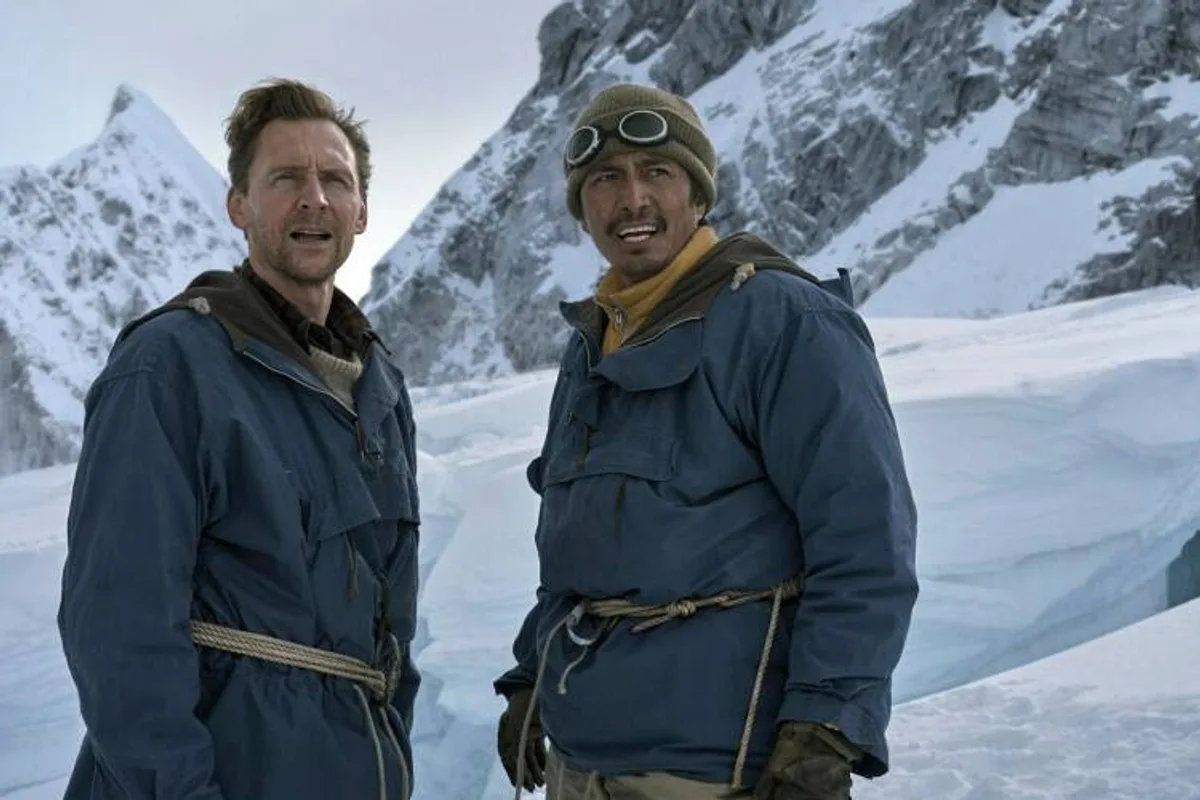
Their relationship becomes particularly important as the physical challenges of the ascent reduce the significance of formal distinctions.
At extreme altitude, decisions depend on trust, coordination and confidence in a partner's abilities.
However, reducing the film to a story of male friendship would miss much of its intended focus.
Peedom gives greater attention to Tenzing's personal journey and the significance of Everest within his life.
His partnership with Hillary is essential to that journey without being its only source of meaning.
Willem Dafoe embodies the expedition's British hierarchy
Willem Dafoe plays John Hunt, the leader of the British expedition.
His position represents both organizational authority and the formal hierarchy through which decisions about the climb are made.
Within the story presented by Apple, Tenzing must demonstrate that he belongs among the mountaineers attempting the summit.
Jill Henderson, played by Caitríona Balfe, becomes an important ally in that effort.
Tenzing's wife Dawa, portrayed by Thinley Lhamo, also encourages his ambition.
These characters expand the story beyond the two climbers who eventually reach the summit.
A major expedition never depends solely on the individuals photographed at its highest point.
It requires preparation, logistical support, leadership decisions and people whose contributions can be decisive without becoming the best-known part of the historical narrative.
The distinction between history and dramatization remains important.
Tenzing is a fictionalized historical drama, not a documentary transcription of the expedition's records.
Its dialogue and character interactions should not automatically be treated as verbatim accounts of real conversations.
The film offers a cinematic interpretation of historical events rather than an exhaustive reconstruction of every documented detail.
For Tenzing, Everest is also Chomolungma
One of the film's central ideas is the difference between ways of understanding the mountain.
Within a familiar Western adventure narrative, Everest frequently represents a challenge to overcome.
The language of conquest, records and human triumph tends to dominate.
For Tenzing, the mountain also has profound spiritual significance.
He knows it by the Tibetan name Chomolungma, associated with a sacred figure.
The summit is therefore more than a sporting record or a personal achievement.
It is a place connected to beliefs and experiences that have shaped his life long before the British expedition.
This distinction should not be simplified into the idea that all Western mountaineers care only about competition while Himalayan traditions are concerned exclusively with spirituality.
The film nevertheless uses differing perspectives to enrich its central conflict.
It invites audiences to consider the mountain as something more than a natural obstacle waiting to be defeated.
The landscape becomes an active presence whose meaning changes according to the people encountering it.
That approach is consistent with the work of director Jennifer Peedom, who has already explored the relationship between human ambition, mountain environments and cultural representation.
Jennifer Peedom knew the Himalayas before making this feature
Tenzing marks Jennifer Peedom's move into narrative feature filmmaking, but it does not represent her first encounter with mountaineering as a subject.
The Australian filmmaker previously directed Sherpa, a documentary examining the experiences and working conditions of the people who make Everest expeditions possible.
She also directed Mountain, a documentary exploring the human fascination with high-altitude environments and the cultural meanings attached to them.
Those projects help explain her interest in Norgay's story.
Peedom approaches the mountain through more than the familiar narrative of athletic achievement.
Her previous work has already considered the experiences of Himalayan communities and their role in modern expedition culture.
Moving into fiction gives her a different set of tools.
Documentary filmmaking generally relies on observation, interviews and archival material.
Historical drama allows filmmakers to construct scenes, dialogue and emotional progression, potentially bringing viewers closer to experiences that cannot be reconstructed directly from surviving records.
That freedom also creates responsibilities.
An invented scene may effectively communicate a historical conflict without establishing that the participants experienced the precise exchange shown on screen.
Luke Davies wrote the screenplay and developed the story with Peedom.
The production team includes Peedom, Davies, Desray Armstrong, Liz Watts, Iain Canning and Emile Sherman.
Norbu Tenzing, one of Tenzing Norgay's sons, serves as an executive producer.
His participation establishes a direct connection between the filmmakers and the mountaineer's family.
It is a significant element of the production, although it does not make every dramatized scene an independently verified historical fact.
Real mountain locations give the ascent physical weight
Everest offers filmmakers an extraordinary visual environment.
Cold, reduced oxygen, steep slopes and hidden crevasses communicate human vulnerability with little need for explanation.
The production filmed mountain sequences in locations including Nepal and New Zealand.
Members of the cast have described demanding physical preparation and the challenges of working in mountainous terrain.
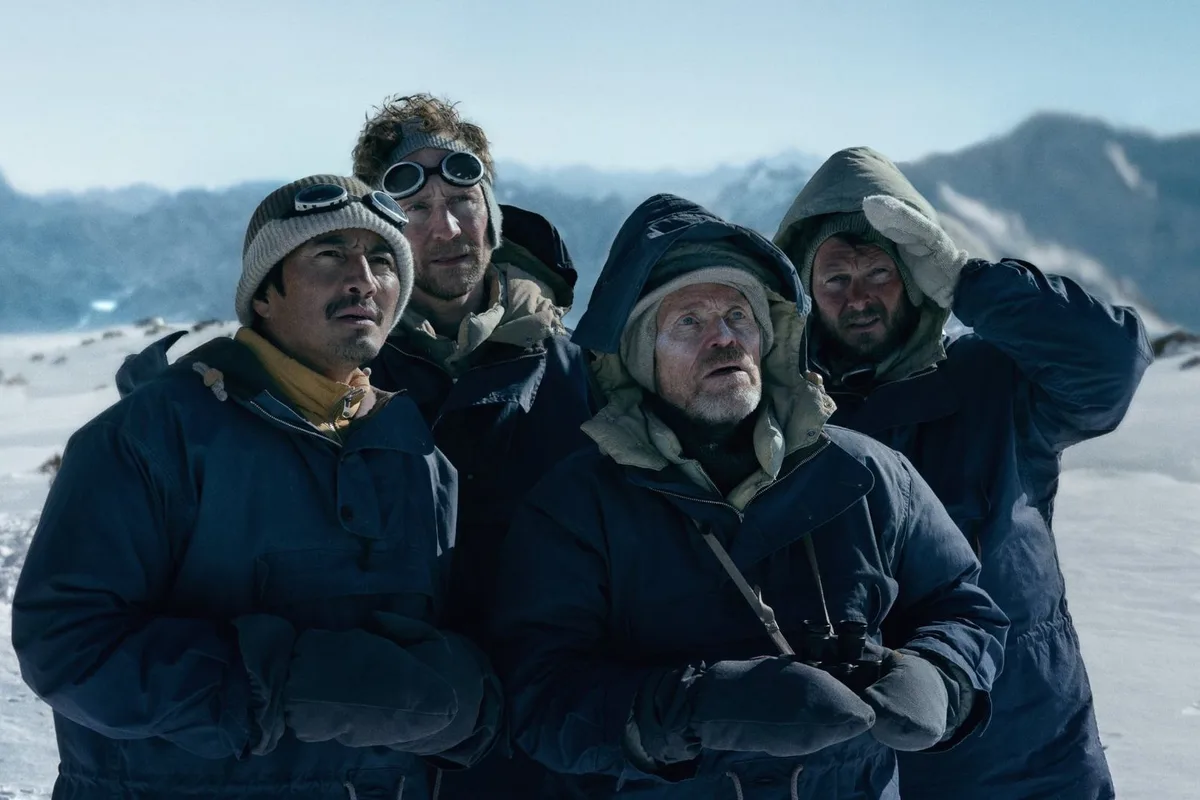
That effort should not be confused with a claim that every scene was filmed on the actual summit of Everest or at the same altitude reached by the historical expedition.
The published production information does not support such an assertion.
The environments nevertheless provide an important element of the film's visual storytelling.
Difficult movement, exposed terrain and the limited space available to climbers can convey physical danger without requiring elaborate dialogue.
The Financial Times review published on October 16 particularly praised the climactic ascent, highlighting how Peedom's documentary background supports the film's most visually effective sequences.
The newspaper awarded the movie three stars out of five, recognizing its strengths without presenting it as an unqualified triumph.
The Guardian offered a similarly measured response, finding the film watchable and supported by Phuntsok's performance while noting a degree of conventional biographical storytelling.
These reviews establish a mixed but engaged critical reception rather than unanimous acclaim.
The movie asks who gets to become a historical hero
Ultimately, Tenzing is concerned with more than the 1953 ascent.
It examines how historical achievements become stories and how those stories determine who receives lasting recognition.
When an event involves different nationalities, social positions and professional responsibilities, who becomes the official hero?
Popular accounts can privilege the individuals whose identities and positions correspond to the expectations of those telling the story.
In twentieth-century Himalayan mountaineering, Sherpa contributions were often presented as logistical support, even when the skills and experience involved were essential to the climbing itself.
Peedom attempts to change that perspective by placing Tenzing at the center of her film.
Doing so does not require erasing Hillary or Hunt.
Their roles remain fundamental to understanding the expedition.
But the characters approach the attempt with different motivations.
Some pursue national achievement, others personal ambition, and others a lifelong goal whose significance cannot be reduced to setting a record.
Those differences give the historical drama a richer foundation than the physical question of whether the climbers will reach the summit.
Apple TV puts a historical adventure before an international audience
Tenzing joins Apple Original Films' catalog of productions built around established creative teams and internationally recognizable casts.
Tom Hiddleston and Willem Dafoe are familiar names capable of attracting viewers who might not otherwise seek out a historical film about Himalayan mountaineering.
The decision to cast Genden Phuntsok as Tenzing gives the project a distinct identity.
The central character is not played by the most commercially recognizable performer on the poster.
The ensemble also includes Thinley Lhamo, Caitríona Balfe and Tenzin Dalha, giving the narrative room to explore family relationships and the collective nature of the expedition.
Apple promoted the release through an official trailer, festival screenings and a New York premiere event on October 7.
That promotional visibility should not be treated as evidence of strong streaming performance.
As of October 16, 2026, the film has only just arrived on Apple TV, and no sufficiently complete audience figures have been published to establish its success on the platform.
Claims about streaming records, exceptional viewing totals or financial profitability would therefore be premature.
Tenzing's greatest victory may be taking ownership of his story
The outcome of the 1953 expedition is not a mystery.
Audiences know that Tenzing Norgay and Edmund Hillary ultimately reached the summit.
The suspense of a historical drama about the ascent cannot depend entirely on whether they succeed.
Its emotional weight must come from the obstacles preceding the climb, the individuals involved and the meaning each attaches to the achievement.
Peedom builds her film around a mountaineer whose life deserves to be understood independently rather than solely through his partnership with a more internationally celebrated figure.
That shift does not eliminate the limitations of conventional biographical storytelling.
Early reviews have noted moments when the film follows familiar dramatic patterns.
Nevertheless, its change of perspective is significant.
The worldwide Apple TV release allows audiences far beyond festivals and specialist theaters to encounter a version of the Everest story with Tenzing at its center.
The mountain remains a formidable cinematic spectacle.
But reaching its summit is not the entire story.
Understanding an achievement also requires recognizing the people whose experience and determination made it possible.
On May 29, 1953, two men stood at the highest point on Earth. In 2026, cinema is finally giving one of them the space to tell his own story.