
Fiscal 2025-26 was extremely weak
Full-year net bookings fell to €1.525 billion from €1.846 billion, a decline of 17.4%. IFRS 15 revenue dropped 21.8% to €1.396 billion.
The IFRS operating loss reached €1.322 billion. On Ubisoft's non-IFRS basis, the operating loss was still €1.045 billion.
A large part of that extraordinary damage came from the portfolio reset. Project cancellations, delays and revised expectations produced roughly €650 million in accelerated write-downs. Those are exceptional charges, but operating cash flow also moved into negative territory. The problem was not merely accounting presentation.
The workforce reduction is already the size of a major publisher
Ubisoft ended March with 16,590 employees, around 1,200 fewer than one year earlier.
Its fixed-cost base fell by €118 million during the year, taking cumulative reductions since fiscal 2022-23 to roughly €325 million. Management is targeting a €1.25 billion annualized fixed-cost base by March 2028, representing about €500 million in cumulative savings.
The cuts continued after year-end. Winnipeg and Belgrade were closed, Barcelona entered restructuring and global publishing was subject to targeted adjustments during the first quarter.

Tencent fundamentally changed the balance-sheet discussion
Tencent's €1.16 billion investment in Vantage Studios supplied Ubisoft with a large cash injection while placing Assassin's Creed, Far Cry and Rainbow Six inside a separately structured subsidiary.
By the end of March, Ubisoft's non-IFRS net debt had fallen to roughly €187 million from €885 million one year earlier.
Debt is not a solved problem. In July, Ubisoft said it was actively reviewing financing options to extend maturities and address future obligations. At the same time, management stated that available liquidity was sufficient to cover the near-term maturity.
That is financial pressure, but it is not the same evidence as an immediate cash crunch.
Ubisoft still expects another loss-making year
The company has not guided for a rapid recovery in fiscal 2026-27. Net bookings are expected to decline by a high-single-digit percentage, while the non-IFRS operating margin should remain negative in the high single digits.
Free-cash-flow consumption could reach €500 million.
Management's recovery target begins in fiscal 2027-28, when it expects both positive non-IFRS EBIT and positive free cash flow. Until that happens, the turnaround remains an objective rather than an achieved financial result.
The first quarter at least stayed inside the plan
First-quarter net bookings reached €255.8 million, down 9.2% year over year but slightly above guidance of approximately €250 million.
Back-catalogue bookings declined 15%, partly because the prior-year comparison included substantial Assassin's Creed Shadows revenue. Rainbow Six Siege performed in line with expectations, while Invincible: Guarding the Globe delivered a record quarter.
It was not growth. It was a quarter without another major downward revision.
Black Flag Resynced provided the strongest recent evidence
Assassin's Creed Black Flag Resynced launched on July 9 and reached 3.5 million sell-in units within fourteen days, according to Ubisoft. That was already above the company's full-year expectation for the title.
It also reached approximately 105,000 concurrent Steam players, a franchise record on the platform.
Because the launch took place after the first-quarter cutoff, its financial contribution should be much more visible in Q2. Ubisoft is currently guiding for approximately €370 million in second-quarter net bookings.
The Creative Houses are a capital-allocation experiment
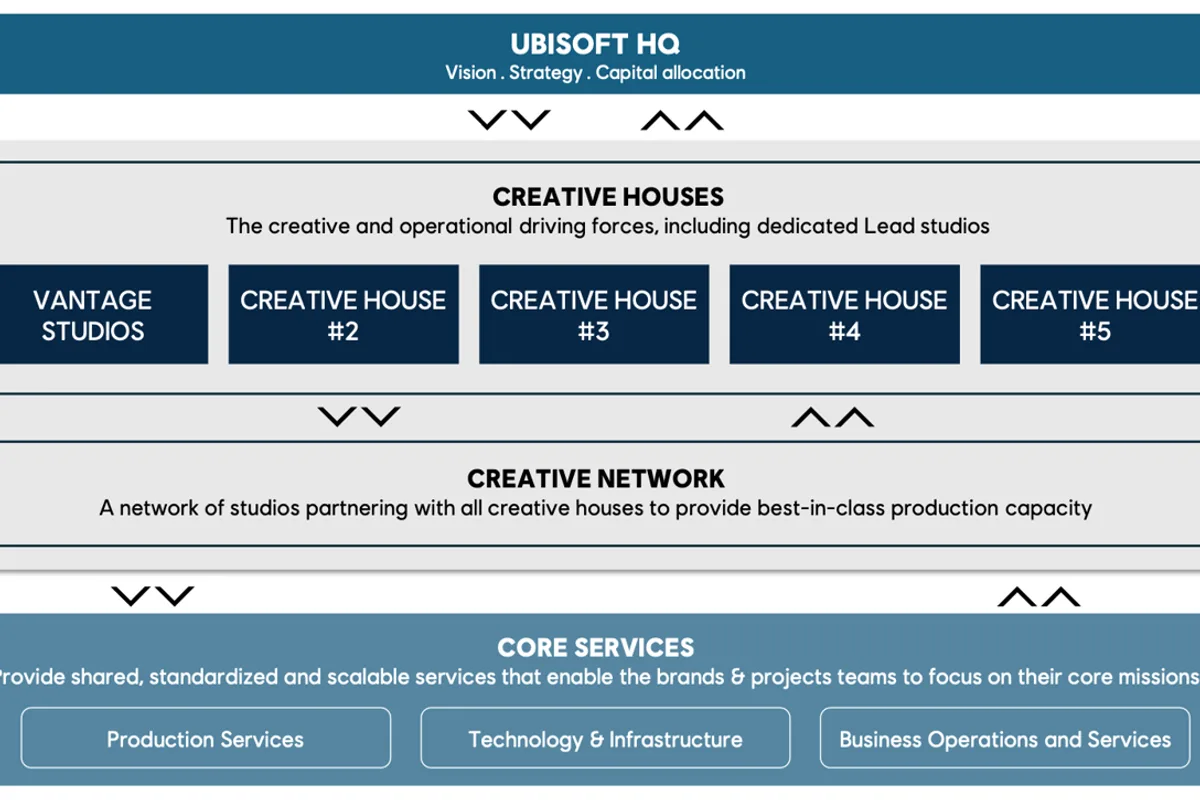
Ubisoft's five Creative Houses are being given separate leadership, clearer portfolios and direct accountability for their brands. Management incentives are tied to measures including player engagement and value creation.
Vantage Studios houses Assassin's Creed, Far Cry and Rainbow Six. Creative House 2 includes The Division, Ghost Recon, Splinter Cell and March of Giants. Other units are built around live experiences, narrative adventures, and casual or mobile games.
The Creative Network supplies shared development capacity, while central services retain functions such as technology, infrastructure, production tooling and business operations.
The business logic is straightforward: major franchises should have management teams that can be held more directly responsible for spending and results.
The risk has moved from financing toward execution
A year ago, Ubisoft's debt position and the cost of sustaining its huge production network were central concerns. Tencent's investment reduced the first problem substantially, while restructuring is attacking the second.
That leaves execution. Ubisoft now needs a smaller number of projects to produce more reliable returns while the group absorbs another year of negative free cash flow.
Concentrating investment on Assassin's Creed, Far Cry, Ghost Recon, Rainbow Six and other established franchises can reduce portfolio waste. It also makes individual delays or failures more consequential.
Crisis, yes. Collapse, no
A company posting a billion-euro operating loss, reducing its workforce by roughly 1,200 in a year, closing more studios and cancelling seven projects meets any reasonable description of a serious corporate crisis.
The available figures do not currently describe a business on the verge of running out of money. Tencent materially strengthened the balance sheet, short-term liquidity is described as sufficient, and recent trading has stayed around or slightly above management's expectations.
Ubisoft has bought itself time. The price has been a severe creative and organizational reset.
The next proof point is no longer another cost-cutting announcement. Management says positive non-IFRS EBIT and free cash flow should return in fiscal 2027-28. That is where the turnaround stops being a plan and starts becoming something measurable.