
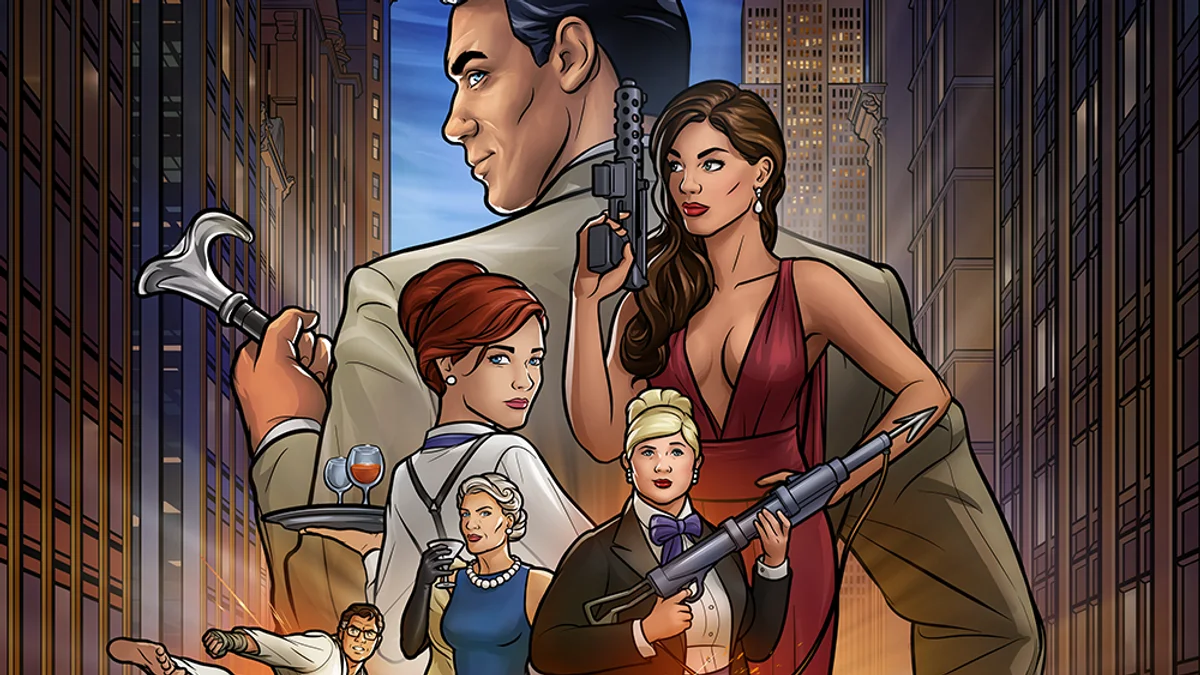
James Bond trapped in the world's worst office meeting
Archer's great idea was never merely turning James Bond into a narcissistic alcoholic. Sterling Archer is obviously the show's visible engine, but reducing fourteen seasons to its lead character misses Adam Reed's real machinery: Archer is a workplace comedy that happens to have guns, double agents and an irresponsibly generous travel budget.
Early reviews quickly identified that distinction. Espionage supplies missions and explosions; the comedy mostly comes from people forced to work together while knowing exactly where everyone else's weaknesses are. Lana can dismantle Archer with a sentence. Malory knows precisely where her son is most vulnerable. Cyril, Pam, Cheryl, Ray and Krieger each carry enough neuroses to turn mission preparation into a disaster before the villain even arrives.
That construction explains why some of the show's best episodes barely need espionage at all. When the team is trapped in an elevator in “Vision Quest,” the series requires little beyond its characters. Slant's reviews repeatedly identified this strength: the precision with which their individual flaws collide eventually matters more than the week's plot.
Dialogue built like a relay race
More than anything, Archer has a rhythm. Lines overlap, a conversation started in one room can finish somewhere else, an obscure reference becomes an insult and then returns episodes later as a running joke. Its vocabulary can jump from an extraordinarily stupid sex gag to a literary or historical reference without asking permission.
That density could easily have become exhausting virtuosity. It works because the voices give radically different personalities to the same tempo. H. Jon Benjamin gives Sterling a register of absolute confidence that makes his narcissism almost musical. Aisha Tyler gives Lana enough force to meet him head-on. Chris Parnell turns Cyril's frustration into a comic weapon, while Amber Nash and Judy Greer can derail an entire scene with a single Pam or Cheryl interjection.
Slant's Season 3 review was already emphasizing the dialogue and cast chemistry as foundations of the series. More than a decade later, reviews of the final season reach essentially the same conclusion. That may be the clearest measure of what Archer built: settings changed and formulas changed, but listening to these characters argue remained enough of an attraction.
Sterling is awful, thankfully
The series nevertheless rests on a dangerous problem: its protagonist is a man almost nobody would want as a coworker, partner or son. Sterling is selfish, irresponsible, cruel, industrially committed to alcohol and extraordinarily skilled at turning other people's trauma into joke material.
Archer generally avoids confusing comic effectiveness with moral approval. The world pushes back. Lana reminds him of his inadequacies, Cyril absorbs endless humiliation but can also reflect Sterling's decline back at him, and the show understands that Archer's professional competence does absolutely nothing to erase the human catastrophe around it.
H. Jon Benjamin is indispensable to that balance. The A.V. Club's review of Into the Cold highlights how his performance lets the audience sense that, beneath all the arrogance, Sterling occasionally understands exactly what he is. The show finds just enough vulnerability beneath the armor to keep him from becoming simply unbearable, without making the mistake of suddenly turning him into an exemplary man.
Change the whole show rather than admit it is bored
Fourteen seasons inevitably force a comedy to stare at its own formula. Archer did so more dramatically than most. Season 5, Archer Vice, abandons the familiar spy-agency structure. Later, Sterling's coma opens three seasons that move the same performers and archetypes through noir, island adventure and science-fiction fantasy.
The idea is bold and the results are uneven. Archer Vice was praised for disrupting a structure that risked becoming circular. The coma seasons are more divisive: Dreamland exploits the show's visual language beautifully, while Danger Island and 1999 sometimes reveal the limits of the device. Switching genres does not automatically solve pacing or repetition.
Those detours nevertheless reveal what Archer actually requires in order to work. Not necessarily ISIS, a particular period or even perfectly stable continuity. It needs these voices, these power relationships and the ability to bounce a catastrophe from one character to another.
A show that ages, sometimes visibly
Longevity has a cost. By Season 6, Slant was already observing that some episodes returned to familiar character beats. That sensation becomes more noticeable over time. A running gag is delightful when it returns at exactly the right moment; it starts feeling contractual when it returns simply because the audience expects it.
Adam Reed's gradual retreat from regular episode writing creates another difficult transition. The A.V. Club noted that newer writers needed time to fully acclimate to the show's unusual pacing. Archer never collapses, but some late seasons feel more like an excellent company performing familiar machinery than the unpredictable comic engine of its strongest years.
Malory's absence following Jessica Walter's death also changes a balance the series could not simply recreate. Lana taking charge of the Agency redistributes the power structure instead. Season 14 adds Zara Khan, giving Sterling a new partner capable of challenging his status, and critics broadly responded to the renewed energy of that final season.
The animation eventually catches up with the ambition
The earliest episodes were not showcases for especially fluid animation. Their art direction, however, immediately had a personality: sharply defined figures, retro environments, immaculate clothes and a world in which technologies from several decades appear to coexist without anybody feeling obligated to explain why.
The staging grows far more ambitious over time. The coma seasons use their genre shifts to explore noir, adventure and science fiction, while later seasons expand the scale of chases, travel and action sequences. Into the Cold takes advantage of that evolution with Rio, jetpacks and a snowy chase without sacrificing the clarity of its comic exchanges.
That evolution matters. Archer began as a series whose sophistication was primarily verbal. It ends as one capable of visually supporting the absurdity of its plots.
Into the Cold understands what needed saving
A show this old could easily mistake a conclusion for an inventory. Into the Cold chooses the smarter route. The finale event does not suddenly try to turn Archer into prestige drama. It puts the team back on a mission, brings pieces of its history with it and lets the characters become what they know how to be: extremely capable, deeply dysfunctional and unable to survive a crisis without insulting one another.
The critical corpus is especially consistent about the ending. The A.V. Club found it fast, funny and unexpectedly heartfelt; IndieWire emphasized how it celebrates the building blocks that sustained the show; The Daily Beast focused on the emotional satisfaction of its final hour. After fourteen seasons, the answer was not to reinvent Archer one more time, but to recognize what was worth preserving.
The show allows itself affection without pretending these people have become reasonable. That distinction is crucial. A grand declaration of maturity would betray Sterling; refusing any emotion would betray the time spent with the entire ensemble. The finale finds the narrow space between them.
The real secret was always the ensemble
Archer leaves behind plenty of things that are easy to imitate: retro artwork, an arrogant spy, Bond references, cocktails, insults and recurring jokes. Its actual achievement is much harder to reproduce. It requires writing that knows every character well enough for a single line to identify its speaker, then performers capable of passing that line around at almost absurd speed.
The fourteen seasons are not equal. The peaks of the early years are more consistent than some of the middle experiments, and the series occasionally survives on the strength of characters it already knows by heart. Yet even its weaker periods retain the strange ability to recover their rhythm whenever the full ensemble is allowed to collide.
That is what makes Archer more than a very long James Bond parody. Espionage was the excuse. The subject was this appalling professional family that somehow became irreplaceable. Danger zone, indeed.