
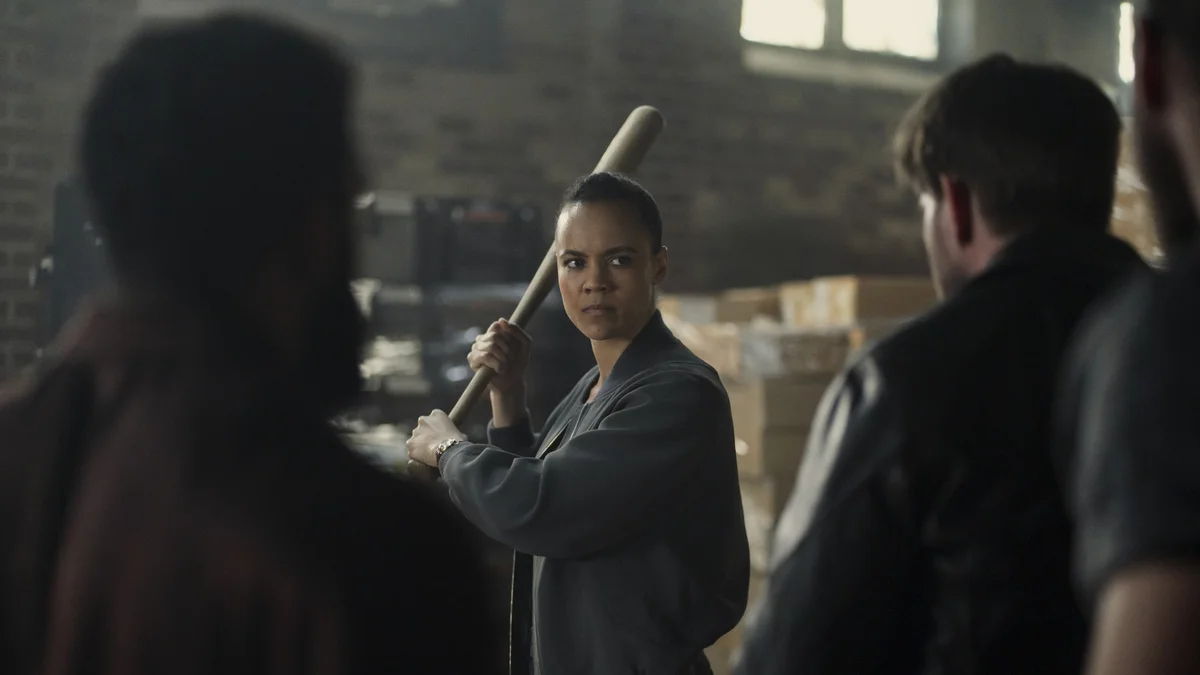
Maria Sten does not need to imitate Reacher
The first season answers its most important question almost immediately. Maria Sten can lead this show. Frances Neagley was effective in Reacher because she never felt designed as a smaller duplicate of Jack. She was quicker, more methodical, less theatrical and usually several steps ahead of whatever conversation everyone else thought they were having.
Moving her to the center turns those differences into an actual dramatic method. Neagley checks information, watches people, works digital trails and prepares before violence becomes necessary. She can still demolish a room when the franchise requires it, but the series is at its most distinctive when the investigation itself feels like action.
Sten also avoids making competence synonymous with emotional emptiness. Frances is controlled because control costs her something. Her aversion to touch, established long before this spin-off, becomes particularly important once the case forces her back into relationships and memories she has spent years keeping at a safe distance.
Tommy's death makes the case personal before it becomes enormous
The cleanest material is in the beginning. Neagley's childhood friend Tommy dies on Chicago's elevated train tracks. The authorities have an explanation that closes the file quickly. Frances has a message from him, a few details that refuse to fit and absolutely no ability to leave an unanswered question alone.
That gives this story a type of stake the parent show does not always need. Reacher can walk into another town, correct an injustice and disappear. Neagley has roots. Tommy belongs to the life she left behind, and following his final movements inevitably leads back toward her family, her dying father and memories she would much rather treat as evidence belonging to somebody else.
The emotional connection works because Sten never suddenly becomes demonstrative. Grief arrives through distraction, irritation and the refusal to stop working. It feels consistent with the character rather than an instruction for the audience to feel sorry for her.
The accidental team may be the spin-off's strongest long-term idea
Detective Hudson Riley initially looks like a familiar crime-show device: the legitimate cop who has to tell an unconventional investigator that warrants and procedures exist. Greyston Holt gives him enough history and stubbornness to escape that function. He and Neagley are both products of families they have spent considerable energy trying not to become.
Renee Birdwhistle brings a lighter rhythm. Adeline Rudolph plays her ambition without making Renee blindly worship Neagley, which matters once the young investigator starts getting close enough to see the cost of Frances's methods.
Jasper Jones' Keno adds a less official route into the case and eventually something more valuable: another person Neagley is forced to worry about. None of these relationships are fully settled by the finale, and that unfinished quality is useful.
Reacher is built around a man who leaves. Neagley is quietly becoming a show about a woman who insists she is self-sufficient while accumulating people she cannot simply abandon. That is a more promising distinction than changing the gender of the person throwing punches.
The mystery is better before every conspiracy arrives at once
Echo Canyon initially gives the investigation exactly what it needs. A seemingly peaceful community connected to Tommy's final days provides secrecy, control and Damon Herriman being very comfortable as the sort of charismatic man everyone should stop trusting immediately.
Then the case expands. Pharmaceutical interests, experimental drugs, hired killers, institutional corruption and multiple layers of concealment begin competing for the same eight episodes. The plot rarely becomes boring, but efficiency and elegance are not the same thing.
This is where the critical response divides most clearly. The season is undeniably easy to binge because almost every answer produces another question. It is also increasingly easy to notice how many mechanisms are being introduced to keep that momentum alive. Several villains remain functions of the conspiracy rather than people worth remembering once the fight is over.
A simpler version of the story might have allowed Tommy's death to remain the gravitational center. By the second half, the conspiracy occasionally becomes larger than the friend whose death supposedly started everything.
The action fits Neagley's body rather than borrowing Reacher's
The fight choreography is smarter than simply asking viewers to believe Frances hits with the force of Alan Ritchson. Sten's scenes favor speed, leverage, weapons, timing and efficient bursts of movement. The action still belongs unmistakably to the Reacher universe, but it is tailored to a different performer.
That physical specificity helps. Neagley can be placed at a disadvantage without the entire sequence becoming implausible, which gives escapes and reversals a little more tension than fights built around the assumption that the hero is the largest object in the room.
There is still plenty of franchise comfort here. Bad people discover that Frances is far more dangerous than expected, and justice frequently becomes physical after conventional systems prove inadequate. Anyone looking for the basic pleasure of Reacher will not go unfed.
A character does not need every mystery solved
The season's most debatable decision is to investigate Neagley herself with almost the same determination she applies to Tommy's case. Her haphephobia receives a personal history, while her relationship with her father forces old events into the present.
There are strong scenes inside that choice. Sten is especially good when Frances cannot solve an emotional situation through competence. The conflict with her father gives the character a vulnerability that does not require suddenly making her soft or sentimental.
The danger is over-definition. Part of Neagley's appeal in Reacher came from the fact that an unusual, highly specific boundary simply existed. Not every distinctive trait needs to become the final clue in a childhood mystery. Some critics responded strongly to the added psychological material; others found the trauma narrative conventional or padded. Both reactions are understandable because the performances often work better than the explanatory architecture around them.
Reacher barely appears, yet his show is everywhere
Alan Ritchson's guest appearance is brief enough to function as a handoff rather than a takeover. The larger problem is structural. Neagley still uses the machinery of Reacher with only modest alterations.
A suspicious death is dismissed too quickly. The hero keeps digging. Local allies assemble. Powerful people assume they cannot be touched. Information leads upward through a conspiracy until investigative procedure eventually gives way to more direct forms of justice.
It is a formula that works remarkably well, which makes escaping it difficult. The Guardian embraces the familiar pulp pleasure. TechRadar argues that the resemblance becomes excessive. TheWrap finds the psychological focus more distinctive. All three descriptions exist inside the finished season.
Whenever the show concentrates on Frances solving something Jack would simply break through, it becomes much more convincing as its own series. Chicago, a permanent office, a recurring team and actual family ties give Neagley a foundation the nomadic parent show cannot use in the same way.
A solid first case with a better second season hiding inside it
Across eight episodes, Neagley proves more than the commercial logic of extending a successful franchise. Sten has enough presence to sustain a lead role, and the new ensemble gives her character relationships worth revisiting. The action works, the central investigation has momentum and the darker emotional material occasionally reaches places Reacher has little interest in visiting.
The season also feels like several possible shows competing for priority: procedural detective drama, violent action thriller, trauma study, ensemble crime story and Reacher universe expansion. It can handle each one. It has not yet decided which should lead.
A second season would not need a larger conspiracy or a heavier Reacher connection. Neagley already has the ingredients the spin-off was created to find: its own hero, its own city and its own team. Trusting them would be the more interesting escalation.