

The bunker works because it feels inhabited before it feels mysterious
Silo's first season earned strong reviews partly because the world was never treated as a puzzle box floating in empty space. The Guardian praised the meticulous construction in 2023, while Rotten Tomatoes' first-season consensus highlighted the writing, production design and Rebecca Ferguson. Mechanical, Judicial, the farms, the central staircase and the social distance between levels establish a functioning society before the mythology starts explaining itself.
The class structure is physical. Authority sits higher. The people keeping the generator alive work far below it. History has been erased, old objects are contraband and intimate decisions can become administrative matters.
Most importantly, the residents have understandable reasons to obey. Silo would be far less interesting if everyone except Juliette were simply waiting to discover that the government was lying.
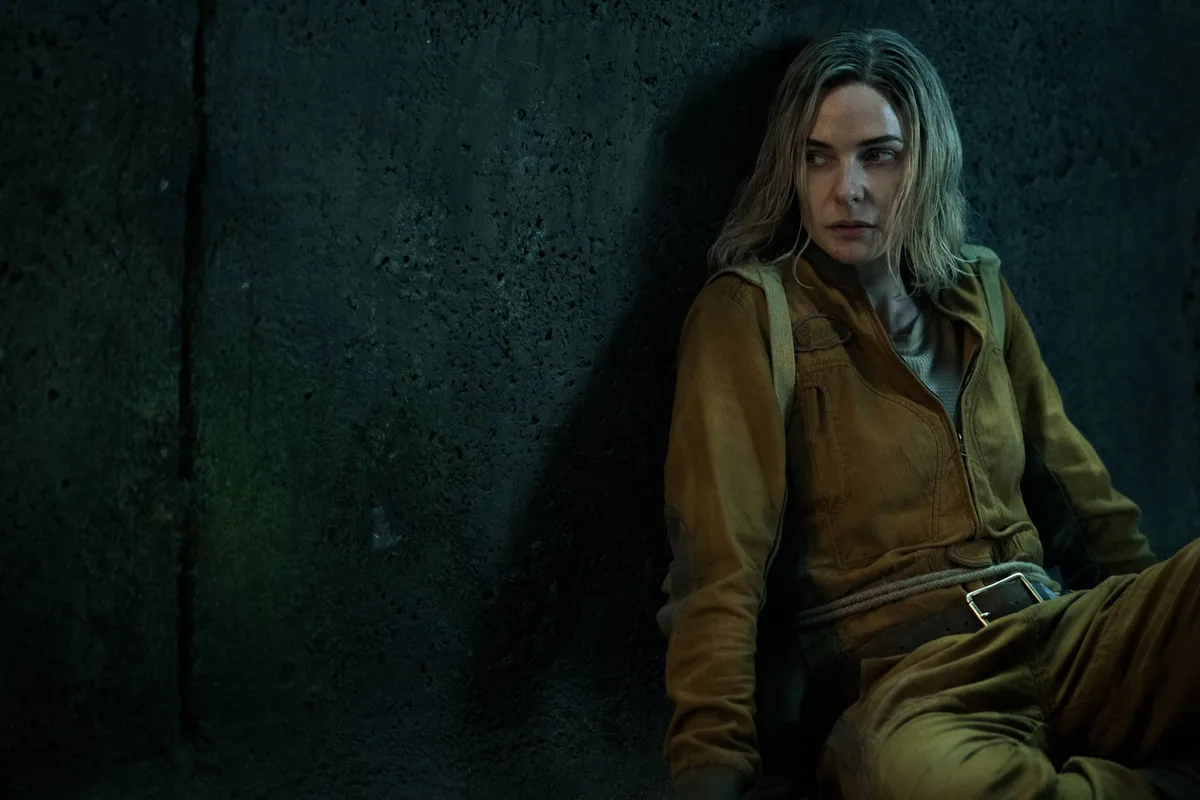
Rebecca Ferguson keeps abstraction out of Juliette
Juliette Nichols is surrounded by increasingly enormous ideas, but Ferguson rarely plays her as a vessel for them. She remains an engineer first. Problems are things to inspect, dismantle and understand. Even her stubbornness feels mechanical rather than heroic.
That quality gives Season 1 much of its propulsion. A relatively contained investigation keeps expanding, yet Juliette always has a practical reason to take the next step. Someone lied. Evidence does not fit. A machine, a document or a person behaves in a way it should not.
Season 2 tests that strength by moving her away from much of the ensemble and pairing her with Steve Zahn's Solo. RogerEbert.com considered the second season less propulsive but praised the character work, particularly the Ferguson-Zahn material. The slower rhythm gains something in return: loneliness becomes more than atmosphere.
Meanwhile, the supporting cast turns Silo 18 into the other lead
Paul Billings, Bernard, Lukas, Walker, Knox, Shirley and the Sims family become increasingly capable of carrying entire stretches without Juliette. That was one of the major improvements critics identified in Season 2. The Guardian argued that the broader second run gave its supporting cast much more room.
Tim Robbins benefits especially from the extra space. Bernard is effective because his authoritarianism is tied to a genuine belief that cruelty may be preventing catastrophe. Other characters eventually confront versions of the same problem.
That is where the adaptation becomes more than an elaborate sequence of locked doors. Who controls history matters because the answer changes what ordinary people believe they are allowed to do.
Season 3 deliberately makes the show harder to move
The third season divides its attention between the familiar future and a much earlier timeline involving Daniel Keene and Helen Drew, played by Ashley Zukerman and Jessica Henwick. It is a major structural change and the critical response makes the trade-off unusually clear.
Rotten Tomatoes records a 96% critics score for Season 3, while Metacritic places it at 77. Empire, IGN, Radio Times and others responded strongly to its ambition, mythology and eventual convergence. RogerEbert.com was notably cooler, arguing that the season often feels like connective tissue for the final chapter.
Both impressions can be true. Early episodes occasionally trap Juliette in narrative holding patterns while the earlier timeline gets the novelty, political intrigue and momentum. Slashfilm found Daniel and Helen's material more compelling even while describing Ferguson as the show's strongest performer.
Then the two halves begin to talk to each other. What initially looks like an expensive digression becomes an explanation for structures the show has been staring at since 2023.
Answers have finally become part of the pleasure
Mystery dramas often become less interesting at the exact moment they explain themselves. The imagined answer was larger than the mechanism.
Silo has mostly avoided that collapse. Season 3 reveals enough about the origins and architecture of its world to substantially change the audience's understanding without making the characters' choices irrelevant.
The later episodes are particularly effective because information carries consequences. The season's strongest material is not simply a list of lore confirmations; it reframes the moral compromises made across earlier seasons.
That helps explain why several reviews that acknowledge the season's slower stretches become much more enthusiastic about its back half.
Its biggest flaw is still measured in minutes
Silo knows how to withhold information. Occasionally it mistakes withholding for momentum.
Season 2 loses pace as its separated storylines wait for one another. Season 3 repeats the risk across two eras. Conversations can revisit already established tensions, and some character arcs visibly stall while another part of the plot catches up.
Audience reaction to the third season has been substantially more divided than the professional critical response. That does not invalidate the reviews, but it fits a weakness even positive critics repeatedly identify: patience is part of the viewing contract.
There are moments when Silo could simply move.
A fixed ending may be exactly what the series needed
Apple renewed Silo for Seasons 3 and 4 together, allowing Graham Yost to work toward a planned conclusion. The fourth season will be the last and is scheduled to begin on July 9, 2027.
That matters for a series built around deferred answers. Season 3 increasingly feels like the moment the architecture changes from expansion to convergence.
Thirty episodes in, Silo can still make a sealed door, an erased file or a quiet conversation in a concrete room feel consequential. It has become slower as its world has grown. It has not become empty.