
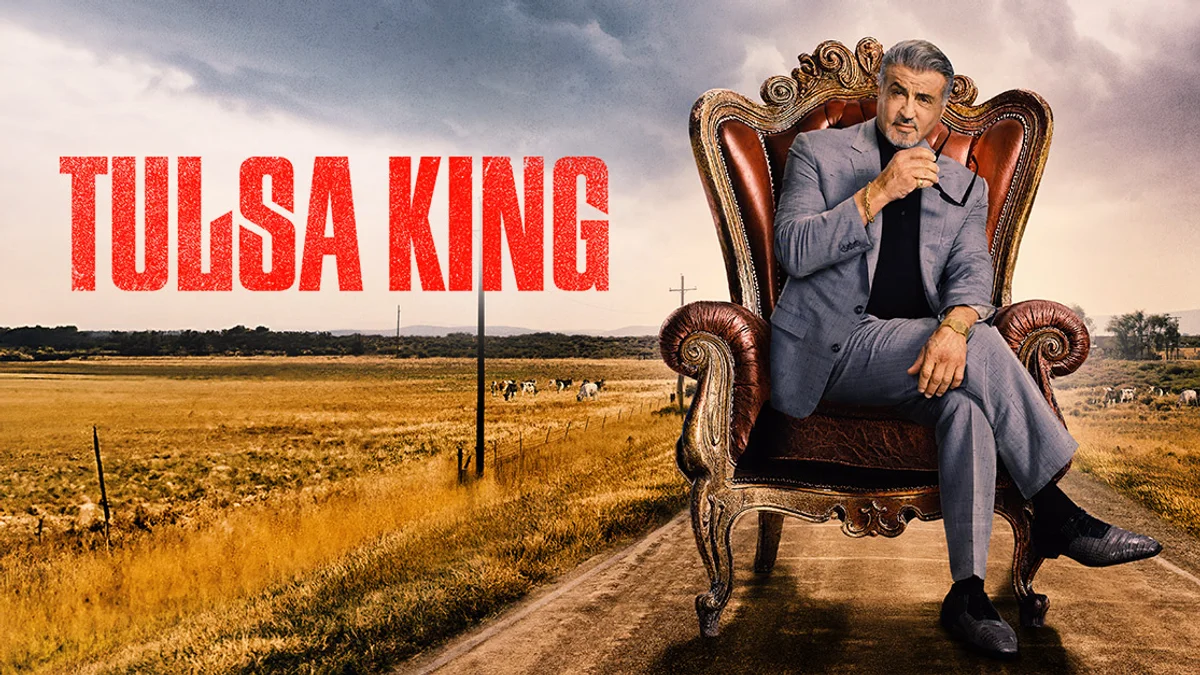
The premise works because Stallone never pretends Dwight belongs in this century
Tulsa King begins with an almost suspiciously perfect piece of casting. Dwight Manfredi has sacrificed twenty-five years to a New York crime family and expects loyalty to be rewarded when he leaves prison. Instead, he is shipped to Oklahoma and told to build something from nothing. The humiliation matters, but the comedy matters just as much.
The first season understands that Stallone does not need to chase jokes. Dwight can simply encounter legal cannabis, apps, younger people and an unfamiliar social vocabulary with the expression of a man personally offended by technological progress. RogerEbert.com and The Guardian both identified that fish-out-of-time quality as a major part of the show's original charm.
Crucially, the joke never completely removes the threat. Stallone can look baffled in one scene and physically intimidating in the next. That combination gives Dwight a range the plot itself does not always earn.
A mob family built out of people who were never looking for one
What keeps the series alive beyond its premise is the crew. Tyson begins as a driver attracted to Dwight's confidence and money, then gradually becomes the clearest test of what following this man actually means. Jay Will gives that progression enough uncertainty that Tyson never feels like a finished gangster waiting for his promotion.
Martin Starr's Bodhi operates from another angle. His persistent disbelief at the world Dwight has dragged him into gives Tulsa King one of its most reliable comic rhythms. Mitch, Goodie, Margaret, Joanne and the expanding circle around them eventually create something much warmer than a convincing criminal organization.
That found-family element is where the show often becomes unexpectedly effective. Conversations inside the crew can carry more weight than whichever turf war currently occupies the season. Dwight may call himself the General, but the series works because the soldiers are gradually allowed to become people rather than accessories.
The plot keeps changing its mind
Season 2 exposes the structural weakness more clearly. Tulsa, New York, legal problems, new rivals and expanding businesses all compete for space. Collider and Decider both noted versions of the same problem: the show can take time to settle into a direction, and its increasingly absurd criminal schemes often become more important than the original fish-out-of-water premise.
Tulsa King frequently introduces a storyline with the confidence of a major season arc and then discovers another shiny threat a few episodes later. Conflicts are shortened, supporting characters drift to the side and potentially significant consequences can become surprisingly easy to resolve.
There is an odd freedom in that looseness. Once the show stops pretending every business plan needs to withstand forensic examination, Dwight's empire becomes a machine for producing entertaining situations. Trouble starts when the writing asks the audience to treat those same shortcuts as intricate mob strategy.
Season 3 gets busier and, somehow, more entertaining
The bourbon business gives the third season a useful central object. Robert Patrick's Jeremiah Dunmire is exactly the sort of antagonist this series handles well: instantly legible, forceful enough to challenge Dwight and played by an actor who can turn a conversation into a confrontation before anyone raises a weapon.
The season also has Frank Grillo, Kevin Pollak, Dana Delany and an already crowded crew moving through overlapping conflicts. Early critical response was broadly positive. Collider and ScreenRant saw a stronger, more character-driven season, while RogerEbert.com remained alert to the unstable tone and expanding number of subplots even while finding the series fundamentally enjoyable.
That contradiction describes Tulsa King unusually well. The cast becomes more fun as it becomes less manageable. Every new veteran actor adds another entertaining presence and another reason an existing supporting character might disappear for an episode.
Samuel L. Jackson's late-season arrival pushes that tendency into explicit franchise building. He is entertaining enough that the machinery works, but the machinery is visible.
The show keeps cleaning Dwight's hands
There is also a limit to how carefully the series protects its lead. Dwight is a racketeer, an extortionist and a violent criminal, yet the writing repeatedly places someone more vicious across the table so he can remain the hero of his own criminal enterprise.
That choice makes him easy company, but sometimes flattens the more interesting version of the character. Tyson's growing immersion in Dwight's world hints at a sharper question: what happens when the charming old man's code becomes somebody else's future?
Tulsa King rarely stays uncomfortable for long. Dwight restores order, delivers a line and moves forward. The show knows viewers came to watch him win, even when the route to victory would collapse under five minutes of scrutiny.
Prestige crime drama is the wrong measuring stick
The series is not especially convincing as a study of organized crime. Its plotting is too elastic and its moral universe too accommodating. What it has become instead is a contemporary gangster Western, a workplace comedy with firearms and a star vehicle built around an aging action icon who has discovered that television can use his limitations as character.
Stallone is the reason the formula survives, but the crew is the reason it became a series rather than an extended joke. The most enjoyable stretches are not necessarily the biggest confrontations. They are the moments when Dwight's collection of outsiders behaves like a family that accidentally happens to own several suspicious businesses.
Three seasons are currently available on Paramount+. Season 4 is scheduled to premiere on October 16, 2026, with Terence Winter returning as head writer and executive producer. Tulsa King has already proved it can keep expanding Dwight's empire. The more important question is whether it can keep that expansion from swallowing the people who made the empire fun to visit.