
Tom Loftis wants to manage a curse like a municipal problem
The opening joke contains most of Widow's Bay in miniature. Tom Loftis, mayor of an isolated New England island, is convinced that his community's central problem is economic. Cell reception is poor, Wi-Fi is nearly nonexistent, young people are bored and tourists have little reason to visit. Tom therefore decides to turn Widow's Bay into a destination. The locals respond, essentially, by telling him the island is cursed.
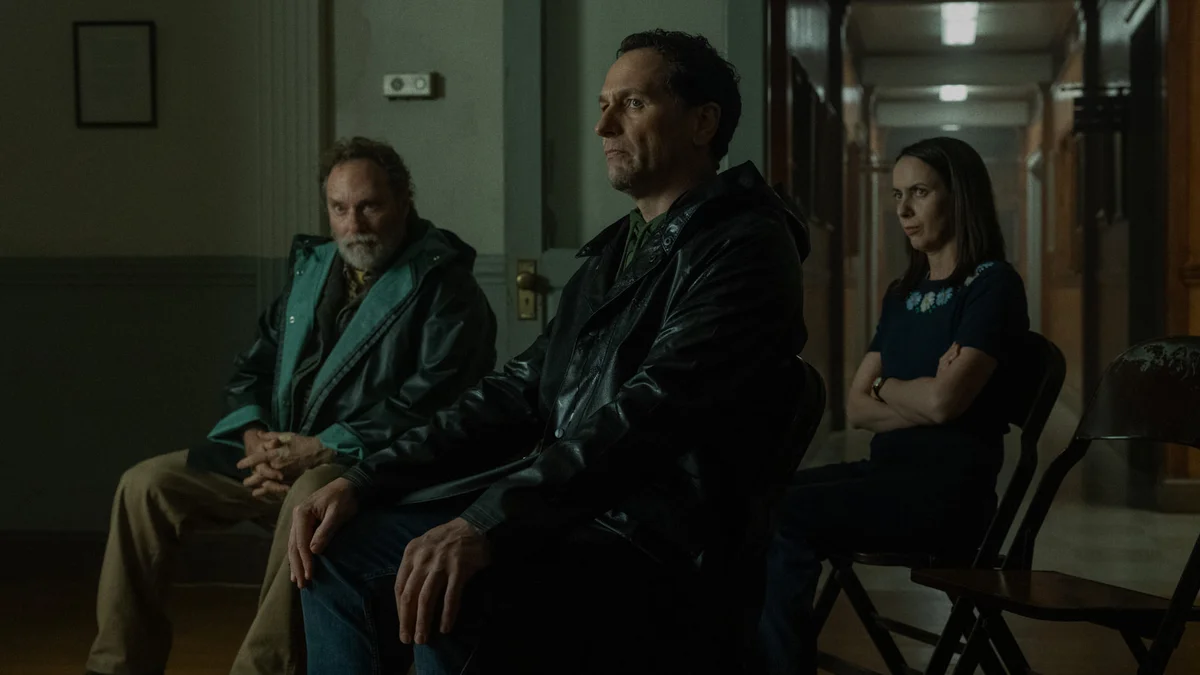
Matthew Rhys is wonderful as a man who receives that information and treats it largely as a public-relations obstacle. Tom is neither the rational hero destined to expose foolish superstition nor the fearless sceptic of a conventional horror story. He is cowardly, vain and sincere enough in his desire to save the town that his terrible choices remain understandable even when they are difficult to defend.
The series becomes more interesting once it stops asking whether the legends are real. They are. Ominous fog, haunted spaces, slasher imagery and several pieces of folklore Tom would rather classify as quaint local anecdotes begin taking physical form. The real question becomes how long one man can keep treating the impossible as though it belongs on the next town council agenda.
Comedy and horror use the same timing
Katie Dippold understands that laughter and fear often depend on an identical mechanism: wait slightly too long, let the audience anticipate what is coming, then break the tension. Widow's Bay exploits that relationship with unusual precision. A scene can begin as municipal dialogue, become socially uncomfortable and then genuinely frightening without announcing the tonal shift.
Hiro Murai, who directs five episodes, establishes that grammar early. Frames leave enough empty space for the background to become suspicious. Silence might prepare an absurd line or an apparition. Crucially, the actors are never asked to perform “the comedy” and then switch into “the horror” as though they were separate shows.
Rhys is particularly effective because his face can travel from smug confidence to panic without ceasing to be funny. The larger achievement is that the rule applies across the ensemble. Supernatural events do not replace personality; they reveal how far each character can push familiar habits before those habits stop working.
Patricia and Wyck keep the island from becoming a one-man show
Kate O'Flynn is essential to the season's balance. Patricia could easily have been the eccentric assistant designed to supply strange reactions and awkward lines. Instead, the series gradually builds a history of loneliness, humiliation and an almost painful desire to belong to a community that made up its mind about her years ago.
That development changes the function of the horror stories around her. The past is not merely a storage room full of monsters waiting for an episode. It continues determining where people sit inside the town's social structure. Widow's Bay's folklore works best when it becomes a literal way of making old wounds impossible to ignore.
Stephen Root performs a similar rescue operation with Wyck. The old fisherman warning everyone about impending disaster begins as a familiar horror archetype, but his relationship with Tom and his knowledge of the island make him considerably more than the obligatory prophet nobody believes.
Dale Dickey, Kevin Carroll, Jeff Hiller, K Callan and Kingston Rumi Southwick help create the same sense of accumulated community. The town feels as though it existed before the pilot arrived. For a series about a cursed population, that matters: potential destruction means more when the people threatened are not simply future bodies in a horror sequence.
One episode can become a slasher and the next a gothic tale
Widow's Bay openly wears its influences. John Carpenter, Stephen King, Jaws, The Shining and a broad library of urban legends sit just below the surface. At times the season becomes almost anthological, allowing each supernatural manifestation to explore a different horror subgenre while the larger curse continues moving forward.
That structure produces some of the strongest episodes, especially when the show slows down and lets one disturbing idea gradually contaminate an ordinary situation. The historical chapter about the island's origins also changes visual and narrative register instead of reducing the past to exposition.
The drawback is that mythology can occasionally feel as though it is chasing the references. Not every manifestation connects with equal elegance, and some imagery seems to exist partly because Dippold and her directors clearly enjoy playing with it. TIME was notably more sceptical of this accumulation than much of the otherwise enthusiastic review corpus.
The truth lies somewhere between those reactions. Widow's Bay does not need every clown, patch of fog or revenant to fit immediately into one pristine cosmology. As the finale approaches, however, the desire to understand the broader logic naturally grows, making intentional vagueness more noticeable.
The second half trades some comic looseness for plot
The early episodes move almost effortlessly between municipal dysfunction, family life and supernatural threat. Once the curse becomes impossible to dismiss, the story has to accelerate. The balance consequently tilts toward horror, explanation and larger stakes.
Both TV Guide and TheWrap identify some loss of momentum or tonal balance in the later stretch. The episodes remain strong, but part of the opening run's peculiar pleasure comes from the amount of time devoted to small civic failures. Once genuine catastrophe is underway, Tom can no longer plausibly devote the same energy to tourism campaigns and embarrassing meetings.
There is also occasional structural repetition: another manifestation, another confirmation that local superstition was justified, another attempt by Tom to regain control. Character development prevents the pattern from becoming truly mechanical, but the seams become easier to see.
The finale understands that a curse eventually has to become a moral choice
The smartest decision in the finale is refusing to make the answer to the mystery into a simple final monster encounter. Tom is instead pushed toward a morally intolerable decision, forcing his most persistent flaw — the ability to rationalise whatever is convenient — to become far more consequential.
K Callan receives an unexpectedly rich dramatic showcase, while Rhys demonstrates why Tom works so well as a protagonist. The story does not need to make him suddenly admirable for his predicament to become painful. The finale supplies meaningful answers, preserves uncertainty and lets human consequences matter more than fully solving the mythology.
The season therefore holds onto its central contradiction. Widow's Bay knows horror conventions well enough to mock them but respects its characters too much to turn their fear into nothing more than punchlines. It understands the grammar of a small-town ensemble comedy too, then keeps open the very real possibility that a routine community problem might end with something ancient and hostile standing outside the door.