
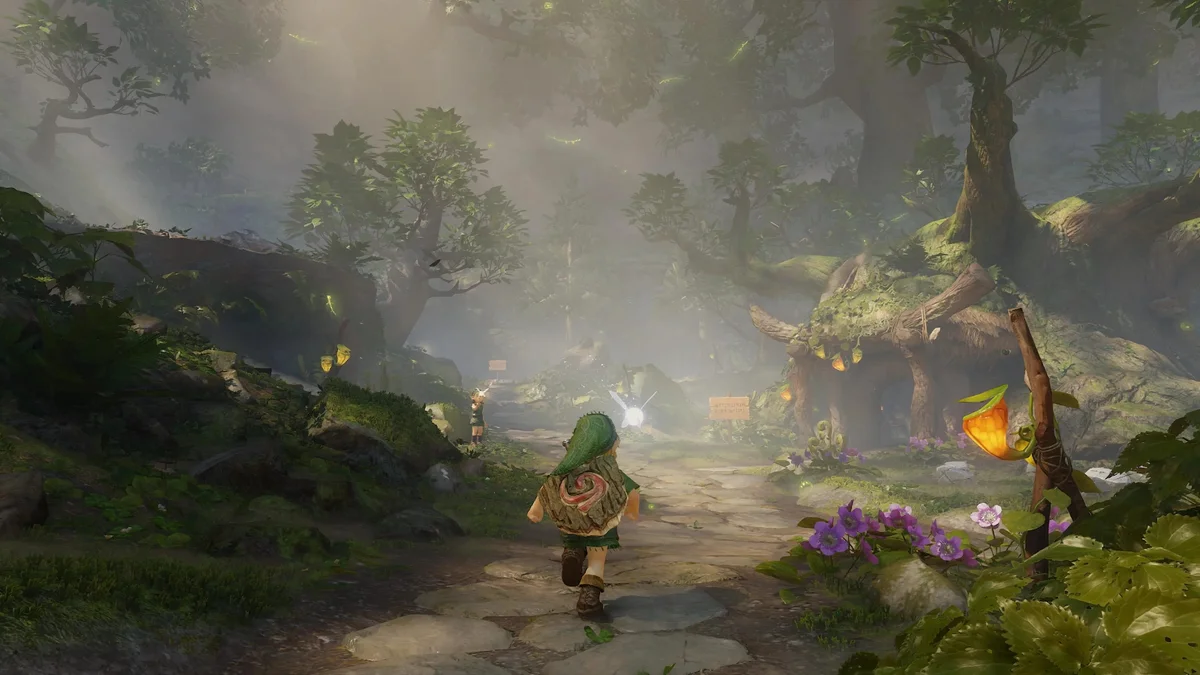
Ocarina of Time has always been a story about growing up, but its approach remains unusually poignant. Link leaves childhood behind, travels through time and returns to a kingdom transformed by forces beyond his control. Places that once represented safety acquire a different significance, while familiar characters reveal the consequences of the years he has missed.
Nintendo's remake strengthens this contrast through environmental detail and more expressive cinematic presentation. Hyrule feels more tangible, and the visual differences between its two eras communicate the emotional cost of Link's journey without requiring the story to become substantially more complicated.
The strength of a simple narrative
The adventure retains its familiar structure. Link encounters new peoples, acquires important objects and gradually becomes capable of confronting Ganondorf. Its larger story is straightforward, but the supporting characters prevent it from becoming a purely mechanical sequence of heroic objectives.
Saria, Zelda and the inhabitants of Hyrule give the kingdom a personal identity. Returning to earlier locations provides the narrative with much of its emotional weight. Changes to these places matter because the player remembers what they once represented.
Expanded dialogue and fully voiced cinematics make these moments more explicit. The performances add personality, though they inevitably compete with the voices and interpretations longtime players have imagined for themselves.
Music that belongs to the world
The orchestral soundtrack is one of the remake's most successful creative decisions. Ocarina of Time's music has always occupied a special position because its melodies are interactive elements of the adventure, not merely accompaniment.
Songs can change the world, open paths and connect characters across time. The new arrangements preserve that relationship while giving familiar compositions greater range and instrumental depth.
Optional microphone controls add a playful new interaction. They are unlikely to replace button inputs for everyone, but they underline the importance of music to the game's identity.
A beautiful world with some uneven artistic choices
Nintendo's interpretation of Hyrule combines richly detailed environments with more stylized character designs. Forests, temples and villages benefit from carefully constructed surfaces and sophisticated lighting. Characters can occasionally feel as though they belong to a slightly different visual world.
This tension is particularly evident in cinematic scenes, where expressive animation and voice performances sometimes feel more pronounced than the restrained original presentation.
The updated Forest Temple is especially effective. Improved lighting and environmental detail strengthen its unsettling atmosphere, allowing the location's identity to emerge more clearly than before.
The remake succeeds when these visual changes support the emotions already present in the original. It is less convincing when additional presentation attempts to explain feelings that were previously left implicit.
A legend beyond nostalgia
What gives Ocarina of Time its lasting power is not simply its historical significance. Its central narrative remains coherent and affecting, built around the relationship between childhood, responsibility and irreversible change.
The new version makes that story accessible without demanding familiarity with the visual conventions of 1998. Some artistic decisions are open to debate, and the expanded cinematics occasionally interrupt the adventure's rhythm.
Yet the emotional journey remains remarkably intact. Hyrule feels both familiar and transformed, which is precisely what makes this remake such a fitting interpretation of a story about time.