
Seventy years of injuries make a surprisingly convincing case file
The premise feels almost offensively obvious once somebody finally uses it. Wile E. Coyote has spent decades ordering rockets, magnets, explosives, springs and increasingly unreasonable machinery from ACME, only for most of those products to end up injuring him. At some point, surely, a refund becomes appropriate.
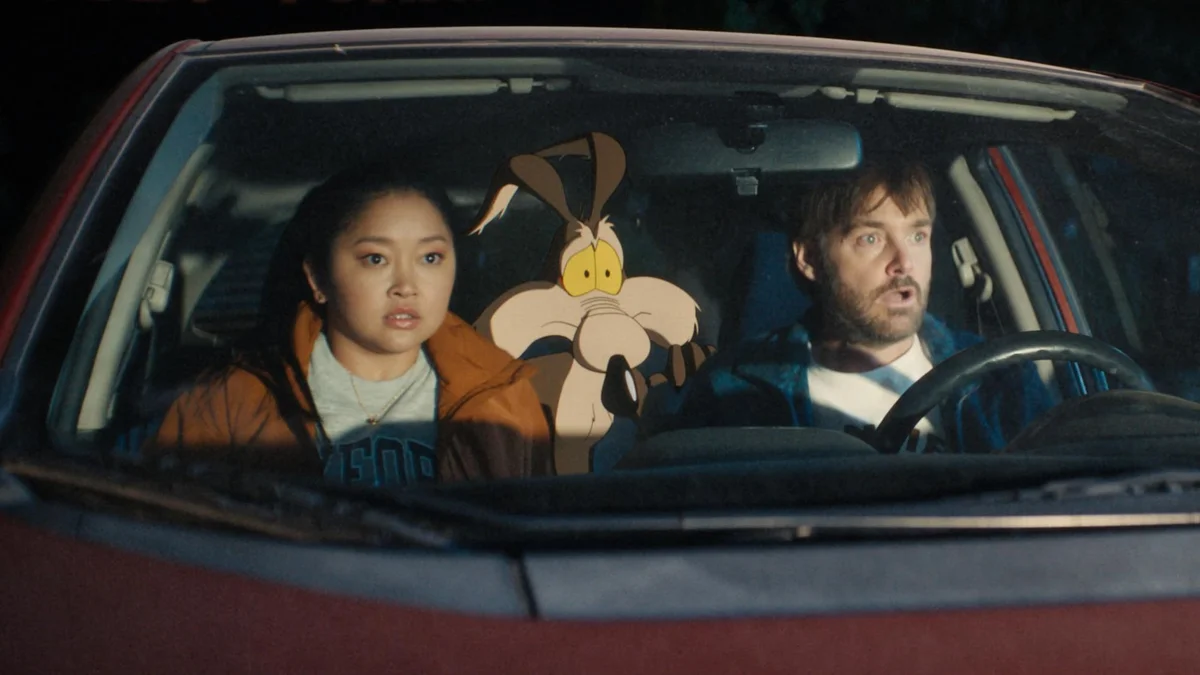
Samy Burch turns that joke, itself inspired by Ian Frazier's 1990 New Yorker piece, into a legal engine. Wile E. hires accident attorney Kevin Avery, played by Will Forte, and arrives with a lifetime of practically charred evidence. He does not speak. The signs remain more than sufficient.
The important choice is that changing perspective does not suddenly make the Coyote reasonable. He is not rewritten as a helpless consumer who did nothing wrong. This is still a predator willing to strap a rocket to his back if there is even a theoretical chance that it will move him several feet closer to the Road Runner.
ACME may be exploiting him. He is also ACME's perfect customer.
Will Forte plays desperation while John Cena plays the suit
Kevin Avery has the career of a man who has been settling small claims for so long that the possibility of actually trying a case sounds irresponsible. Forte gives him exactly the right mixture of fatigue and low-grade panic. He looks like someone already calculating the repair bill while the next disaster is still approaching.
John Cena moves in the opposite direction as Buddy Crane, ACME's immaculate attorney and Kevin's former rival. Everything about him is polished: tailoring, posture, smile, confidence. Cena wisely refuses to compete with Daffy Duck for manic energy. He lets the ridiculousness happen around an absurdly stable center.
Several critics found the live-action characters thin compared with their animated partners, and the complaint is fair. Lana Condor brings welcome momentum as Kevin's niece and assistant Paige, but her dramatic path is limited, while Kevin's rediscovery of professional courage follows a familiar route.
The performances still give the Tunes something important: a surface solid enough to bounce off.
The Looney Tunes are cast into the story rather than assembled for a brand photo
Dave Green's smartest creative decision is refusing to treat every character as part of one giant Looney Tunes friend group. They appear because the story gives them jobs that fit who they already are.
Foghorn Leghorn makes an almost suspiciously natural corporate executive. Bugs Bunny can operate as the person who always knows more than everybody else. Daffy destabilizes whatever room contains him. John Cena interrogating Tweety does not require explanatory dialogue before the image becomes funny.
That approach prevents many of the cameos from becoming simple recognition tests. There are references everywhere, but the film generally lets the characters function before asking the audience to applaud their existence.
Eric Bauza voices an impressive portion of the animated cast while making the feat nearly invisible. The world simply accepts that a rooster can run a corporation and a canary can become part of a legal investigation. The movie never needs to stop and congratulate itself for the concept.
When the machinery starts exploding, Chuck Jones feels close
The best sequences are not built around dialogue or franchise references. They return to the oldest Coyote principle: one simple mechanical objective, a grotesquely overcomplicated solution and a consequence that strikes exactly the wrong target.
The early Road Runner pursuit is especially strong. Rocket shoes, magnets and impossible trajectories create that familiar geometry where the audience understands the coming catastrophe perhaps half a second before Wile E. does.
Green has a harder time sustaining that rhythm inside feature-film structure. Chuck Jones could end a short without resolving anything because repetition was the point. Coyote vs. Acme has to investigate a corporation, develop a lawyer, uncover evidence and eventually reach some form of narrative resolution.
That tension between repetition and progression can never disappear completely. The film negotiates it often enough to stay funny, but not often enough to become as ferocious as the cartoons it reveres.
The lawsuit was enough; the conspiracy is less useful
The first half has an elegantly ridiculous legal question. Did ACME knowingly sell dangerous products, and how much responsibility does a coyote retain when he purchased those products with the explicit purpose of murdering a bird?
Then ACME becomes more than an irresponsible manufacturer. Hidden information accumulates, motives become increasingly sinister and the story expands into corporate conspiracy. RogerEbert.com, Screen Daily and Variety reached very different overall verdicts on the film, yet each identifies some version of the same structural issue: the plot eventually takes up too much oxygen.
The satire did not need much help. A company repeatedly selling defective rockets to the same catastrophically loyal customer already says plenty about consumerism, liability and corporate power.
The more the screenplay proves that ACME is evil, the less elegantly funny ACME becomes.
The visual hybrid remains the film's most unstable ingredient
Any live-action and animation combination invites a comparison that almost no filmmaker wants: Who Framed Roger Rabbit. Coyote vs. Acme cannot match its tactile integration or the uncanny certainty that animated characters actually occupy the set.
The Tunes here move between different visual treatments. Some shots preserve their silhouettes and expressions beautifully. Others give them a slightly inflated digital volume, an odd response to live-action lighting or a texture that makes the compositing suddenly obvious.
The A.V. Club was among the critics to highlight the uneven character models while praising the effects once the film turns toward violent physical comedy. That distinction matters. A digital Coyote can look awkward while standing beside a human and completely correct one second later when passing through a wall.
Looney Tunes characters have always survived destruction more gracefully than stillness.
The real rescue story gives the film a metaphor nobody planned
It is impossible to watch a case against ACME without knowing what happened to the movie itself. Completed and then shelved by Warner Bros. Discovery, Coyote vs. Acme spent years as a finished film its owner did not intend to release. Ketchup Entertainment eventually acquired the rights and brought it to theaters in August 2026.
The parallel is almost suspiciously perfect: an indestructible character takes on a giant corporation that treats damage as an accounting concern. The screenplay could not have predicted how closely the film's own history would begin resembling its premise.
That history should not become a critical exemption. A rescued film is not automatically a great film, and the more skeptical responses from Variety and Screen Daily are useful reminders that surviving corporate limbo does not transform pacing problems into virtues.
It does, however, deepen the story's obsession with failure. Wile E. matters because the universe gives him every possible reason to stop and he returns the next morning with another diagram. His movie eventually did the same thing.
One hundred and three minutes is a long time for a character perfected in seven
This is the simplest structural problem. Wile E. Coyote and the Road Runner were built for concentration. No psychology is required, barely any dialogue exists, and no subplot has to be serviced. There is an idea, a trap and gravity waiting somewhere nearby.
A feature cannot simply string fifteen shorts together, so Coyote vs. Acme builds Kevin, Paige, Buddy, a courtroom, an investigation and a corporate mystery. Several additions are genuinely funny. Taken together, they inevitably create stretches where the movie explains something when an object falling from the sky might have been preferable.
Brian Tallerico notes the length even within his highly positive RogerEbert.com review. The Guardian, Variety and Screen Daily make the loss of momentum more central to their mixed or negative responses. The disagreement is largely about how much courtroom machinery a viewer wants between explosions.
Whenever the movie returns to Wile E. confronting a problem he can solve in the worst possible way, the rhythm immediately improves.
The greatest loser in animation finally receives something resembling a win
Giving genuine emotion to Wile E. Coyote is riskier than it sounds. The easiest version would turn him into a harmless victim and quietly forget that his lifelong project involves eating the Road Runner.
The film fortunately preserves his absurdity. Wile E. can be exploited by ACME and remain completely committed to capturing the bird. Those ideas do not have to cancel each other out. His persistence becomes affecting because it is still fundamentally unreasonable.
That also gives Kevin Avery's predictable arc a useful mirror. Lawyer and client are two different failures: one has almost stopped trying, while the other appears biologically incapable of stopping.
Coyote vs. Acme does not recover all of the brutality, precision or elegance of the best Chuck Jones shorts. It does contain enough real invention to avoid feeling like an ACME product assembled simply because someone owned the trademark. Considering how close the movie came to never being judged at all, that is a satisfying result.