
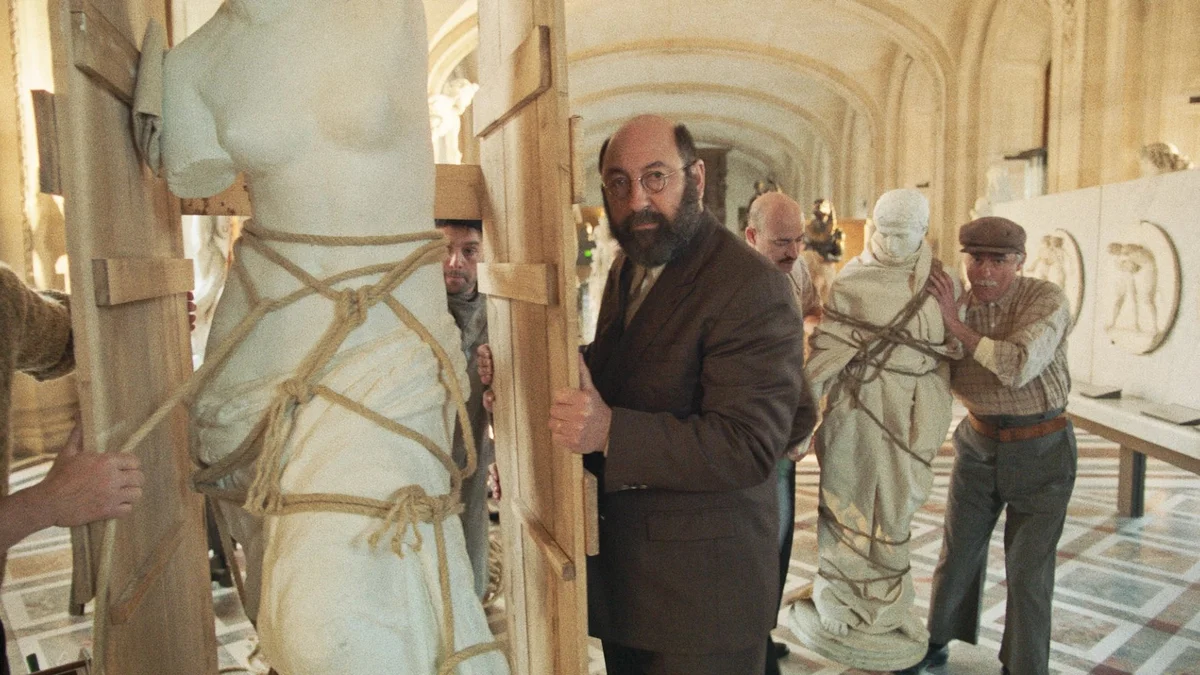
Some films seem to have a reason to exist before they have found the ideal way to stage it. Les Héros du Louvre clearly belongs to that category.
Élie Chouraqui is not merely adapting an unusual episode in the history of the Louvre. He is returning to the story of his grandfather, Babi Maklouf Benhamou, a night guard at the museum and a Jewish man living in France who became involved in moving artworks to safety as war approached.
The Louvre itself documents the evacuation of thousands of works under Jacques Jaujard's direction before and during the German invasion. Chouraqui combines that historical framework with stories preserved inside his own family, openly acknowledging that some moments have been shaped for cinema.
That intimacy is both the film's strongest asset and the source of several of its weaknesses.
The Louvre is enormous, but the film chooses to watch one family
The title suggests a broad historical drama about the extraordinary operation to protect France's national collections.
The actual film is much narrower.
The Louvre provides the starting point, Jacques Jaujard sets events in motion and the artworks remain a constant thread. Yet Chouraqui is primarily interested in Babi, Lucie and their children as they are pushed onto the roads of a country entering war.
That makes sense for a project built from family memory. It also creates a certain frustration. The museum operation itself — the staff, logistics, hiding places and institutional resistance — is rich enough to support an entire film.
Chouraqui instead chooses domestic memory: how one family experiences and preserves a historical event far larger than itself.
Kad Merad gives the film its center of gravity
One point recurs across much of the critical response: the cast often keeps the film grounded when the direction becomes overly busy.
Kad Merad plays Babi without turning him into an uncomplicated monument. His familiar warmth works particularly well for a man who does not think of himself as heroic and acts more from responsibility than any desire for glory.
Marie Gillain gives Lucie an equally important presence. She is stubborn, anxious and practical, holding the family together without becoming a passive figure waiting for Babi's decisions.
These are the scenes where Les Héros du Louvre feels most convincing: when history stops functioning as exposition and becomes pressure placed on ordinary people.
The camera almost never stops moving
This is the criticism that appears most consistently across reviews.
Chouraqui keeps the lens close to faces and relies heavily on handheld movement, abrupt reframing and a visual urgency apparently designed to maintain constant danger.
The intention is understandable. The family is fleeing, war is approaching and their physical space is closing in.
Yet an inherently powerful situation does not always become stronger when the camera insists on its intensity.
Le Monde characterizes the direction as operating in a kind of overdrive, while other reviews similarly criticize the film's frantic movement and tendency to push emotions already present in the material.
Audience response is somewhat more divided. Some viewers specifically praise the nervous camera for keeping them close to the characters. The technique is therefore clearly deliberate rather than accidental.
Deliberate does not necessarily mean restrained.
The archive material sometimes provides the calm the film refuses itself
Chouraqui researched locations, dates and historical figures with documentary assistance, and the Louvre notes that several compositions directly reproduce wartime photographs of artworks being packed and moved.
That connection to archival imagery is one of the film's most compelling formal ideas.
It reminds us that beyond the dramatized family story was an enormous practical undertaking: cataloguing, crating, transporting and hiding works that have since become some of the most recognizable objects in world culture.
Whenever the film simply trusts that material, the emotion arrives with far less effort.
The screenplay wants to transmit so much that it sometimes underlines everything
A similar problem affects the writing.
Les Héros du Louvre carries a large number of serious themes: family transmission, antisemitism, displacement, cultural heritage, ordinary courage, historical memory and the responsibility to protect what survives a civilization.
All of them belong here.
The weakness appears when the film seems determined to make sure every one of them has been clearly identified. Supporting characters become functions, certain conflicts flatten into types, and dialogue occasionally explains emotions the performances have already communicated.
Several French reviews make essentially the same point: fear and heroism are emphasized when the circumstances already make them self-evident.
The film rarely trusts how extraordinary its own story already is.
An imperfect film built around a memory worth preserving
It would still be easy to judge Les Héros du Louvre too harshly and overlook what it restores to public memory.
The evacuation of the Louvre was remarkable. The participation of relatively anonymous museum workers is remarkable too. Chouraqui placing his Jewish grandfather inside that history gives the film an intimacy that never feels like a manufactured premise.
French critical response has been mixed: some reviews emphasize the emotion, subject and cast, while others focus on frantic direction, thin characterization and overly insistent writing.
That disagreement fits the film rather well.
It is entirely possible to be moved by what Les Héros du Louvre remembers while wishing it had remembered that cinema can sometimes stand still.