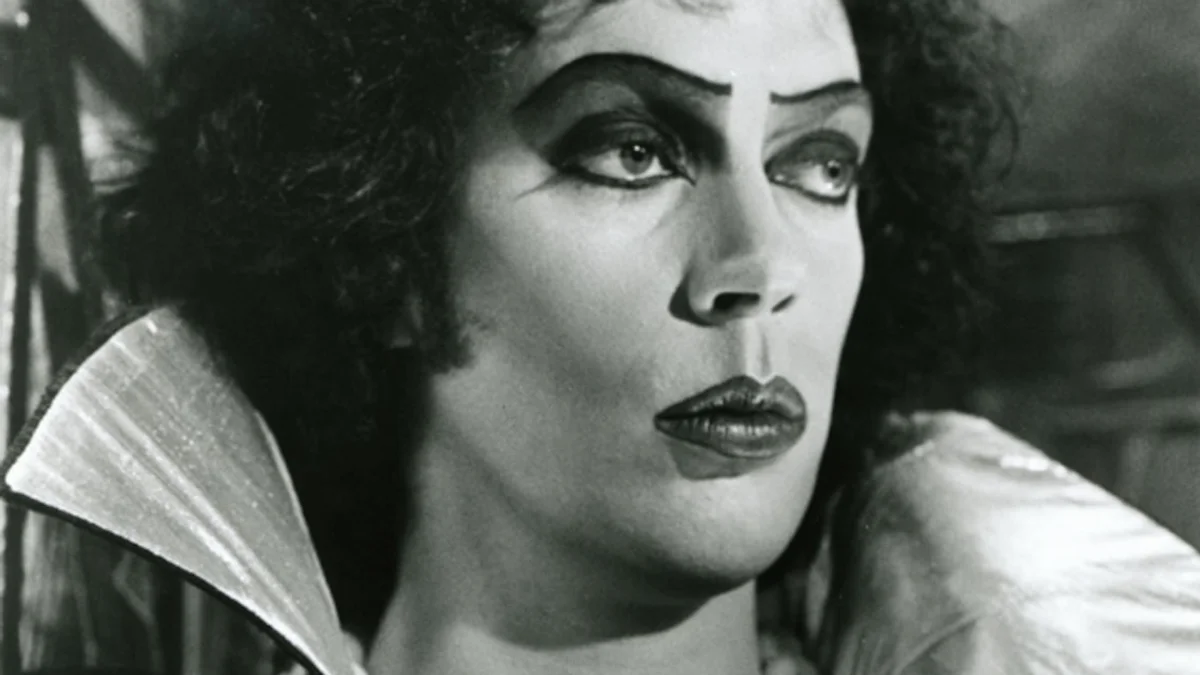
Curry first played Frank-N-Furter onstage in Richard O'Brien's The Rocky Horror Show in 1973. By the time Jim Sharman brought the musical to film in 1975, the actor already understood the character as more than a visual provocation.
The movie itself did not arrive as an instant institution. Its early theatrical performance was unimpressive. Midnight exhibition gave it another life.
Rocky Horror changed when watching stopped being enough
Fans began returning in costume, calling back to the screen, bringing props and eventually performing alongside the film. The audience developed its own script around the script.
That distinction helped Rocky Horror become foundational to midnight-movie culture. A cult film could now function as a recurring social event rather than simply an obscure title discovered by enthusiasts.
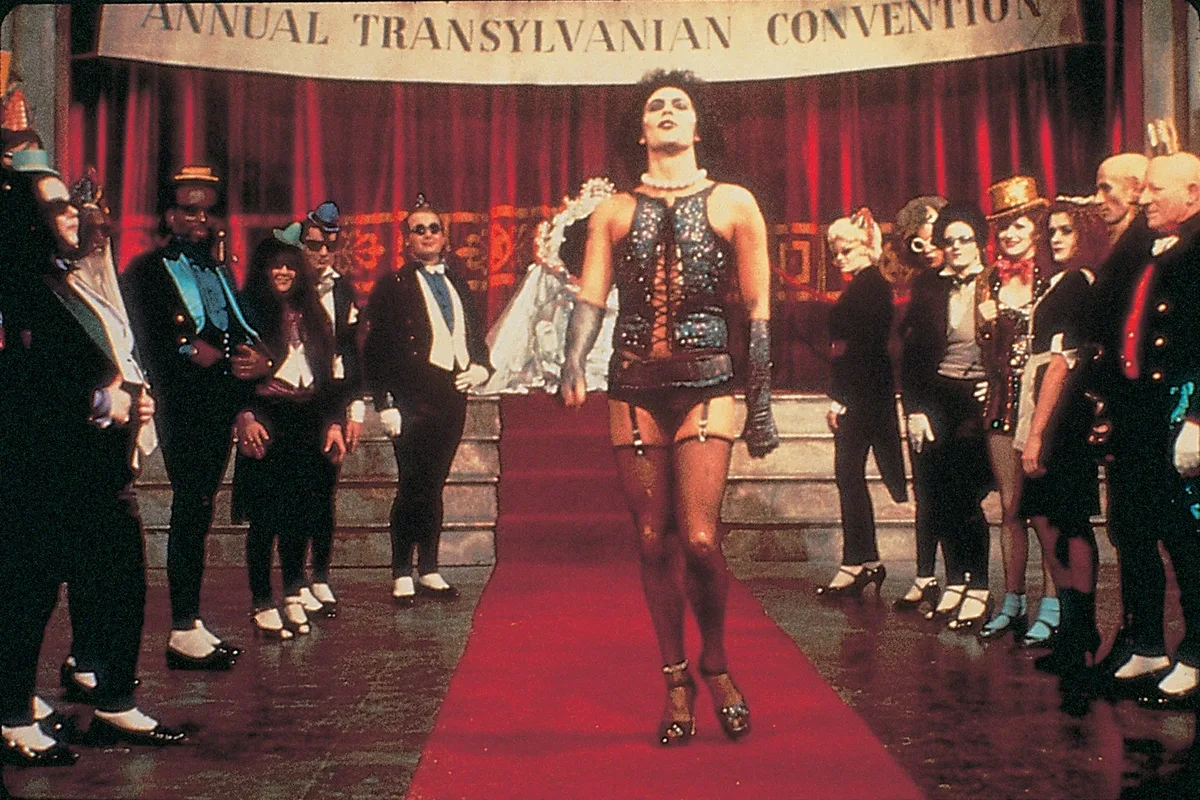
Curry gave that ritual an obvious center. Frank arrives with the confidence of somebody who assumes every rule in the room can be rewritten. The corset and makeup are inseparable from the iconography, but the performance works because he treats them as ordinary extensions of Frank's authority.
Camp was part of the character, not an excuse to avoid acting
Frank is funny, threatening, seductive, selfish and occasionally wounded. Curry moves between those qualities without apologizing for the theatrical scale of the performance.
That is why simply reproducing the costume never reproduces Frank-N-Furter. The visual design can be copied almost exactly while the strange balance of command and vulnerability remains Curry's.
For many audiences, the theater became the more radical space
Rocky Horror's place in queer culture is complicated by the fact that its language and ideas about gender come from the 1970s. Its legacy does not require pretending otherwise.
What endured was the permission created around it. Repeated screenings became places where gender presentation, sexuality and conventional audience behavior could all become flexible at once.
During the film's 50th anniversary in 2025, Curry reflected that experimentation had been part of the atmosphere in which Rocky Horror emerged. He described being proud that Frank helped give people permission to discover who they wanted to be.
The role Curry feared might trap him never stopped following him
Curry once worried that a character this flamboyant could damage his prospects. Instead he built a remarkably broad career across Clue, Legend, It, theater, comedy and voice acting.
Frank still remained the unavoidable reference point. Curry gradually re-engaged with the phenomenon and, despite the effects of his stroke, continued appearing at anniversary events decades after the movie's release.
Following his death on August 25, 2026, Rocky Horror colleagues Barry Bostwick, Patricia Quinn, Nell Campbell and Richard O'Brien all returned to the scale of Curry's contribution when remembering him.
The film has now spent more than half a century teaching new audiences how to perform an old performance back to the screen.