The festival's official awards list names Harada's film as the recipient of both the FIPRESCI Award and the Ateneo Guipuzcoano Award. It is an unusually visible festival start for a filmmaker making her feature directing debut, although Harada is hardly a newcomer to storytelling.
She wrote and directed the film herself, adapting the title story from her 2014 collection Anata wa, Dareka no Taisetsu na Hito. The production therefore begins with a writer revisiting her own material rather than handing it to another filmmaker for interpretation.
A father's room becomes the story's map
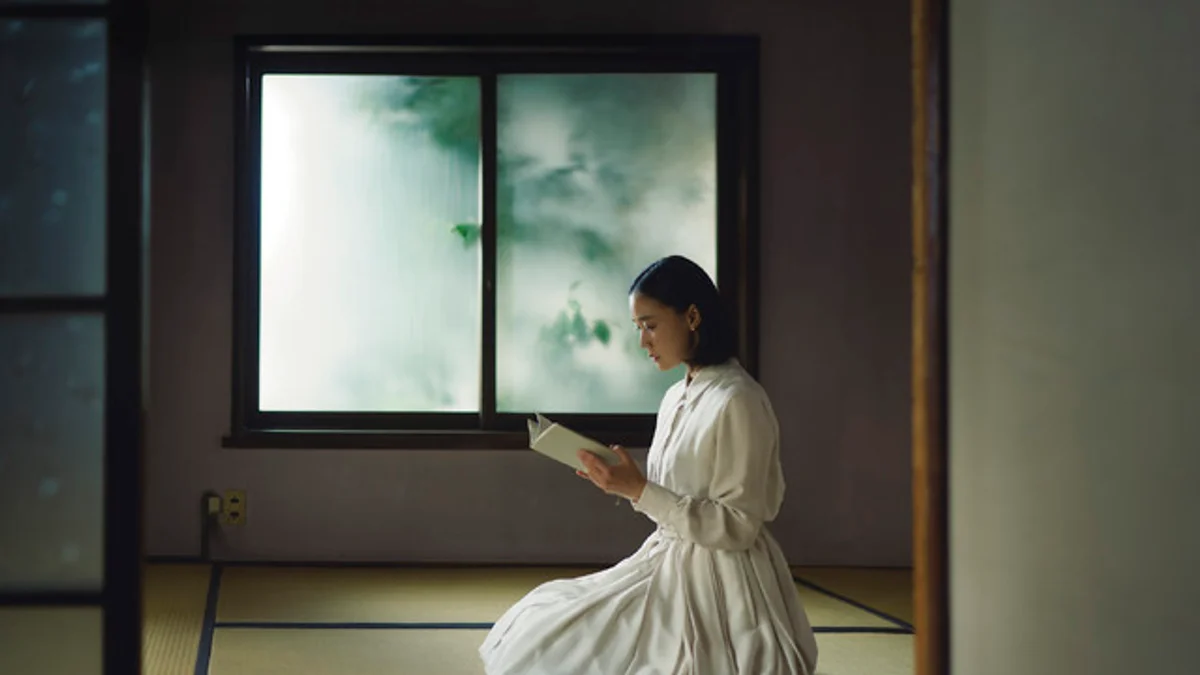
Yu Aoi stars as Satomi, an employee at an art museum. A month after her estranged father dies alone, an envelope containing a mysterious key reaches her. The key opens a room she never knew he had.
What follows is less a conventional mystery than a reconstruction of a person. Satomi traces her father's final years and discovers a private world built around language, tea ceremony and an appreciation of quiet beauty. The man his family had come to regard as unnecessary had, outside their view, created a life with its own rituals and attachments.
Issey Ogata plays Satomi's father. Eita Nagayama and Eri Watanabe are also among the principal cast, with Kami Hiraiwa, Motoki Nakazawa and Arisa Nakano appearing in the wider ensemble. San Sebastián lists the finished film at 109 minutes and in Japanese.
Harada's art background follows her behind the camera
The museum setting is not incidental to Harada's career. Before becoming known as a novelist, she worked in the art world, and visual art has repeatedly provided both subject matter and structure for her fiction. Her first film keeps that interest close to the surface.
The objects Satomi encounters, the practice of tea and the museum where she works all become ways of reading a life through what somebody chose to notice and preserve. The official Japanese material surrounding the FIPRESCI result specifically highlights the jury's response to the film's respect for art and its visual qualities.
Yoshio Kitagawa served as cinematographer, Azusa Yamazaki edited the film and Mamiko Hirai composed the music. The imagery released ahead of the Japanese opening similarly favors faces, interiors, ceramics and restrained gestures over a more declarative visual campaign.
Satomi is losing her own certainty too
The father's death is only one disruption in Satomi's life. While she follows the clues he left behind, her museum contract is terminated and she is forced to reconsider her own future. Her investigation therefore takes place while the institutional role that has defined her daily life is disappearing.
That parallel gives the premise another layer without requiring a larger mystery. Satomi is learning how incomplete her judgment of her father was at precisely the moment when she has to decide what remains valuable in her own life.
There is a similar echo in Harada's position as filmmaker. She is returning to a story she first published more than a decade ago, translating something familiar into a medium she has never previously directed. The daughter reassesses an inherited story; the writer reassesses her own.
San Sebastián is only the first stop
In My Father's Room premiered at San Sebastián on September 21 as part of the Official Selection. Five days later, the festival's closing awards confirmed its FIPRESCI and Ateneo Guipuzcoano prizes.
The film is also continuing on the international festival circuit, including an announced appearance at Busan in October. Distribution has been secured in several overseas territories, including France, although no French theatrical date has yet been publicly confirmed.
Japan already has one. Bitters End will release Muyou no hito nationwide on January 29, 2027. Harada will arrive at that date in the unusual position of being a first-time director whose first completed feature has already acquired a festival identity of its own.