
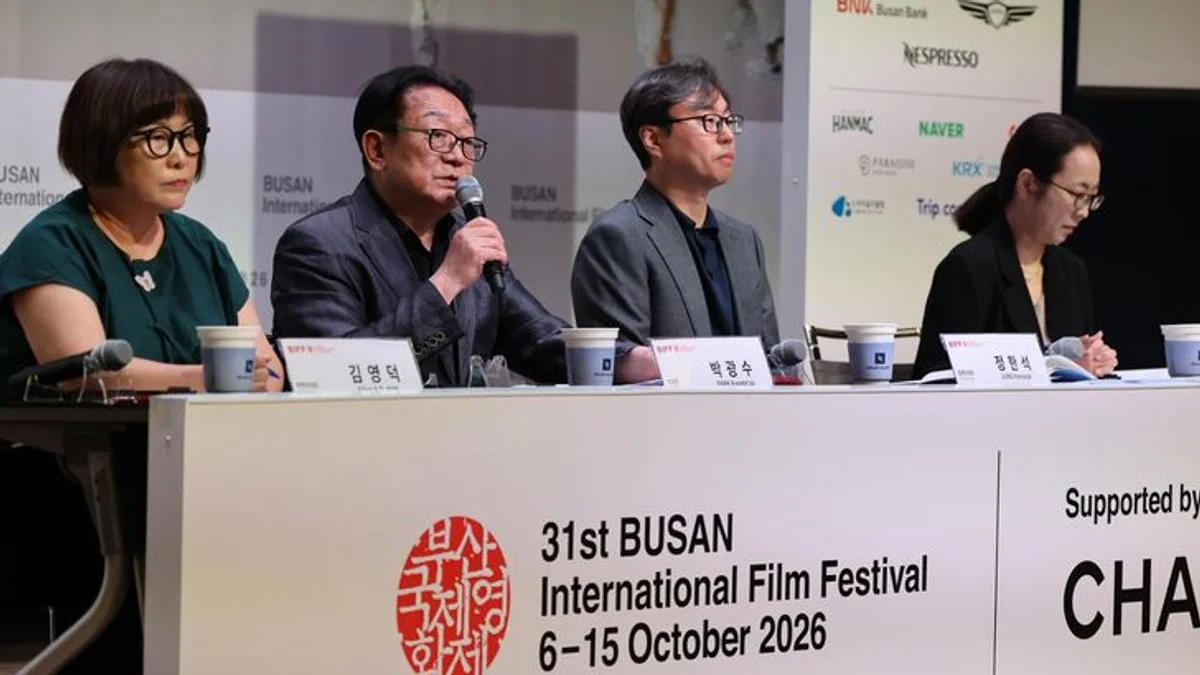
Busan has unveiled the scale of its next edition, and the numbers are unusually useful here. The festival will run from October 6 to 15 with 246 films in its official selection, its largest lineup since 2019.
Ninety-five of those films are world premieres. Once Community BIFF's 69 titles are included, organisers list 315 films across 31 screens in eight theatres.
That is a lot of cinema to fit into ten days.
The competition is only two years old
BIFF spent most of its history without a conventional main competition. That changed in 2025, and the second edition of the section will bring together 14 Asian films from territories including South Korea, Japan, Iran and Taiwan.
Majid Majidi's Bread and Books is in the field alongside Nanako Hirose's Between Two Rivers and Shuichi Okita's Satoko Is Always. Organisers say the depth and quality of submissions increased substantially after the competition's first year.
There is now another incentive attached to winning. The Academy of Motion Picture Arts and Sciences has included Busan in an initiative that gives the winner of the Busan Awards Best Film prize an additional pathway toward consideration in the International Feature Film category, separate from the usual national submission route.
A competition created only last year suddenly has consequences well beyond Busan.
Busan is pairing discovery with an unusually heavy guest list
The festival is not abandoning its traditional role as a showcase for new Asian filmmakers, but the 2026 programme is also loaded with established names.
Michelle Yeoh will return to Busan to receive the Asian Filmmaker of the Year award. Hong Kong filmmaker Ann Hui will receive the Camellia Award, while Hirokazu Kore-eda and Majid Majidi are among the directors expected to attend.
Maggie Gyllenhaal, Isabelle Huppert, Zhou Xun and Fan Bingbing are also on the announced guest list. The Icons programme, meanwhile, brings recent work from major filmmakers including Ryusuke Hamaguchi and Cristian Mungiu.
It is a fairly clear bit of positioning: new Asian cinema inside the competition, internationally recognisable filmmakers around it.
Japanese animation gets more than a token slot
One of this year's more distinctive programmes is devoted to Japanese animation, with 13 features and shorts selected partly because they are difficult to encounter in regular Korean theatrical circulation.
The festival is adding overnight screenings and an industry forum examining Asian animation rather than treating the programme as a side attraction.
More screenings, and a Tuesday opening for the first time
BIFF will begin on Tuesday, October 6, moving its traditional opening forward by a day. From Thursday through Sunday during the busiest opening stretch, daily screening slots will increase from four to five.
Festival director Jung Han-seok has framed the change as a practical audience measure. Most visitors concentrate their schedules in the opening week, so an expanded programme requires more opportunities to actually see it.
Kim Jong-kwan's The Table: Day and Night will open the festival. Kim Min-ha is set to host the opening ceremony, with Yim Si-wan taking over hosting duties for the closing event.
The film market matters almost as much as the red carpet
Busan's international push does not stop with the screenings. The Asian Contents & Film Market will run from October 10 to 13 alongside the festival, bringing sales, projects and industry meetings into the same week.
BIFF says the market's 2025 edition recorded a 14.4 percent year-on-year increase in industry registrations and a 13.5 percent rise in total attendance.
That makes the 2026 expansion easier to read. Busan is trying to strengthen several roles at once: discovery platform, competitive festival, industry marketplace and a route into the international awards ecosystem.
Its fourth decade begins with 246 official films and very little interest in staying small.