
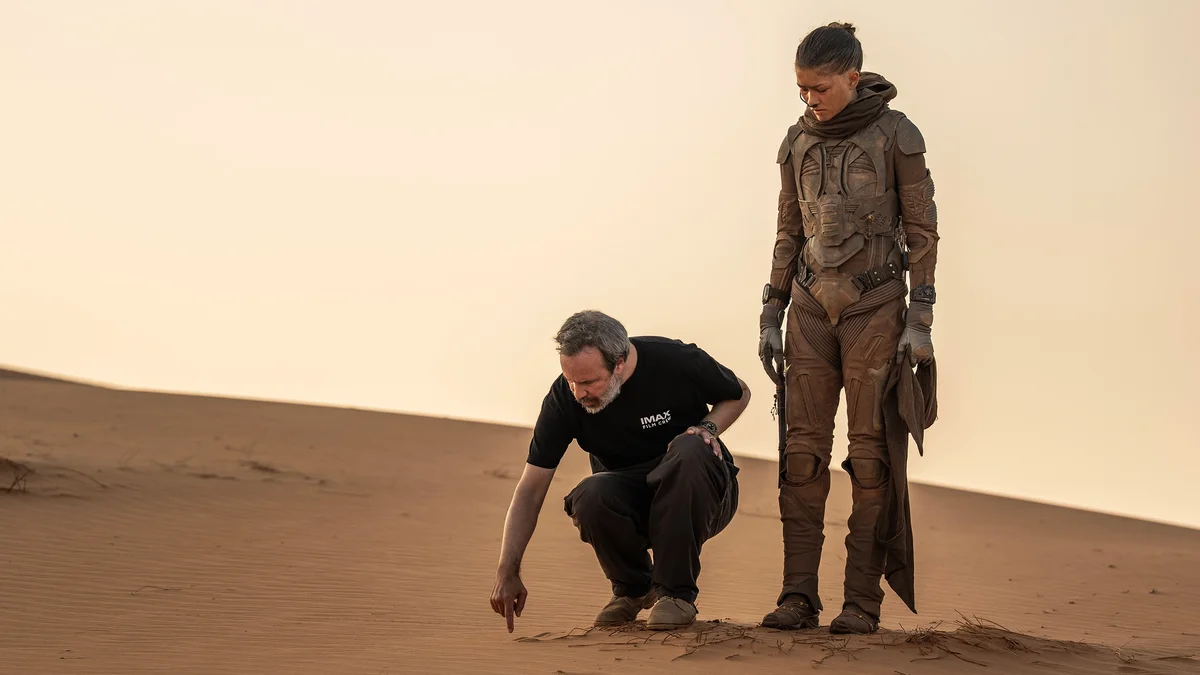
Sandgren replaces Greig Fraser, who photographed the first two films. Villeneuve has said that after a 17-year jump in the story, changed conditions on Arrakis and the introduction of new planets, he wanted to approach the final chapter with new eyes.
That intention is now built into the negative. American Cinematographer says Part Three includes material captured in 5-perf 65mm and 15-perf IMAX, marking the franchise's first use of film as an acquisition format. Villeneuve has separately said that most of the movie was photographed on 65mm and that a substantial portion used IMAX film.
The previous Dune films only became photochemical later
Part One and Part Two looked like film without beginning on film. Fraser captured the movies digitally with large-format ARRI cameras, then used FotoKem's film-out and scan-back process to push the image through 35mm negative before returning it to a digital master.
The point was not nostalgia. Fraser and Villeneuve had tested direct film capture and digital capture on the first movie. Film felt too rooted in the past; untouched digital felt too sharp. The intermediate photochemical step landed between them.
Part Two retained that approach even as its compositions became more aggressively designed around IMAX exhibition.
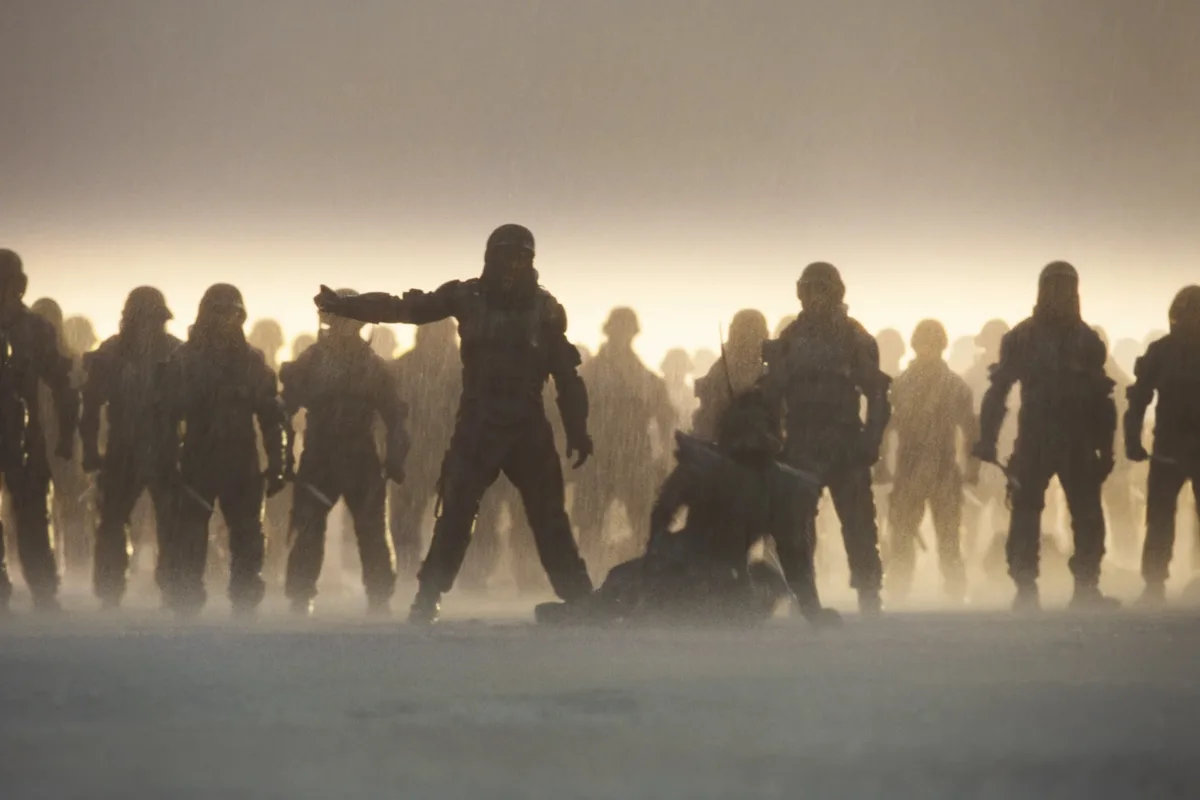
Part Three puts IMAX film cameras into the capture chain
This time the large-format film is no longer appearing only downstream. IMAX confirms the movie was shot with its film cameras and will be presented in IMAX 70mm.
For Villeneuve, working with those cameras was a new experience. He has described the result on a large screen as difficult to match and says Part Three was specifically dreamed as an IMAX experience.
That makes Sandgren's arrival more than a personnel change. The cinematographer inherits a franchise with a very established visual identity while changing the material that records it.
The desert is the deliberate exception
Villeneuve's most revealing decision may be the one that sounds least fashionable: he kept the desert digital because he prefers its brutality that way.
It turns the mixed capture formats into part of the visual grammar rather than a hierarchy where film automatically means better. Different environments can carry different textures. Arrakis does not have to become softer or more romantic simply because the rest of the production has gained access to a larger negative.
That distinction should become especially noticeable in a story that moves beyond the geography established by the first two films.
A new image without rebuilding Dune from scratch
Several key department heads remain in place. Patrice Vermette returns in production design, Jacqueline West in costumes, Joe Walker in editing and Hans Zimmer in music. Sandgren therefore changes the photographic layer inside a world whose broader design language is still continuous.
Villeneuve says the main edit is complete, while visual-effects work continues ahead of the December release.
The final image will have passed through digital capture, conventional 65mm and IMAX film before audiences start arguing about which screen presents it correctly. For Dune, that argument has effectively become part of the release ritual.