

Hope was an industrial gamble before it became a potential franchise. Na Hong-jin returned to feature filmmaking a decade after The Wailing with a production reportedly approaching 100 billion won, roughly $74 million by several recent estimates.
For the Korean film business, that is an extraordinary amount of money to put behind one director's science-fiction vision.
Na was already thinking beyond it. At Cannes in May, he confirmed that he had written a story continuing the film. Screen International reported that both a story and script exist, although no sequel has been formally announced for production.
The aliens were cast with another movie in mind
That longer plan also helps explain two of Hope's stranger casting decisions. Michael Fassbender and Alicia Vikander appear as extraterrestrial beings created through performance capture, alongside Taylor Russell and Cameron Britton.
Na has said that if a second movie happens, Fassbender and Vikander's characters would become far more central. He was therefore casting them not simply for what Hope shows, but for material the first film deliberately leaves beyond its borders.
It is an ambitious way to build a world. It also asks the audience to accept that some answers may live inside a movie that does not exist yet.
The first Hope is already testing that patience
The story begins in Hope Harbor, an isolated community near the Korean Demilitarized Zone. What appears to be an animal threat sends police chief Bum-seok, played by Hwang Jung-min, officer Sung-ae, played by Hoyeon, and a group of local hunters into a much larger extraterrestrial disaster.
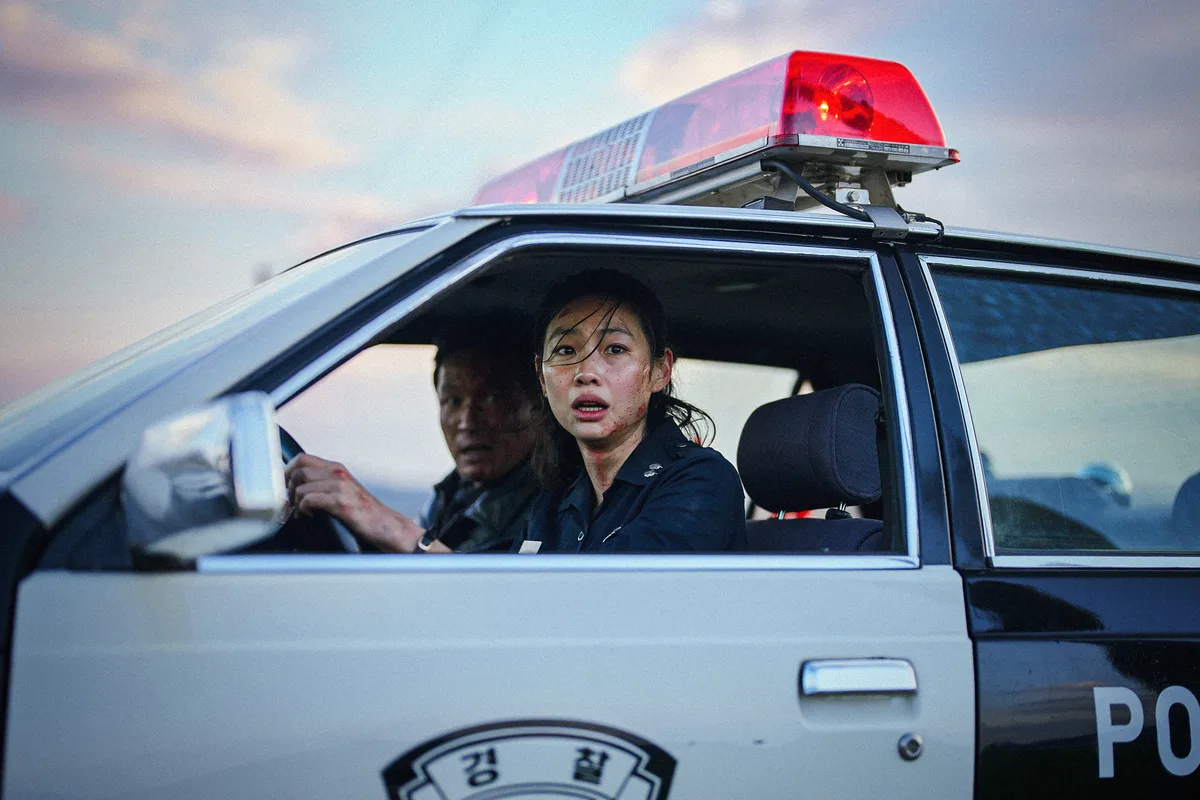
Na stretches that premise across 160 minutes according to the Cannes listing, moving through creature horror, action, comedy and large-scale science fiction.
Some critics have loved the excess. Screen International called the Cannes premiere a thunderous genre mash-up, while Associated Press has praised its performances, Hong Kyung-pyo's cinematography and spectacular action even while pointing to an overlong structure and uneven CGI.
Other reactions have landed on precisely the issue a sequel creates. Reviews around the September 9 US release have questioned whether too much of Hope's final stretch is designed to establish mythology for later chapters rather than fully resolve the movie in front of the audience.
The Atlantic pushed that argument furthest, framing the franchise setup itself as one of the film's major weaknesses.
The Korean launch gave the plan some real ammunition
The commercial picture is not remotely disastrous. Plus M Entertainment sold Hope into more than 200 territories, and Screen International reported that international pre-sales alone had already recouped close to half of the production budget.
The domestic launch was equally loud. Hope sold more than 550,000 advance tickets and opened in South Korea on July 15 with 333,915 admissions, the country's biggest opening day of 2026 at that point.
That is the kind of start a film this expensive needed.
A written sequel is not a financed sequel
There is still no official Hope 2 production announcement. Na has consistently described the continuation as something he wants to make if circumstances allow, not as a movie already ordered by Plus M, Neon or another distributor.
That matters because a second chapter would inherit the scale of the first one. Hope relies heavily on creature effects, elaborate action, large environments and an international cast. Na has also spent years constructing the mythology surrounding its extraterrestrial characters.
This is not the sort of sequel that becomes cheap simply because the screenplay already exists.
Na Hong-jin is trying something Korean cinema rarely attempts at this scale
His previous films built their reputation through singularity. The Chaser, The Yellow Sea and The Wailing were recognisably genre movies, but none looked like a conventional franchise starter.
Hope keeps some of that unruly personality while adopting the machinery of a global blockbuster: premium-format releases, international stars, extensive visual effects, worldwide sales and mythology deliberately capable of supporting another chapter.
Korean cinema has already demonstrated its ability to travel globally. Building an original science-fiction series at this budget level is a different test entirely.
Na Hong-jin has done the creative part early. The sequel is written. Now the first Hope has to make the business case for it.