
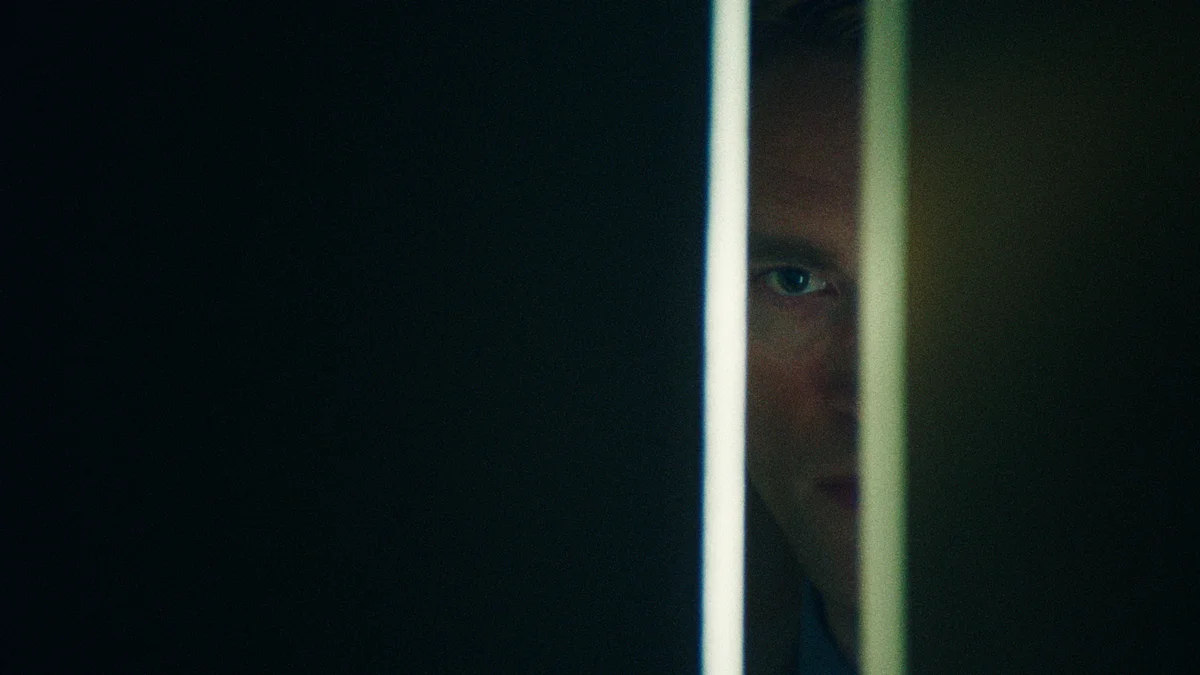
Primetime is already becoming a genuinely international release
Lance Oppenheim's Primetime is the obvious large-scale example. Produced by A24, Range Media Partners, Icki Eneo Arlo and Square Peg, it stars Robert Pattinson in a story inspired by Chris Hansen and the cultural phenomenon surrounding To Catch a Predator.
After competing at the Venice Film Festival, the commercial rollout begins almost country by country. France opens the film on September 23, followed by Germany and Austria on September 24. A24 releases it in the United States on September 25, alongside its Canadian opening.

October then adds Malaysia, Belgium, the Netherlands, Greece, Portugal, Poland, Italy, Romania, Türkiye, Australia, New Zealand, Ireland and the United Kingdom at different points in the month.
That staggered schedule is much closer to how international independent distribution usually works than the idea of one universal release date.
The Incomer goes in the opposite direction
Louis Paxton's The Incomer opens at New York's IFC Center on September 25 after preview screenings and filmmaker appearances. Domhnall Gleeson, Gayle Rankin and Grant O'Rourke lead the cast.
The story takes place on a remote Scottish island where siblings have built their lives around inherited rules: protect the island, let nobody in, survive. A council official arrives to evacuate them and brings the deeply suspicious forces of paperwork, the internet and mainland life with him.
It is a British production with a much smaller theatrical footprint than Primetime. Both are independent releases. The similarity mostly ends there.
The History of Concrete is exactly the John Wilson title it sounds like
John Wilson's new documentary begins with concrete and quickly discovers that concrete is not really a limit. Rome, New York, Ohio, roads, sidewalks, architecture and the awkward mechanics of making documentaries all become part of the trip.
The film began its theatrical run on September 18 and is currently playing in New York, with a Film Independent event on September 23.
It is a useful reminder that a film can be small in conventional commercial terms without being minor in ambition.
Ha-Chan, Shake Your Booty! makes grief a dance problem
Josef Kubota Wladyka's film stars Rinko Kikuchi as Haru, a Tokyo woman whose carefully built life with her Mexican husband is shattered by tragedy. Returning to dance becomes a route through grief, awkward attraction and the possibility of beginning again.
Alejandro Edda and Alberto Guerra also star. Film Independent highlighted the film during September, and it appears in the late-month limited theatrical calendar in the United States.
Its Japanese, Mexican and American elements sit together without turning the film into a self-conscious exercise in internationalism. The characters simply already live across those boundaries.
Barbara Forever should not vanish because September moved on
Brydie O'Connor's Barbara Forever opened theatrically on September 4 through Strand Releasing. The documentary reconstructs experimental filmmaker Barbara Hammer's life largely through Hammer's own enormous body of filmed work.
Rather than forcing more than 90 films into a conventional chronology, O'Connor organizes the material through themes, relationships and Hammer's recurring interest in bodies and queer visibility.
It is the kind of independent theatrical release that can disappear from listings quickly even though its subject covers decades of filmmaking history.
Atonement shows why festival screening and theatrical release are not synonyms
Reed Van Dyk's first feature Atonement was presented by Film Independent on September 22. Boyd Holbrook, Hiam Abbass and Kenneth Branagh star in a drama inspired by Dexter Filkins' article Atonement After Iraq.

The story connects an Iraqi family with an American veteran carrying the consequences of a fatal encounter with civilians years earlier.
Its September event should not be mislabeled as a worldwide theatrical release. Film Independent presented the picture, but a festival or curated screening is a different stage of distribution from a confirmed commercial rollout.
Festivals are part of the release life, not merely the waiting room

Venice, Toronto, Sundance and smaller international festivals create a distribution geography of their own. A film can already be public, reviewed and traveling between countries while having no single conventional theatrical date.
British productions such as TIFF selection One Thick Second demonstrate how that route works: festival selection first, sales and publicity around it, then different release arrangements territory by territory.
For independent cinema, asking for the global release date can sometimes be asking the wrong question.
September 25 is still unusually busy
North American limited-release schedules for September 25 include Primetime, The Incomer, MUBI's Pulp: What Do You Do for an Encore?, IFC Films' The Stunt Driver and a long tail of much smaller releases appearing in only a handful of theaters.
The scale differences are enormous. An A24 production starring Robert Pattinson can still belong to independent cinema while having almost nothing in common financially with a documentary opening on one screen.
That contradiction is part of what the term “independent” means in 2026.
October is already waiting behind it
The first October schedules add another wave of British and North American releases, including new independent genre films and restorations. A24's autumn calendar continues toward Club Kid in November and The Debut in December.
There is no shortage of independent cinema. The harder part is that its distribution is scattered across countries, small distributors, festival programs and theatrical windows that rarely align.
Primetime will be easy to spot this week. Finding The Incomer or The History of Concrete may require checking what actually plays in your city. That remains part of the experience.