
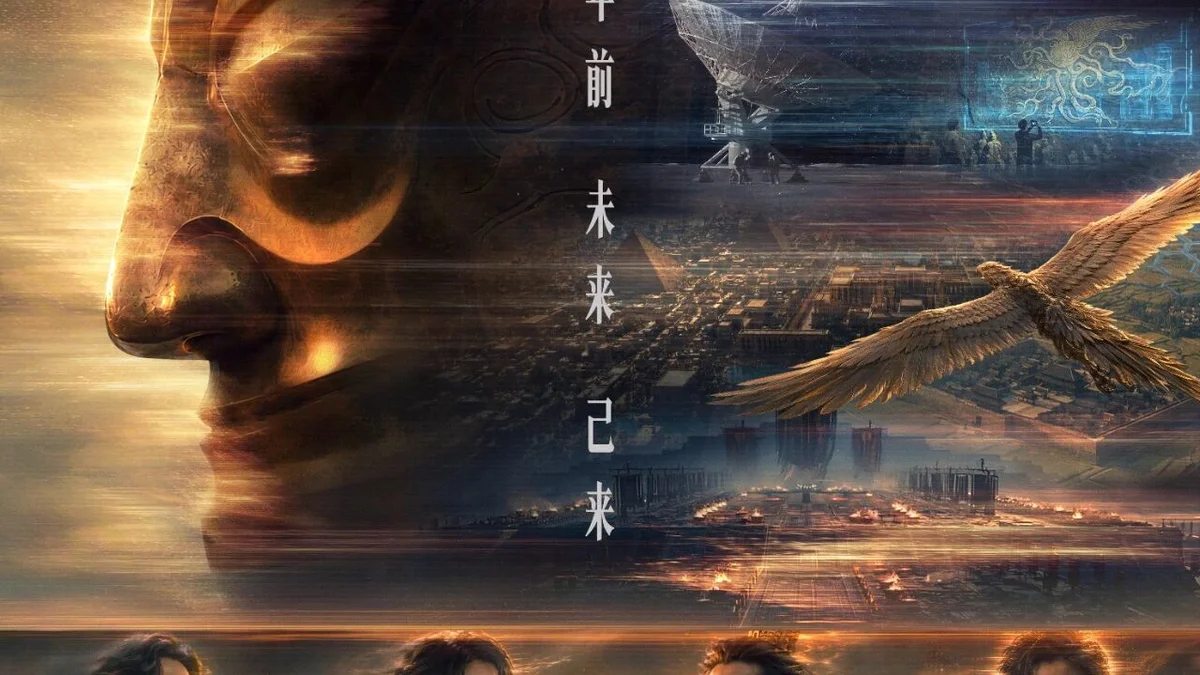
The film's approval is not the new development this week. China's National Film Administration granted its public-screening license in late April. At the time, Caixin reported that the 90-minute version submitted for approval was treated as an animated feature because regulators did not have a separate classification for AI-generated movies. Bona now lists the finished theatrical feature at 100 minutes and has given it a firm release date.
That turns an abstract industry milestone into a much more measurable proposition. On October 23, Sanxingdui will have to compete for screens and audiences rather than simply demonstrate that a major studio can get an AI-intensive production through China's theatrical approval process.
The characters are digital, but not digital replicas
One production decision is being emphasized ahead of release: every character in the movie is an original digital creation. Bona says the film does not digitally reproduce real actors. That choice is particularly relevant as generative production has intensified disputes over performers' likenesses, voices and ownership of training material.
Bona's description of the workflow is also more specific than simply calling the movie “AI-generated.” Boka Movie Cloud Studio handles generation and execution, while the company's AIGMS filmmakers retain control over creative initiation and artistic decisions. Yue Ming is credited as writer and director.
The company has spent much of the year framing the process as human-machine collaboration rather than autonomous filmmaking. Its stated model puts inspiration, aesthetics and judgment in human hands while using AI for generation and execution. Whatever one thinks of that terminology, it establishes a useful distinction between this production and the fantasy of entering a prompt and receiving a finished feature.
A million images for one movie
The production numbers make that distinction harder to ignore. Bona says the team spent two years developing the process, generated more than 1.2 million working images and went through over 100 iterations of the complete film.
Those figures do not by themselves prove artistic quality, but they do expose one awkward assumption about generative cinema. Removing a conventional camera shoot does not remove the problem of maintaining characters, environments, objects, lighting and visual continuity across a feature-length timeline. Generation can make individual images cheap while consistency turns selection and revision into a different kind of production burden.
Bona has been building toward this scale for some time. The Sanxingdui project previously produced the AI science-fiction short-form series Sanxingdui: Future Revelation. A concept trailer for the feature appeared at Hong Kong's FILMART in March 2026, followed by an international presentation during the Cannes Film Festival in May.
A movie made with AI about trusting AI too much
Its premise adds a layer of self-awareness. In the film's future, humanity has become deeply dependent on a superintelligent AI and ends up facing a global crisis. The potential solution points backward three millennia to seven markings found on Sanxingdui bronzes.
An archaeologist discovers that the markings contain what appears to be binary information that should not belong to their era. The story then stretches from the ancient Shu civilization to a technological future, reimagining recognizable Sanxingdui objects such as the bronze sacred tree, standing figure and protruding-eye masks within its hyperrealistic visual world.
AI is consequently both production method and dramatic subject. A film built through generative technology is asking what happens when people outsource too much judgment to algorithms. Whether the finished narrative does anything interesting with that contradiction remains a question for the movie rather than its production notes.
China's AI-video boom is already much larger than one film
Sanxingdui is arriving inside a market that has moved far beyond isolated AI experiments. Reuters reported that 221,900 new AI shows appeared on Douyin during the first half of 2026 alone. Production costs for AI short dramas also fell sharply during that period, according to CCTV figures cited by Reuters.
Volume has brought its own problems. Chinese actors have raised concerns about likeness use, voice performers fear job displacement, and viewers have complained about plagiarism and recycled material. China requires explicit labels on AIGC content, while clear copyright rules for the field are still developing.
That makes Bona's decision to avoid real-actor digital replicas commercially understandable as well as creatively significant. It does not settle the wider copyright debate around generative systems, but it removes one of the most visible disputes from this particular production.
October 23 is the harder milestone
Getting a theatrical license proved that an AI-intensive feature could pass through China's existing film-regulation system. Opening it nationwide asks a different set of questions. Will audiences accept synthetic performers for 100 minutes? Can the visual continuity survive the scale of a cinema screen? And will the technological novelty translate into ticket sales once it is competing with ordinary movies?
Bona has already demonstrated that its workflow can produce enough material to assemble a feature. The October release will test something its render pipeline cannot answer: whether viewers find the result worth watching as a movie rather than merely discussing as a technical first.