The British shoot is beginning to reveal what Mendes' unusually large Beatles project actually looks like in motion.
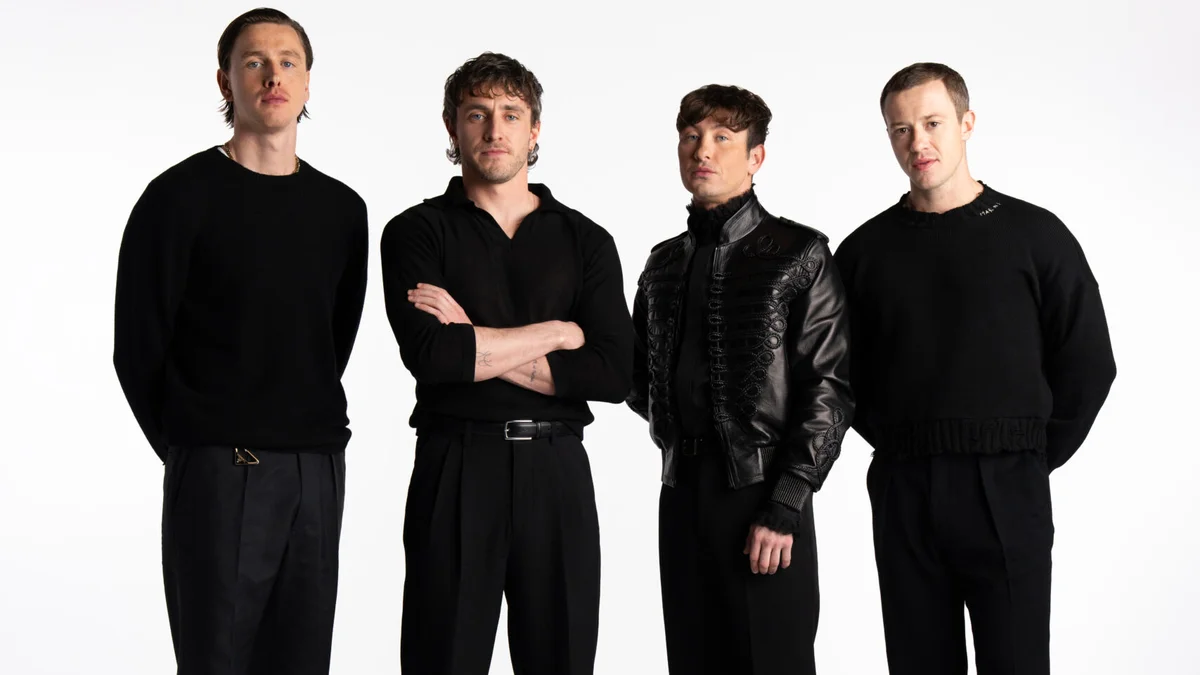
Harris Dickinson, Joseph Quinn and Barry Keoghan were photographed around London's Marylebone Station dressed as the early-1960s Beatles while a group of period-costumed extras chased them through the streets.
The reference is unmistakable: the opening of Richard Lester's 1964 movie A Hard Day's Night.
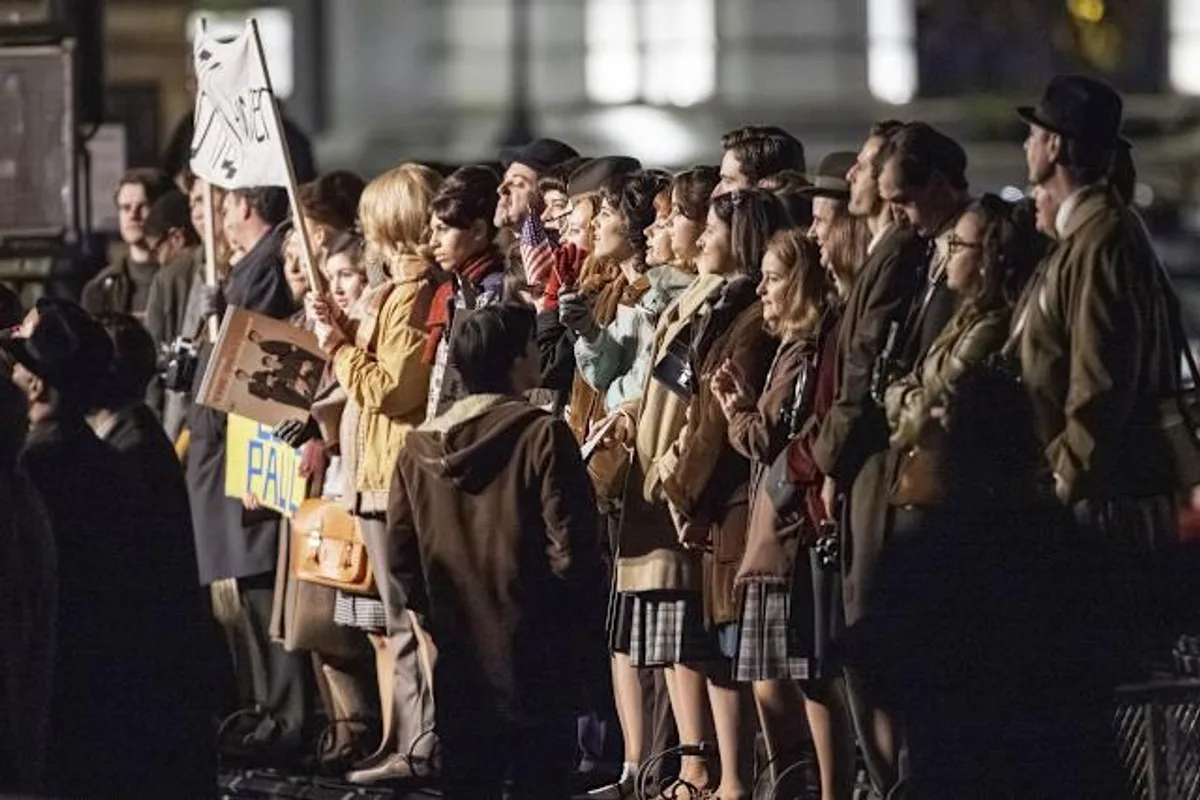
The famous chase has been built again
Lester's movie begins with Lennon, Harrison and Starr running from hordes of fans on their way to a train.
Dickinson is playing Lennon, Quinn is Harrison and Keoghan is Starr in Mendes' films, making the new footage a direct recreation of one of the most familiar pieces of Beatles screen imagery.
Paul Mescal was not visible during that specific shoot.
That does not necessarily indicate anything unusual about his role. Paul McCartney is also separated from the other three during the opening mechanics of the original sequence before the group reunites.
The production is reconstructing the real history around A Hard Day's Night too
The project has also returned to Liverpool for a much larger 1964 event.
Mescal, Dickinson, Quinn and Keoghan filmed the Beatles' homecoming surrounding the northern premiere of A Hard Day's Night.
The real band arrived to enormous crowds, traveled through the city and appeared at Liverpool Town Hall before attending the premiere.
Rebuilding both the fictional chase and the real public hysteria surrounding the same movie creates an interesting overlap between Beatles mythology and Beatles history.
Beatlemania can be shown instead of explained
Both sequences are fundamentally about scale.
The Beatles are not shown writing songs in these moments. They are shown trying to move through ordinary public space after ordinary movement has become almost impossible.
A Hard Day's Night turned that pressure into comedy, with the group constantly escaping fans, managers, journalists and schedules.
For Mendes, reproducing the chase is also an efficient way to dramatize celebrity. Three musicians appear in public, and the environment immediately stops functioning normally.
Abbey Road has already been reconstructed as well
The production has been gradually revealing other recognizable periods of the band's history.
In August, all four actors were seen recreating the Abbey Road album cover at the famous London crossing.
The two images sit at almost opposite ends of the group's career.
A Hard Day's Night belongs to the explosive early Beatlemania of 1964. Abbey Road represents the group near the end of its recording life in 1969.
The production is therefore clearly working across multiple eras during principal photography.
Four films will tell one history from four positions
The Beatles – A Four-Film Cinematic Event is not structured as one conventional band biopic.
Mendes is directing four separate features, each built around the perspective of one Beatle.
Harris Dickinson leads the John Lennon perspective, Paul Mescal the Paul McCartney story, Joseph Quinn the George Harrison film and Barry Keoghan the Ringo Starr chapter.
The films are designed to intersect rather than operate as completely isolated biographies.
That makes shared historical events especially important. Sony has not explained whether identical scenes will appear repeatedly from different perspectives, but the format creates room for the same period to carry different emotional weight depending on whose story is being told.
The wider Beatles world is already heavily cast
The four leads are surrounded by an extensive group of historical figures.
Saoirse Ronan plays Linda McCartney, Anna Sawai is Yoko Ono, Aimee Lou Wood portrays Pattie Boyd and Mia McKenna-Bruce plays Maureen Starkey.
James Norton is Beatles manager Brian Epstein and Harry Lloyd plays producer George Martin.
Lucy Boynton appears as Jane Asher, Morfydd Clark as Cynthia Lennon, Farhan Akhtar as Ravi Shankar and Ben Schwartz as American disc jockey Murray the K.
The production has unusually broad access to the band's history
The films carry official cooperation that previous scripted Beatles projects have not had at this scale.
Apple Corps, Paul McCartney, Ringo Starr and the families of John Lennon and George Harrison granted life-story and music rights for the project.
The official announcement described it as the first scripted theatrical project to receive that complete level of authorization.
That gives Mendes and the writers access not only to the band's public milestones but also to the music required to make those moments recognizable on screen.
Three writers are handling four screenplays
Jez Butterworth, Peter Straughan and Jack Thorne are writing the four films.
Mendes directs all of them and produces alongside Pippa Harris, Julie Pastor and Alexandra Derbyshire.
Neal Street Productions is making the project in association with Apple Corps, with Sony Pictures financing and distributing the films worldwide.
All four movies remain planned for April 2028
Sony continues to list April 2028 as the theatrical window for the entire four-film event.
Mendes has described the concept as a theatrical experience built to be consumed with the momentum normally associated with serialized storytelling.
The exact dating pattern inside that month has not yet been fully detailed.
For now, the set itself is providing the clearest preview of the method: the Beatles story will not only be told through private conversations and recording sessions, but through the moments when four musicians stepping onto a street could make an entire city move around them.