
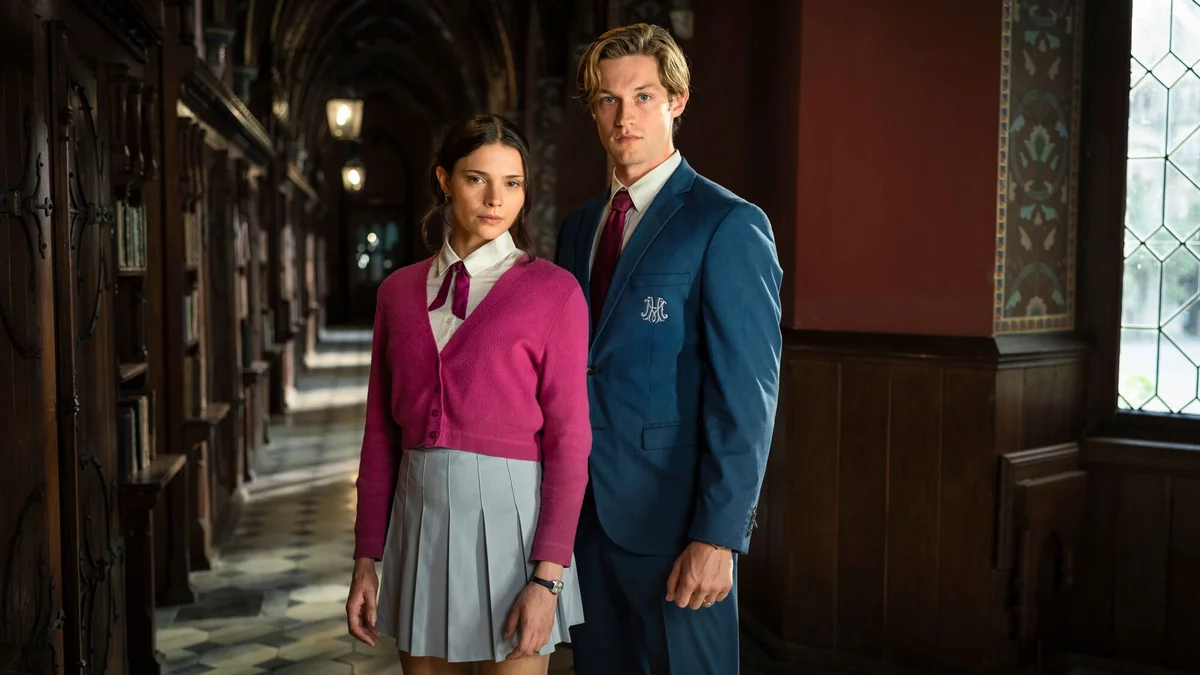
Prime Video launched its new lip-sync dubbing technology globally on September 9 across the first two seasons of Maxton Hall.
The audio performances are still human-recorded dubs. Amazon says AI and visual-effects technology are then used to synchronize the actors' mouth movements with that translated English dialogue.
The localization process is no longer limited to the soundtrack.
The voices are not being generated
That distinction is central to Amazon's announcement.
The system is designed to work with human-dubbed audio rather than replace dubbing performers. Its job is visual: reduce the familiar mismatch between translated speech and the mouth movements captured during the original performance.
That separates the feature from other forms of AI localization involving synthetic voices or fully automated translation.

Maxton Hall is a very deliberate test case
Amazon describes Maxton Hall as Prime Video's most successful scripted International Original. Its first season reached No. 1 on Prime Video charts in more than 120 countries and territories following its 2024 debut.
That makes it a useful series on which to test technology designed specifically to help content cross language boundaries.
Lip-synced English dubs are available now for Seasons 1 and 2. Season 3 will include the same treatment when it premieres December 9.
The third season is also the final chapter, runs for six episodes and brings Harriet Herbig-Matten and Damian Hardung back as Ruby and James.
Localization has moved into the image pipeline
For decades, international versions of a show primarily changed two layers: audio and text. Viewers selected subtitles or a dub while the photographed performance itself remained fixed.
Visual lip-sync weakens that assumption.
A viewer watching the English dub can now see slightly different facial motion from someone watching the original German track. The underlying scene remains the same, but the visual representation of the performance has been localized too.
For a global streaming platform, the attraction is obvious. If foreign-language content feels less visibly dubbed, Amazon can potentially reduce another barrier between a local production and an international audience.
Creative oversight is going to matter as much as accuracy
Prime Video says the process is carried out under creative oversight and presents the technology as a tool for creators rather than an automated replacement for them.
Raf Soltanovich, vice president of technology at Prime Video and Amazon MGM Studios, argues that the approach can help stories travel to broader audiences while preserving their artistic integrity.
That promise will be tested as the technology expands.
Changing a subtitle does not modify an actor's photographed performance. Changing the movements of their mouth does. Even when the purpose is straightforward localization, the intervention raises a different class of creative and labor questions.
The best version of the effect may be the one nobody notices
Visible mistakes will be easy to identify: unnatural mouth shapes, facial artifacts or movements that feel detached from the performance.
Success is harder to see.
A convincing visual dub is supposed to disappear into the scene and remove the moment when a viewer remembers that the lips and dialogue belong to different languages.
Prime Video intends to expand the system to additional titles after Maxton Hall.
If it works, one of the most consequential changes to streaming localization may also become one of its least visible.