Netflix released the first full trailer for Brad Bird's Ray Gunn on September 23.
The Skydance Animation feature will stream globally on Netflix December 18, following a select theatrical release beginning December 4 that includes a limited number of 70mm engagements.
For a movie whose entire aesthetic argument revolves around treating animation as cinema rather than a demographic category, that theatrical detour feels particularly deliberate.
Metropia is not the future — it is 1939's idea of the future
The visual premise is unusually precise.
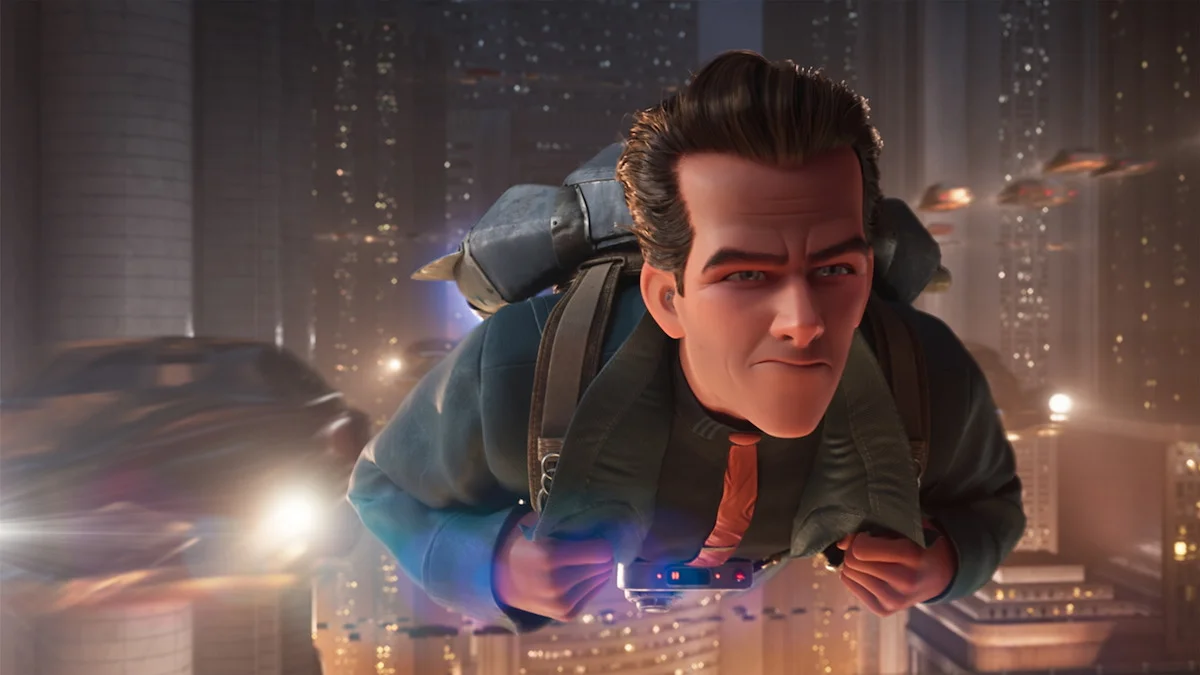
Metropia is an alternate future imagined from a pre-World War II point of view. Buildings keep stretching upward, cars fly and enormous holograms dominate the skyline, but the city's visual grammar remains rooted in Art Deco and streamline modern design.
Bird has pointed to monumental architectural visions associated with Hugh Ferriss and the industrial design of figures such as Raymond Loewy and Norman Bel Geddes.
The trailer therefore feels less like an old city decorated with futuristic gadgets than a timeline in which an entirely different version of modernity simply kept developing.
Ray Gunn is already obsolete in a world that has automated his job
Sam Rockwell voices Raymond Gunn, a private detective still insisting on doing the work the old-fashioned way.
Much of the legwork once associated with investigators can now be handled by tiny machines called pry bots.
Ray still walks the streets, questions people and maintains the kind of office where Venetian blinds apparently survived every technological revolution.
His partner Eye-Ra, voiced by Tom Waits, is a one-eyed alien. The trailer does not treat him merely as a visual punchline; he plays like the weary colleague who has already witnessed far too many of Ray's decisions.
Scarlett Johansson brings the problem called Venus Nova
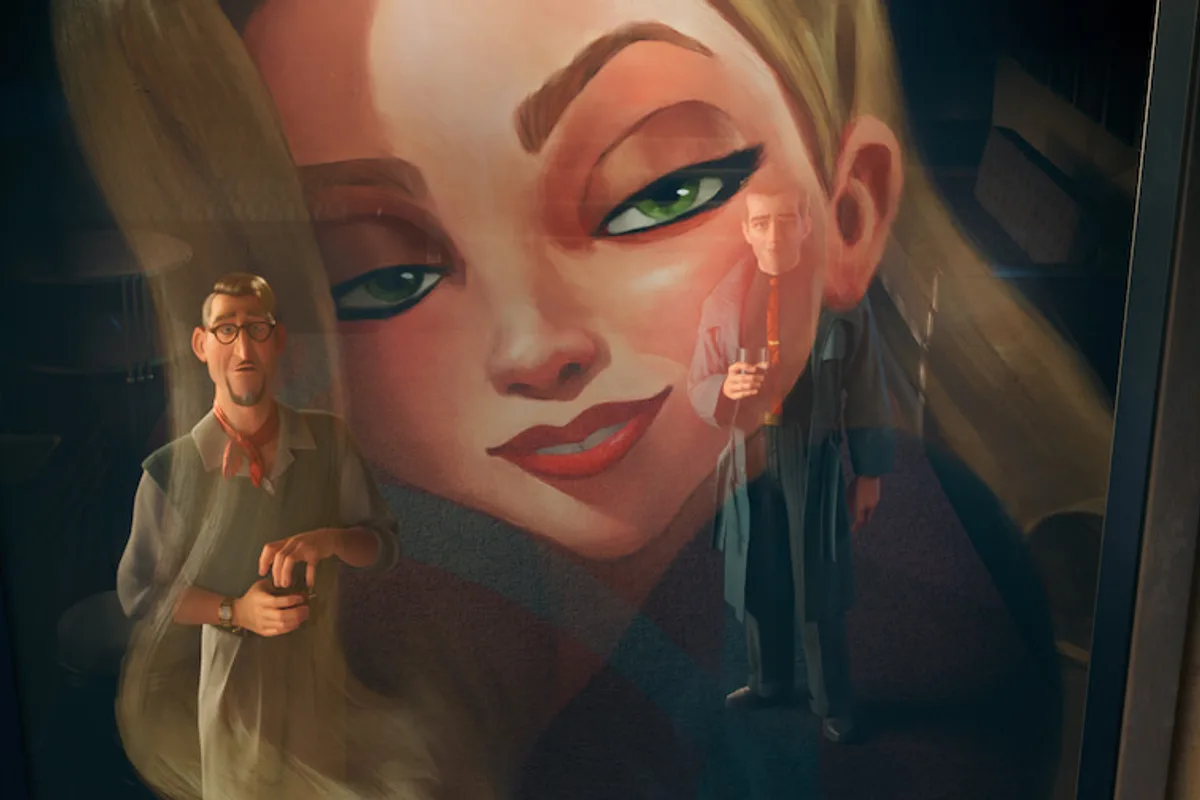
The case orbiting Ray involves Venus Nova, voiced by Scarlett Johansson.
Netflix describes her as one of Metropia's biggest and most controversial multimedia stars, a celebrity whose scandals threaten both her career and potentially her life.
Following her trail pulls Ray between the city's glamorous heights and its much less presentable underworld.
That structure could have been lifted straight from classic noir: tired investigator, inaccessible star, money, lies and an assignment that becomes far more dangerous than the original invoice suggested.
The distinction is that the mobster might be an alien and the femme fatale can tower over an entire avenue as a hologram.
Bird's shorthand remains The Maltese Falcon meets Buck Rogers
Bird has used that combination for years to explain the project.
The Maltese Falcon side provides the hard-boiled investigator, corruption and people whose friendliness immediately looks suspicious.
Buck Rogers supplies rockets, impossible towers, extraterrestrial life and an optimistic early-20th-century vision of technological progress.
The trailer works because those references are not separated into alternating modes.
A detective office can look pulled from a 1940 studio picture while an alien sits behind the desk. A city block can preserve Manhattan-like architecture while traffic flows through the air above it.
Bird is borrowing classical staging, not just classical furniture
The old-Hollywood influence extends beyond costumes and production design.
Bird has discussed studying how filmmakers such as Michael Curtiz and John Huston staged scenes: low camera positions, visible ceilings, strong depth and character blocking that makes architecture part of the drama.
He has also cited David Lean, Orson Welles and Alfred Hitchcock among the filmmakers whose visual solutions informed his thinking.
That approach is already visible in the trailer. Characters are not always framed as the unquestioned center of every animated composition. Metropia repeatedly overwhelms them with staircases, halls, façades and sheer vertical scale.
The harder animation challenge may be two people talking in a car
Ray Gunn also appears designed to test a quieter assumption about feature animation: what audiences consider worthy of being animated.
Bird specifically uses the example of two people sitting in a car and talking.
There is no dragon required, no explosion and no compulsory physical gag. He wants performance, silence, eye movement and framing to sustain an animated scene with the same confidence they would have in live action.
That helps explain the emphasis he places on voice performances.
A few seconds of recorded dialogue can occupy an animator for weeks, with cadence and hesitation becoming raw material for the physical performance on screen.
The voice cast is much larger now
Sam Rockwell, Scarlett Johansson and Tom Waits are no longer the only announced performers.
Netflix has added Alan Tudyk, Matt Berry, Bobby Cannavale, Michael Chernus, Kether Donohue, Michelle Rodriguez, Aasif Mandvi, Matt Jones, Kathryn Hunter, John Ratzenberger, Justin Peck and Patton Oswalt.
Not every role has been formally identified yet.
Bird co-wrote the screenplay with Matthew Robbins from Bird's original story, and Michael Giacchino is composing the score.
The idea is older than The Iron Giant
The strange thing about Ray Gunn is how much it resembles a new creative direction for Bird even though he conceived it near the beginning of his career.
The project predates The Iron Giant, his 1999 feature directing debut.
It then survived decades of development, shifting studio circumstances and enormous changes in animation technology before Skydance Animation finally brought it into production.
Bird says the basic concept remained remarkably stable: merge 1940s detective movies with science-fiction adventure.
What changed was his ability to build the scale of Metropia around that concept.
Why put an animated movie on 70mm?
The limited 70mm release may be the most revealing detail in Netflix's new announcement.
Bird has said he wants audiences to encounter the movie on the largest screen possible, where the production design can retain its detail and the Dolby Atmos mix can operate at theatrical scale.
He has also described using a spherical widescreen lens philosophy to preserve a broad image while avoiding the specific distortions associated with some anamorphic photography.
Most viewers will ultimately watch Ray Gunn on Netflix, of course.
But the theatrical run functions as an aesthetic statement: this was not designed merely as an animated asset waiting to become a thumbnail on a streaming homepage.
More grown-up does not mean adults-only
Netflix and Bird have both emphasized that the film operates in more mature territory than audiences often expect from a large-scale animated adventure.
Its story involves murder, corruption, celebrity and a detective moving through the dirtier corners of a futuristic metropolis.
That does not make Ray Gunn an adults-only production.
The broader ambition is to challenge the assumption that theatrical animation must restrict itself to a narrow set of tones and stories.
Bird repeatedly returns to the same principle: animation is a medium, not a genre.
Ray Gunn appears determined to prove it in spectacularly complicated fashion — by building a 1939 film noir inside a future that never existed, filling it with aliens, and then putting some of it on 70mm film.