
The original masterstroke was putting Clarkson in a room where he was not the expert
The first season of Clarkson's Farm had an almost perfect engine. Jeremy Clarkson arrived carrying decades of television confidence into a profession where confidence had remarkably little purchasing power. Weather could not be bullied. Sheep were unimpressed by celebrity. A badly planted field did not improve because a production crew happened to be filming it.
Kaleb Cooper became the necessary counterweight immediately. He was never merely there to receive Clarkson's punchlines. He knew what he was doing, said so repeatedly and developed a mixture of patience and disbelief that made ordinary conversations about tractors funnier than many of the show's deliberately engineered comic set pieces.
Five seasons inevitably change that relationship. Clarkson now knows his land, his machinery and enough agricultural language to stop being the complete novice of 2021. The comedy has therefore shifted. The show is no longer primarily about a beginner discovering farming. It is about a highly experienced amateur who still assumes the next impossible problem probably has one enormous, expensive and entertaining solution.
Kaleb, Charlie and Lisa became the structure of the show
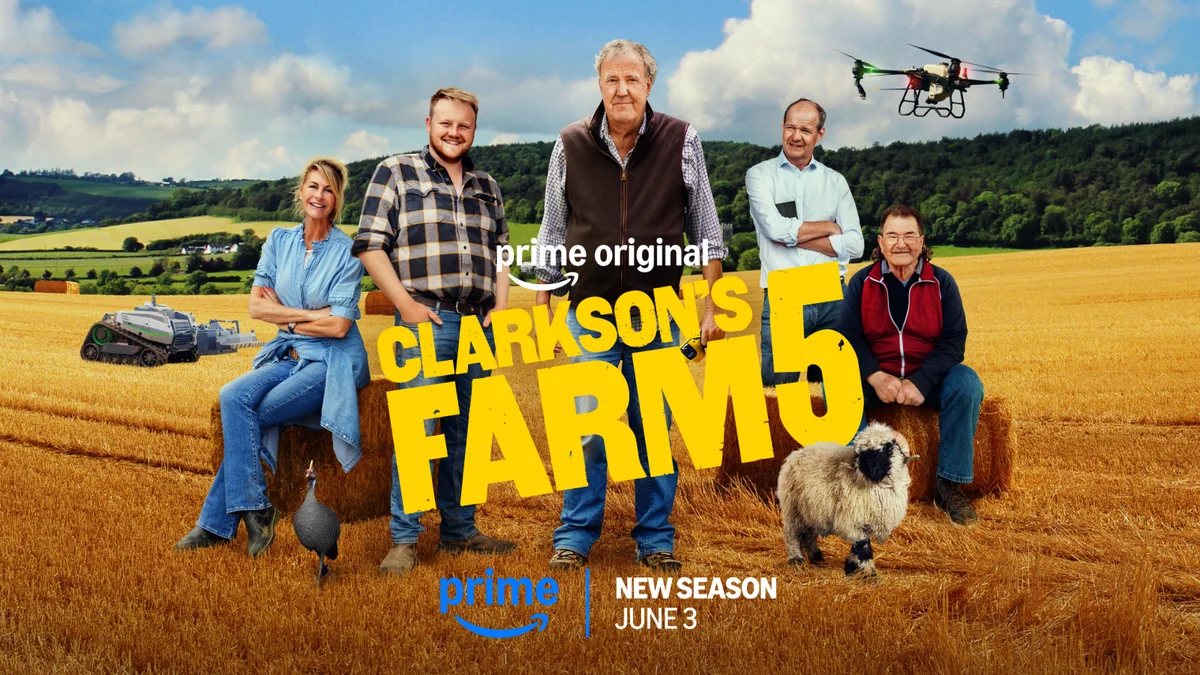
The longer-term achievement is the ensemble. Clarkson's Farm has built a group around its host whose responses are now as important as his provocations. Kaleb can often diagnose the bad idea while it is still being explained. Charlie Ireland tends to arrive carrying the number, regulation or practical detail that reveals why the day's genius plan will cost substantially more than expected. Lisa Hogan brings a different relationship with Diddly Squat, less obsessed with machinery and occasionally just as capable as Jeremy of converting enthusiasm into expenditure.
Gerald Cooper barely needs every word to be decipherable to remain essential to the atmosphere. Vets, builders, breeders, neighbouring farmers and specialists come and go without making the farm feel like a closed television set. That is something many reality formats never manage: Diddly Squat appears to have a life beyond the edit.
It is why a quiet exchange between Kaleb and Charlie can be more engaging than an entire commercial side quest. Their disagreements matter because they represent competing ideas about what the farm should become rather than conveniently assigned television roles.
Agriculture is still surprisingly good television
Give this series a seed drill and ten minutes. It can explain soil compaction, crop yield, machinery costs or the financial consequences of one poor decision without making the result feel like homework. Season one proved it with the harvest and that famous end-of-year calculation. Later seasons expanded the vocabulary into cattle, pigs, mushrooms, restaurants and an increasingly ambitious collection of diversification schemes.
Season five is strongest when it finds something genuinely new to learn. The Netherlands trip and its look at highly automated agriculture provide Clarkson and Kaleb with exactly that. Bringing some of those ideas back to Diddly Squat produces a conflict more useful than another manufactured feud: new technology promises efficiency, the existing system has decades of accumulated knowledge behind it, and the two men trust those answers to very different degrees.
The positive reviews of the season repeatedly respond to this combination of education and comedy. Even Stuart Heritage's more reserved Guardian assessment argues that the series comes alive again when it gets back to actual farming. That feels accurate. The equipment may evolve, but Clarkson's best antagonist remains a field that refuses to cooperate.
Diddly Squat has become a television empire as well as a farm
The complication arrived gradually. The shop expanded. The brand expanded. A restaurant consumed a significant storyline. Season four devoted much of its running time to finding and opening a pub. Diddly Squat is no longer simply a working farm being filmed by Amazon. It is a network of businesses whose extraordinary commercial visibility exists partly because the farm became a hit television series.
Season four made that transformation difficult to ignore. Reviews were still broadly positive, but several noted that the spirit of the early years was being diluted as the Farmer's Dog moved towards the centre of the story. Season five inherits the pub, its operational problems and the increasingly awkward line between documenting a farmer who needs alternative sources of income and following a media personality expanding a hugely visible consumer brand.
That does not automatically put these stories outside the show's subject. Diversification, selling produce and finding viable routes to market are legitimate agricultural questions. The dramatic weight changes, though. A crop failure on a field and a logistical problem at a celebrity-owned destination business do not carry quite the same texture of risk.
The catastrophe has become a recognizable piece of formatting
There is another form of wear. Jeremy has an idea. Kaleb or Charlie explains why it is terrible. Jeremy proceeds. Machinery, livestock, bureaucracy or weather introduces a complication. Editing then finds the joke, the absurd expense or the temporary solution. It remains an effective rhythm. It is also much easier to see than it was five years ago.
Season five's critics differ on how damaging that is, but not really on its existence. Some describe the disasters as increasingly stage-managed. Others simply argue that a well-managed Clarkson catastrophe is still extremely funny.
Both positions have something to them. Clarkson remains exceptionally good at television. He knows how long to leave a silence after something goes wrong, how to sustain an argument and which machine will transform an ordinary rural task into a sequence worth watching. Five seasons have not removed that talent. They have made the machinery around it easier to recognise.
Season five finds something the usual joke structure cannot absorb
The final stretch of the fifth season changes the emotional temperature considerably. Health problems disclosed by Clarkson within the episodes themselves periodically take him away from the farm, leaving Lisa and Kaleb to keep the work moving. His absence exposes something years of comic arguments could obscure: these people have developed relationships that matter independently of the format.
Kaleb is particularly effective here because the show does not need to manufacture his development. It has already happened. The young contractor introduced in season one has become central to the operation of Diddly Squat, a father and a public figure, while still looking at some of his employer's decisions as a personal attack on agricultural common sense.
The show wisely allows farm life to continue around the heavier material. Crops still require attention. Animals create another problem. Harvest eventually arrives. That continuity gives the episodes much of their power. Agriculture does not pause its calendar because one member of the team is going through a difficult period.
Five seasons have changed Clarkson and changed the question the show has to answer
Season one could still flirt with the possibility that Clarkson might discover the true cost of his experiment and walk away. That question no longer has much force. Diddly Squat, the series and the businesses around it are established institutions now. Whether Jeremy Clarkson can become a farmer is no longer the story.
The more interesting future lies in consequences. Did the unusual crop introduced two seasons ago ever make financial sense? Did the expensive machine genuinely improve efficiency? What became of an earlier experiment once the cameras moved to the next project? How does a choice made in one season reshape the farm two years later?
That continuity is already Clarkson's Farm's greatest advantage over a simple collection of rural disasters. Viewers now know the buildings, animals, fields and people. A failed harvest is not an isolated gag when previous seasons have shown how much labour, money and expectation have been buried in the same ground.
Clarkson will continue to attract the camera. Five seasons in, though, the show's cleverest achievement may be that it has built a world in which Jeremy Clarkson is no longer automatically the most interesting person in every scene.