
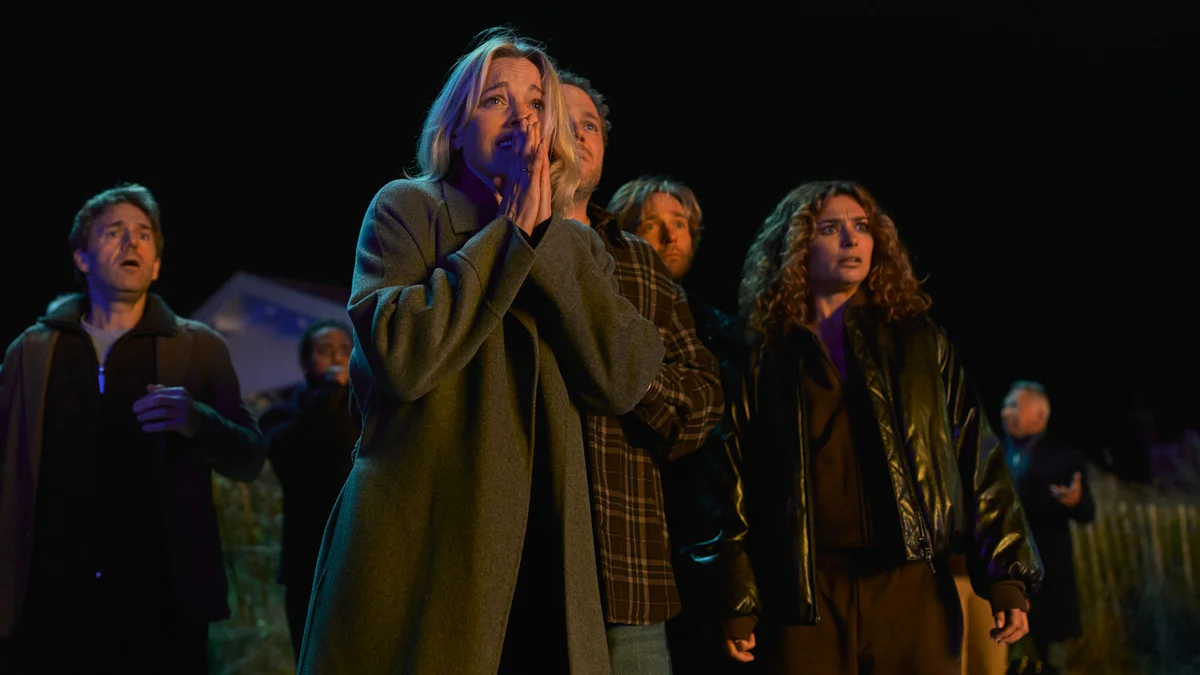
Seven episodes, seven versions of the same friendship
The Perfect Lie makes one structural decision that immediately solves part of the adaptation problem. Each episode is named after a character, while the mystery is gradually reconstructed through police questioning after the fire that killed Evert. Karen opens the story, then the perspective shifts. Hanneke, Simon, Michel, Patricia, Babette and Ivo each receive their turn inside the machine.
The device is hardly new. VPRO Cinema openly describes the police-interrogation framework as a familiar television trick. Familiar does not mean ineffective. In a story built around people lying to one another, letting each person provide a version of events creates useful friction. Something casually stated in one episode can return later with a different meaning.
This is where the series becomes more interesting than a straightforward murder puzzle. The question is not only what happened inside the villa. It is how much these people ever understood about one another before the fire forced them to reconsider every supposedly intimate relationship.
Karen gets us through the door, but the room is more interesting than she is
Loes Haverkort gives the series a reliable centre as Karen, the outsider whose arrival in Bergen coincides with an already fragile period in her professional life. The move promises escape. The dinner club offers something more seductive: huge houses, money, parties, desire and the accelerated intimacy of people who behave as though a new friendship has existed for years.
That speed is also one of the writing problems. SerieTotaal makes a convincing criticism when it argues that Karen and Michel become integrated too quickly. The series needs the audience to accept the group's attraction almost immediately because it wants to start dismantling the friendship before it has completely demonstrated why Karen needed it so badly.
Haverkort has enough control to keep Karen credible, particularly once her past begins interfering with her new life. Yet several supporting characters become more intriguing precisely because they receive less obvious narrative responsibility. Rifka Lodeizen gives Hanneke a loneliness that exists beyond the mystery. Teun Luijkx makes Michel's relative decency feel almost strange in a room full of competing agendas.
The characters are often most interesting when the show temporarily stops treating them as suspects.
Bergen provides the perfect lie before anyone speaks
The critical response is far more consistent about the production itself. The series looks excellent. The dunes, sea, wooded roads and expensive houses are not merely there to display the Netflix budget. They immediately communicate the protected social bubble these couples have constructed around themselves.
Bert Pot's cinematography repeatedly exploits the contradiction. Spaces are open, bright and almost aspirational while the relationships inside them become progressively narrower and more uncomfortable. Clothes, cars and interiors all contribute to a life designed to be looked at.
FilmVandaag's comparison with Big Little Lies is easy to understand: a wealthy coastal community, complicated marriages, curated lifestyles and a death disturbing the scenery. The Perfect Lie does not have the same psychological precision, but it understands the visual pleasure of allowing something ugly to spread through a place that looks built for a luxury property brochure.
Soap is not automatically a weakness
There is sex, alcohol, jealousy, marital deception and enough spectacularly poor decisions to sustain several dinner parties. A number of reviews describe the series as soapy, sometimes critically. Netflix itself labels the show that way in its Dutch catalogue, so the production is hardly disguising its intentions.
The tone works when it gives scenes immediate energy. A dinner can become a competition. A minor remark can reopen a wound. The cast understands that very few of these people are as relaxed as they pretend to be, and the show is often stronger during a tense conversation than when it loudly activates the machinery of a thriller.
Heaven of Horror sees the relationship drama as part of the appeal. Decider is more skeptical, arguing that the mystery lacks enough depth underneath its glossy surface. Both responses make sense. The Perfect Lie can generate plenty of motion by destabilizing marriages and friendships. It is less consistent at turning all that motion into layered character work.
Everyone has a secret; fewer people have an arc
This becomes the most persistent limitation. Seven episodes give the adaptation something the 2010 feature film simply did not possess: time. Dorien Goertzen and Jop Esmeijer can redistribute perspectives, modernize the material and let the people inside Saskia Noort's premise exist beyond the mechanics of a murder mystery.
Some of that opportunity is used well. Character-focused episodes add context and reshape alliances, while individual performances can alter our understanding of someone who previously looked straightforward. But the series enjoys revealing another affair, resentment, shady arrangement or concealed truth so much that depth occasionally becomes indistinguishable from inventory.
VPRO Cinema calls the characters fairly flat despite praising the cast. SerieTotaal goes further, arguing that the additional runtime too often produces soap-level development. What's on Netflix reaches almost the opposite conclusion and sees the same abundance of secrets and relationships as evidence of a rich, unusually strong Dutch drama.
The divide is understandable. If the pleasure comes from watching the series rapidly turn over the cards it has placed on the table, The Perfect Lie is generous. If every revelation is expected to permanently deepen the person attached to it, the results are much less even.
The timeline occasionally fights the mystery
Flashbacks give the series its framework and also create some of its clumsiest passages. Both FilmVandaag and SerieTotaal identify moments when the chronology becomes unnecessarily difficult to read. The time shifts are frequent enough that the question occasionally stops being “Who is lying?” and becomes “When exactly is this happening?”
That matters in a thriller built around who knows what at a particular point in time. A revelation works because information has been distributed in a precise order. Once that order feels uncertain, a character's reaction can appear premature or logically inconsistent.
The episodic rhythm remains effective despite those problems. Most chapters find a strong enough final turn to create immediate curiosity about the next one, which helps explain why even several of the more critical reviews still describe the series as easy to binge.
A modern adaptation that knows what should survive
Updating the novel means more than replacing phones and cars. Karen's professional situation, shifting expectations inside the marriages, the group's social behaviour and the particular way these people consume wealth clearly belong to 2026. They do not feel like characters preserved from a 2004 novel and given a new wardrobe.
The adaptation also preserves Saskia Noort's most useful premise: social closeness can become a form of surveillance. These people dine together, know one another's children, enter one another's homes and collect intimate knowledge almost casually. The closer the circle becomes, the more valuable a secret is.
That makes the series format an obvious fit. Seven episodes can watch the façade crack far more slowly than a ninety-minute film ever could. Which is exactly why the occasions when The Perfect Lie chooses to introduce another crack instead of examining the one already there feel like its biggest missed opportunity.