
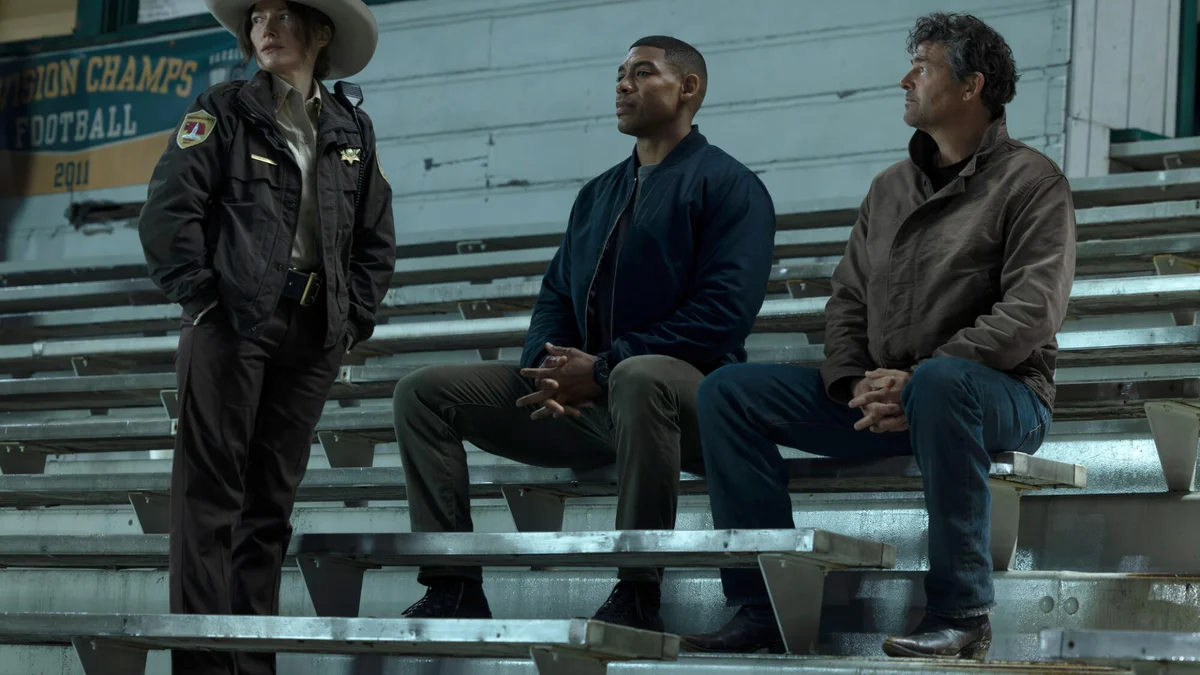
Two Green Lanterns who would almost rather work alone
Lanterns begins with an idea far less spectacular than its source material: put Hal Jordan and John Stewart in a car, send them into rural Nebraska and wait for them to start tolerating each other. Hal is already a legend when John is assigned to him as a trainee, and he immediately recognises what that arrangement might eventually mean. John has little interest in spending his career thanking a mentor who keeps reminding him that he never wanted an apprentice.
Kyle Chandler plays Hal through confidence, instinct and accumulated fatigue. The charm is still there, although it often functions as camouflage for selfishness. Aaron Pierre builds John in the opposite direction: controlled, intensely observant and carrying anger that rarely needs to become loud. Critics who screened seven of the season's eight episodes repeatedly identify their abrasive chemistry as the element capable of carrying the series whenever the central investigation loses momentum.
The mentorship also avoids the easy version of an ageing hero gracefully preparing to leave. Hal protects his position. John wants to earn his without becoming Hal. Their conversations consequently feel like negotiations over authority rather than standard superhero lessons.
True Detective with a green ring, but not merely that
The True Detective comparison is unavoidable: empty roads, a small town guarding old secrets, outsiders investigating a crime that exposes older resentments. Chris Mundy knows that vocabulary, and Lanterns understands it well enough to avoid feeling like an HBO procedural wearing a temporary DC costume.
Rushville gradually becomes more interesting than the crime that brings the Lanterns there. Kelly Macdonald gives Sheriff Kerry Kane enough authority to avoid becoming the local official whose job is simply to explain the town. Garret Dillahunt and Poorna Jagannathan contribute to the same effect, playing people whose private interests exist before the mystery turns them into suspects, witnesses or obstacles.
That is where the Earthbound approach earns its keep. Green Lanterns can create extraordinary constructs from thought; the series spends far more time asking them to understand ordinary people. Viewers expecting eight hours of interstellar battles may reasonably find the restraint frustrating. The advantage is that the rings still feel strange whenever the fantastic breaks into a landscape that had begun to resemble an almost conventional crime drama.
John Stewart benefits from television's extra time
Multiple timelines allow Lanterns to explore what the mentor-trainee relationship cannot explain by itself. John's family history, his understanding of fear and his definition of courage receive space that a feature film would probably compress into a couple of flashbacks and one serious conversation. The episode most directly focused on his background is among the instalments most consistently praised in the review corpus.
That structure prevents Pierre from playing John as merely the next man in line. He studies Hal, occasionally admires him and frequently judges him, while discovering that sharing a symbol does not mean sharing a moral code. Succession becomes a conflict between personalities before it becomes a piece of franchise planning.
Hal is still the more immediately seductive presence. Chandler makes his arrogance funny without making it harmless, and some of the series' best character work comes from realising that confidence is also one of Hal's avoidance mechanisms. The scripts occasionally explain this after Chandler has already made it clear.
The timeline structure eventually charges interest
Moving between different periods creates mystery and perspective, but it also interrupts momentum. Some flashbacks arrive just as the present investigation needs to keep moving. Critics have similarly singled out uneven middle episodes and a broader sense that Lanterns can feel divided between rural detective story, family drama, meditation on heroism and cosmic mythology.
Eight episodes leave relatively little room for narrative idling. An hour devoted primarily to repositioning information or delaying a reveal occupies a large percentage of the season. The dialogue and cast usually keep those stretches watchable, but the mystery itself is not always as compelling as the people moving through it.
Lanterns also has a habit of verbalising ideas it has already dramatised successfully. Fear, inheritance, power and responsibility emerge naturally from Hal and John's relationship. A few scenes then underline those themes after the actors have already done the job.
Limited spectacle is a choice, not always an advantage
The restrained action is the clearest dividing line across reviews. Long sections pass without the kind of large-scale set piece expected from Green Lantern, and the episodes that finally increase the volume can briefly feel as though another show has broken through the wall. The contrast gives the powers weight, but it can also expose how deliberately subdued the preceding hours have been.
The Guardian largely sees flatness where TV Guide, the Los Angeles Times, RogerEbert.com and TechRadar find room for character. Both reactions make sense. Lanterns is at its strongest when the lack of spectacle creates tension; it is weaker when restraint simply feels like postponement.
The wider Green Lantern mythology creates a similar tension. Sinestro, the Guardians, Guy Gardner and the broader DC Universe all exist around the edges, but the series resists turning every appearance into an advertisement for another project. That discipline is welcome, even when certain characters feel temporarily parked outside the story waiting for a future assignment.
A review written before the public finale
As of September 26, 2026, six episodes have aired, with episodes seven and eight scheduled for September 27 and October 4. Several launch critics were given seven of the eight episodes for review. This assessment therefore draws on a critical corpus that extends beyond the publicly available run without pretending that the unaired finale has already settled every question.
The central achievement does not depend on that final twist. Lanterns has found a convincing way to make Hal Jordan and John Stewart interesting before making them spectacular. Its pacing and timeline architecture are not as consistently sharp as the performances at its centre, but the series understands one useful contradiction: a ring capable of turning imagination into reality becomes more compelling when worn by two men who cannot agree on what should be done with it.