
The smartest thing the show did was stop trying to prove how smart it is
Rick and Morty has rarely suffered from a shortage of concepts. Even weaker seasons could produce a throwaway science-fiction premise that another show might build an entire year around. Simulations inside simulations, disposable universes, fabricated memories, cloned families and societies built around ridiculous logical rules are still treated like ordinary Tuesday material here.
What became exhausting was the show's awareness of that reputation. At its most self-conscious, Rick and Morty could feel like a comedy about Rick and Morty explaining why conventional Rick and Morty episodes were beneath Rick and Morty.
Season 9 loosens that grip. The critical response has been unusually strong: Rotten Tomatoes lists a 100 percent Tomatometer from ten reviews, while the available Metacritic notices range from positive to highly enthusiastic. More useful than the numbers themselves is the recurring argument underneath them — the series feels less stagnant.
Rick is changing, just not into a nicer person
Early Rick could erase almost any consequence. A portal gun, another reality or a sufficiently cynical speech usually restored his position as the smartest person in the universe.
That trick has become less reliable.
Season 9 continues a longer character shift in which Rick's depression, drinking and emotional avoidance are allowed to exist beyond nihilistic punchlines. He is still capable of appalling behavior. The writing simply no longer assumes that intelligence protects him from having to live with himself.
That is a much better direction than preserving the untouchable Rick of the early seasons forever. He was an extraordinary comic weapon. Nine seasons of invulnerability would have turned him into furniture.
Morty has absorbed more of Rick than either of them would like
Morty is no longer merely the terrified kid dragged through a portal. He has enough experience to recognize patterns, make decisions under pressure and occasionally become the person in the room who understands how dangerous Rick's solution actually is.
That growth creates some of Season 9's friction. The return of Evil Morty, for example, pushes long-running continuity forward in ways some viewers and critics found surprisingly abrupt. The show still has a habit of building mythology with one hand and mocking the audience's investment in mythology with the other.
But allowing Morty to retain what he has learned matters. Resetting him to the pilot version would now feel dishonest.
The Smith family has quietly become the show's second engine
Summer, Beth and Jerry were once mostly the people left behind when the portal opened. The better recent episodes understand that they are now essential to the structure.
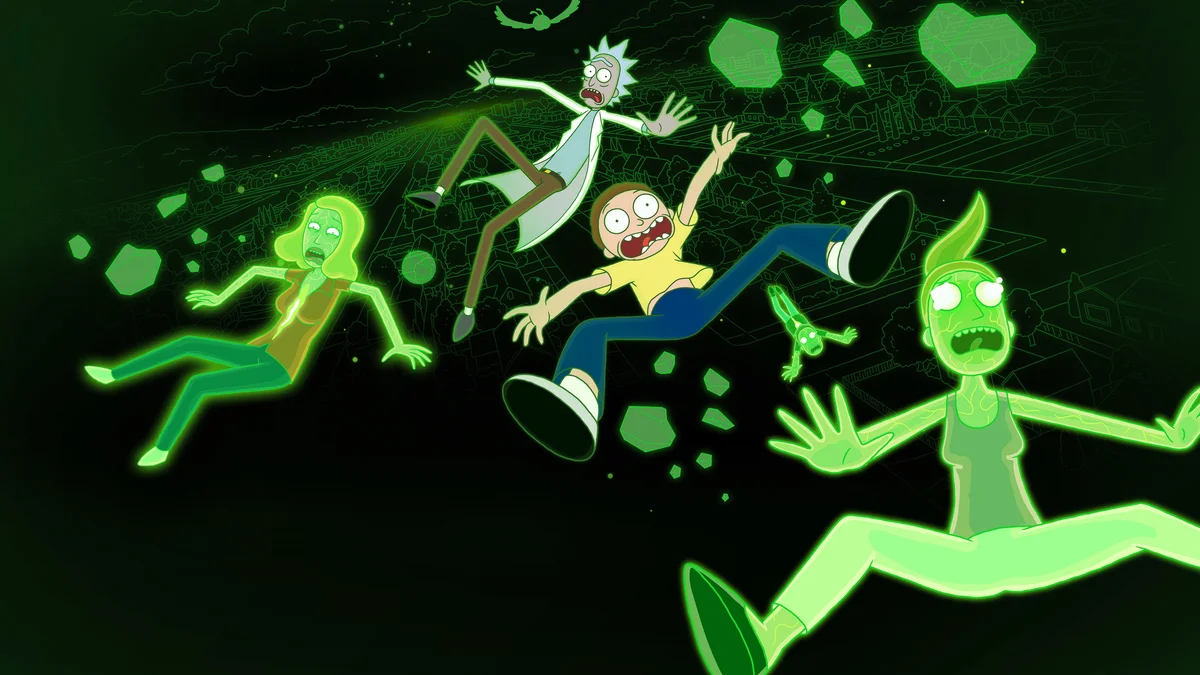
Jerry remains magnificently Jerry, but he is no longer useful only as a target. Summer can carry large sci-fi ideas herself. Beth and Space Beth let the series explore the family's inherited narcissism without routing every emotional problem through Rick.
GamesRadar's Season 9 assessment highlights this broader use of the family, and it is one of the clearest signs of maturity in the writing. A show this old cannot survive forever on the exact same grandfather-grandson configuration.
The animation keeps getting more ambitious without abandoning its ugly little charm
Adult Swim has promoted Season 9 as the show's most technically ambitious run, pointing to hand-drawn material, bespoke 3D work and battle sequences involving hundreds of characters.
The basic Rick and Morty visual language remains deliberately crude enough that these bursts of complexity still register. Huge choreographed fights or bizarre alien spaces feel bigger precisely because the series can also spend several minutes watching two badly drawn people argue in a garage.
That balance matters. Spectacle is useful here, but an emotionally miserable conversation can still land harder than an interdimensional war.
The voice transition is finally just part of the show
Ian Cardoni and Harry Belden are no longer functioning as novelties or replacement voices to be inspected against old clips. They sound increasingly like the current versions of Rick and Morty because the performances have had time to develop with the characters.
Cardoni is particularly effective when Rick's certainty collapses. Belden gives Morty more confidence without losing the strained anxiety underneath it.
The most important success is simple: whole scenes can pass without the casting change becoming the subject.
There are still episodes where the machine rattles
Nine seasons create repetition no matter how aggressively a show fights it. Some concepts stretch beyond their natural length. Some jokes circle familiar territory. Continuity-heavy episodes can still create the odd sensation that the writers both want viewers to care deeply and find caring deeply slightly embarrassing.
Collider's review captures that tension well, describing Season 9's broader experiment as imperfect while still finding the standalone adventures consistently entertaining. Metacritic's small set of critic reviews similarly suggests improvement rather than universal perfection.
That is a fair description of modern Rick and Morty. The lows have not disappeared. The distance between them and the highs has become less irritating.
It is better now that it is no longer required to be a cultural event
At its peak, Rick and Morty escaped the boundaries of television. Pickle Rick, Szechuan sauce and portal-green merchandise became part of internet culture, along with a fan reputation the show itself eventually learned to mock.
That level of omnipresence has faded. A recent Guardian retrospective on Adult Swim still identifies Rick and Morty as the block's rare crossover into genuine mainstream success, but the series no longer dominates online culture the way it once did.
The reduced pressure suits it.
Season 9 can just be a strong season of television. It can resolve a long-running piece of mythology, spend another episode on a stupid family problem, push Rick toward an uncomfortable emotional realization, then immediately throw everyone into another ridiculous universe.
Nine seasons into a show built on infinite possibilities, the surprising achievement is that some of those possibilities still feel new.