Before the maze became the show
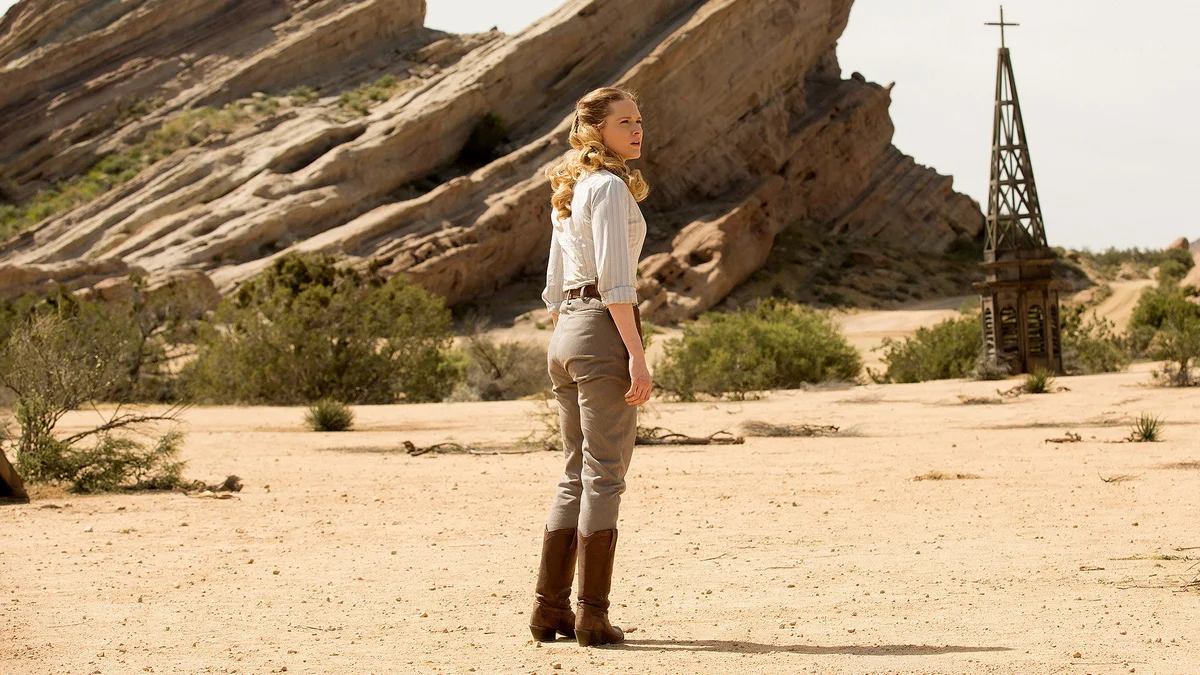
The first season of Westworld understands a crucial distinction: a mystery is useful only while it remains attached to someone who has something to lose. Dolores wakes inside the same morning. Maeve performs another variation of the same life. Bernard studies consciousness while quietly carrying mysteries of his own. Their loops are narrative architecture, but they are also prisons.
That is why the early density works. The Guardian praised the fusion of western imagery and corporate science-fiction dystopia, while Vanity Fair found the series troubling, addictive and increasingly compelling after its deliberately overloaded opening. The ideas are huge, yet viewers still have emotional anchors inside them.
The cast does an enormous amount of that work. Evan Rachel Wood makes tiny shifts in Dolores feel consequential. Thandiwe Newton gives Maeve wit and urgency. Jeffrey Wright turns restraint into tension, while Anthony Hopkins makes Robert Ford's calmest conversations feel dangerous.
Season two discovers the cost of being clever
Once the hosts rebel, the series expands its geography and its philosophy at the same time. Other parks appear. Delos' deeper purpose comes into focus. Human consciousness itself becomes data that might be stored, reproduced or controlled.
Some of Westworld's finest individual hours come from that expansion, especially when the series pauses its larger machinery long enough to remain with one character. Bernard becomes particularly important because he exists on both sides of nearly every divide the series has created.
The season is also where the puzzle begins competing with the drama. Vanity Fair responded enthusiastically to its maze-like construction, while other critics increasingly objected to the fractured chronology and uneven pacing. Metacritic's season-two collection reflects that split: the acting, imagery and thematic ambition were widely respected, but narrative structure had become a recurring objection.
Confusion can be productive. Constantly proving that events occurred in a different order than expected eventually produces diminishing returns.
The real world is deliberately less magical
Season three makes the series' biggest change by leaving the park behind. Its central irony is strong: humans who treated hosts as programmable objects discover that an artificial intelligence has been modelling and directing their own behavior.
Rehoboam takes the question of free will out of Westworld and turns it into infrastructure. Dolores' revolution becomes larger than host liberation, and Caleb gives the outside world a human point of entry.
Critical reaction shows the cost. Metacritic records a more divided season, with praise for cleaner storytelling and its visual reinvention alongside complaints that the show had lost something essential. Vanity Fair's criticism is more specific: by trading mystery for muscular action, Westworld became easier to follow and less alluring.
The sleek future is impressive. It is also much more familiar than a western amusement park operated like a laboratory for consciousness.
Season four remembers why repetition mattered
The final season partially reverses that drift. Characters once again wake inside patterns they do not fully understand. Stories control behavior. Familiar relationships reappear in altered forms. The series does not literally return to its original configuration, but it begins folding back toward its own language.
Vanity Fair described the fourth season as an upgrade after the muddier third, praising a more coherent version of the show's old philosophical machinery. The A.V. Club similarly welcomed the early return to more comprehensible storytelling, even while acknowledging that this is still Westworld and therefore never truly straightforward.
The season's recursive nature is one of its better ideas. A show obsessed with loops finally starts using its own history as one.
Dolores and Maeve keep the philosophy human
Westworld's larger arguments are most effective when Dolores and Maeve disagree with them through action. Dolores repeatedly thinks at the scale of species, systems and revolutions. Maeve is usually driven by memory, attachment and the stubborn belief that a personal bond can matter even when its origin was programmed.
Bernard occupies the strange middle ground, forever calculating futures while retaining a gentleness that the show's grander intellectual battles often lack. William follows the darker path: a man who treats reality as a game until the search for authenticity consumes almost every other part of him.
When Westworld lets those contradictions breathe, its philosophy feels dramatic. When characters mostly deliver the philosophy aloud, the machinery becomes visible.
The ending is a loop that never receives its final turn
Season four ended on August 14, 2022. Jonathan Nolan and Lisa Joy had conceived a fifth season as the final chapter, but HBO canceled the series that November.
The existing finale can function as a circular stopping point, particularly because it deliberately turns back toward the imagery and structure of the beginning. It is not, however, the complete ending the creators had planned.
That unfinished quality is frustrating precisely because Westworld spent four seasons insisting that stories and endings shape identity. Its own last story was left unwritten.
The irony is almost too appropriate for this show.