
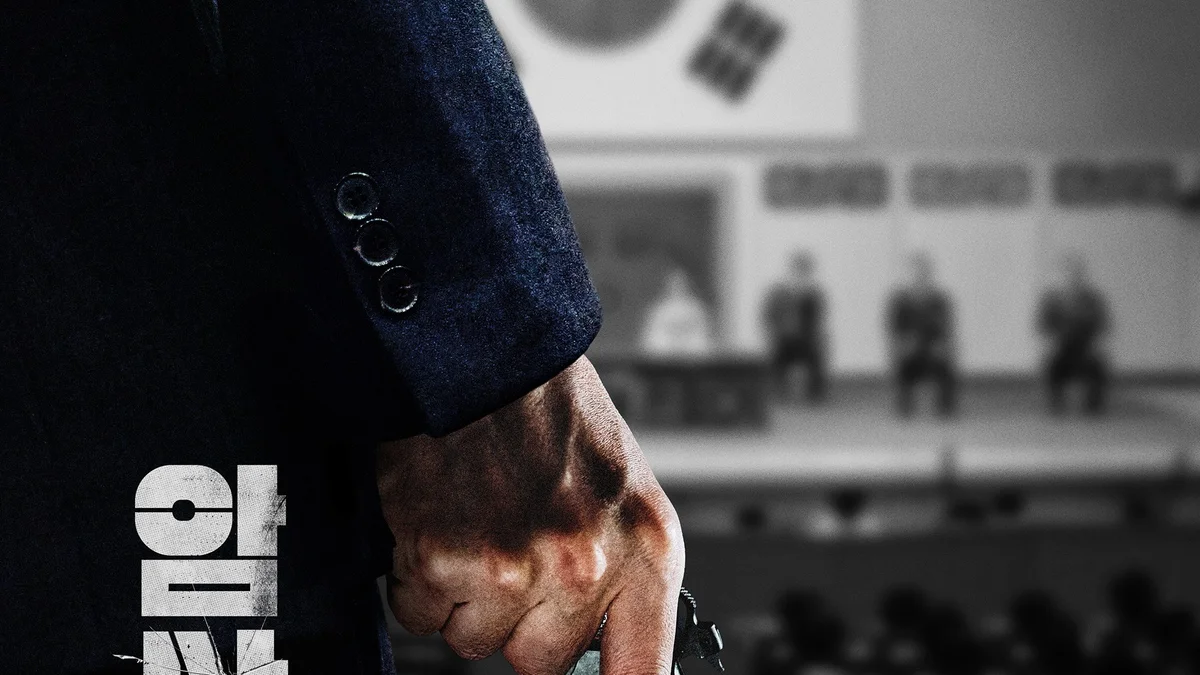
The calendar was unusually crowded. The Chuseok holidays brought several Korean releases into theaters at once, including a new Tazza film and Lee Chang-dong's Possible Love. The Assassin(s) nevertheless remained at No. 1 through its first five days in theaters.
For the Friday-to-Sunday period of September 25-27, KOFIC figures reported by Yonhap give the film 1,199,156 admissions. Across the four-day holiday beginning Thursday, it attracted roughly 1.4 million viewers. Screen International reported 1,119,154 admissions and almost 41 percent of revenue using its own weekend window. The cumulative KOFIC total through Sunday stands at 1,566,222 admissions.
A crowded Chuseok for Korean cinema
The No. 1 position matters because The Assassin(s) was hardly alone in targeting holiday audiences. Tazza: The Song of Beelzebub, the latest installment in the crime franchise adapted from Huh Young-man's comics, finished second with 566,528 weekend admissions according to Yonhap.
Christopher Nolan's The Odyssey continued its huge Korean run behind it, with more than 11.7 million cumulative admissions. The Korean remake of The Intern ranked fourth, while Lee Chang-dong's Venice-winning Possible Love, which is also heading to Netflix, completed the top five.
Against that field, 1.56 million tickets in five days immediately makes The Assassin(s) one of the more significant Korean releases of the year. Korean Film Biz Zone's annual chart already placed it 15th among films released in Korea in 2026 after that initial run.
Hur Jin-ho turns from romance to a 1974 political trauma
The film's subject is considerably less comfortable than the usual holiday thriller. The Assassin(s) is inspired by the August 15, 1974 attempt to assassinate President Park Chung-hee during a ceremony marking Korea's liberation. Park survived the shooting, but his wife, First Lady Yuk Young-soo, was fatally wounded.
The official investigation identified Moon Se-kwang, a Korean resident of Japan, as the gunman. The movie, however, is not presented as a reconstruction claiming to have solved the case. Hur uses lingering questions surrounding the event as the foundation for a fictional dramatic investigation.
Three characters provide its structure. Yoo Hae-jin plays Cheol-gu, a police detective present at the attack. Park Hae-il is Jae-hwan, a newspaper city desk editor, while Lee Min-ho plays Young-il, a rookie reporter drawn into the case. Their parallel investigations let the film approach the event through law enforcement, the press and direct reporting.
A commercial hit inside a historical controversy
The mixture of real history and fictional speculation has also generated controversy in South Korea. Some scenes entertain hypotheses involving figures around Park Chung-hee or the KCIA. Critics and political figures have consequently accused the film of distorting history.
Hur Jin-ho has explicitly resisted presenting the movie as a definitive solution. Before release, he said he had spent years developing the project through documentaries, books, academic papers and overseas material. His stated purpose was to begin with questions left by the historical record and depict people living through a period shaped by political violence, rather than announce a newly identified culprit.
That distinction matters. The possibilities dramatized by The Assassin(s) belong to the film's fictional construction and should not be treated as newly established historical conclusions. The findings of the contemporary official investigation remain separate from the movie's narrative.
Toronto before the Korean box office
The Assassin(s) began its public journey outside Korea. It held its world premiere at the Toronto International Film Festival on September 16 as part of the Gala Presentations program. According to KOBIZ, all 4,256 seats across its four public festival screenings sold out.
Hive Media Corp. produced and distributes the film. Its September 23 domestic opening placed it immediately before the core Chuseok holiday period, following a campaign built heavily around Yoo Hae-jin, Park Hae-il and Lee Min-ho. At least at launch, that scheduling bet has worked.
One holiday weekend cannot establish the full shape of a theatrical run. Five days in, however, The Assassin(s) already carries two stories at once: the commercial story of a historical thriller becoming Chuseok's first choice, and the far more contested question of what happens when popular cinema turns a politically sensitive memory into fiction.