

Daisy Edgar-Jones plays Elinor Dashwood and Esmé Creed-Miles is Marianne in Georgia Oakley's new feature, written by novelist and screenwriter Diana Reid.
The 132-minute film opens in France on September 23 and in the UK on September 25, ahead of Focus Features' U.S. release on October 16.
The underlying crisis is still Jane Austen's. After Mr. Dashwood dies, Norland Park passes to his son from an earlier marriage, leaving Mrs. Dashwood and her three daughters with sharply reduced means and forcing them to relocate.
Elinor is not simply the sensible one
The title makes a binary reading tempting. Elinor represents sense, Marianne represents sensibility, and the story teaches each woman the dangers of taking her trait too far.
Oakley has described the sisters differently. Their relationship is symbiotic: neither starts from a position of complete emotional wisdom, and each possesses something the other needs.
Elinor's control can protect the family, but it can also become self-erasure. Marianne's openness makes her vulnerable, yet it also gives Elinor permission to acknowledge desires she has spent much of the story containing.
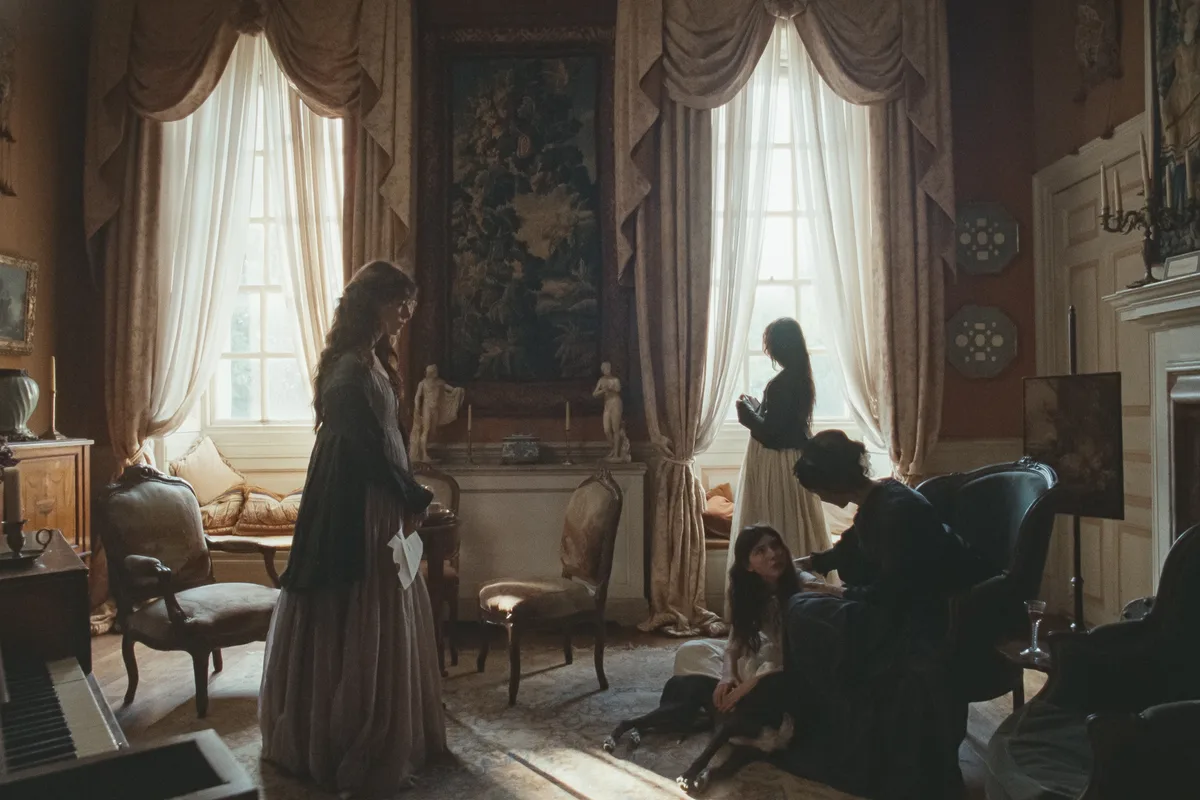
Sisterhood becomes the adaptation's central relationship
Edgar-Jones and Creed-Miles have emphasized that their characters' bond is not merely connective tissue between romances.
Bodhi Rae Breathnach plays younger sister Margaret, while Caitríona Balfe is Mrs. Dashwood. Oakley's film establishes the women as a family unit facing financial displacement before treating the courtships as the entire story.
That matters because the Dashwoods' problem was never only romantic. Their social position, home and economic security are all altered by inheritance law before Elinor or Marianne can begin worrying about whom they love.
George MacKay and Frank Dillane inherit two closely watched Austen roles
George MacKay plays Edward Ferrars, whose restrained relationship with Elinor is complicated by family pressure, money and an existing commitment she does not initially know about.
Frank Dillane is John Willoughby, the charismatic figure whose immediate intensity makes him appear far better suited to Marianne.
Herbert Nordrum takes on Colonel Brandon, a role still strongly associated with Alan Rickman's performance for many viewers. Fiona Shaw plays Mrs. Jennings, with Eliot Sumner also among the ensemble.
Austen adaptations come with unusually long casting memories. These performances are not entering empty roles; they are entering characters audiences have watched other actors inhabit for decades.
Even the costumes avoid an overly polished Regency fantasy
Costume designer Grace Snell approached the period with the same grounded intention as Oakley's direction.
The wardrobes use relatively restrained silhouettes, muted colors and some antique textiles. Clothing also changes with the Dashwoods' circumstances, moving from mourning into the warmer, more practical world of Devon and then toward a sharper visual language in London.
The goal is to make clothing feel owned, reworn and sometimes shared rather than treating every scene as another pristine Regency fashion plate.
The 1995 film remains the unavoidable comparison
Ang Lee's 1995 adaptation, written by and starring Emma Thompson opposite Kate Winslet, won the Academy Award for adapted screenplay and remains one of the defining modern Austen films.
Focus Features and Working Title are hardly strangers to the author either. Their history includes Joe Wright's Pride & Prejudice in 2005 and Emma. in 2020.
Oakley's film therefore cannot sell itself merely as another chance to see the familiar plot. Its distinction is in emphasis: instead of asking which sister has the healthier temperament, it asks what each one would lack without the other.
Sense and Sensibility opens in French theaters on September 23, 2026.