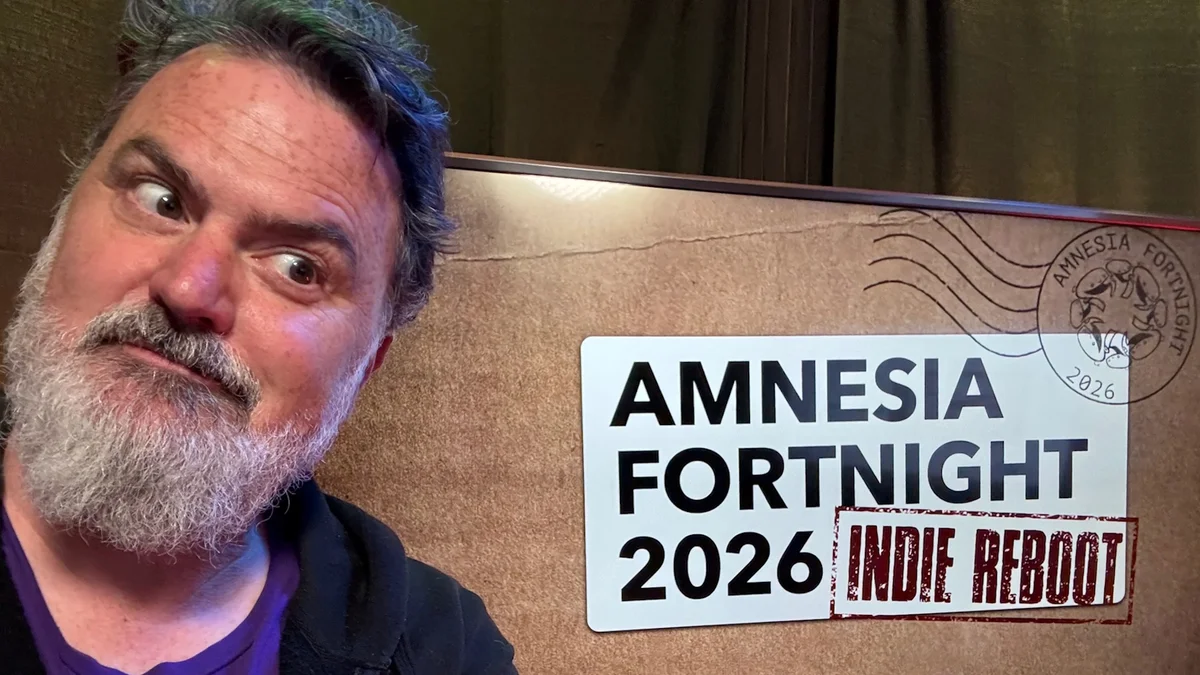
Amnesia Fortnight 2026: Indie Reboot launched on August 31 as a Kickstarter campaign, public game jam and documentary project.
Double Fine employees submitted 26 concepts. Community voting reduces them to four.
The production schedule is deliberately compressed
The first voting round was scheduled to close on September 6, with the finalists to be announced shortly afterward.
Development begins September 9. The four small teams then have until September 23 to produce playable prototypes before eligible backers receive them and a final vote begins.
The Kickstarter closes on September 30.
That timetable is the mechanism, not promotional theatre. Amnesia Fortnight works by denying projects the usual answer to production problems: extending the schedule.
There is now a commercial label waiting on the other side
For 2026, one prototype is intended to move beyond the jam. The final winner will receive additional development and become a small commercial release.
Double Fine Action Labs will publish it.
The studio describes the label as a home for small weird games. Economically, it creates a route for ideas that may be too limited in scope or too unusual to justify becoming a conventional multi-year Double Fine production.
Twenty-six pitches act as the first filter
The candidates range from Architactics, a tactical city-builder with mobile robot buildings, to Fermi's Playground, where the player changes physical laws inside a galactic simulation.
Bard Crawl begins as an online co-op drinking trip and turns into a fantasy dungeon crawler.
The community decides which ideas earn development time. The two-week jam then becomes another filter, testing whether the pitch actually produces an interesting playable system.
Only after both stages does one project receive a longer commercial runway.
The timing follows Double Fine's exit from Xbox
Double Fine announced on July 6 that it would become independent again after seven years inside Xbox.
The studio said the agreement preserved its history and culture while returning ownership of its games.
Its Amnesia Fortnight announcement followed with considerably more discussion of what independence requires. Double Fine has explicitly asked its audience to support the Kickstarter as the studio establishes its next phase.
Crowdfunding is familiar territory for the company, which previously used it around Broken Age, Massive Chalice and Psychonauts 2. The context is different now: the studio is rebuilding an independent operation after years with a platform holder.
Backers are being turned into part of production
Kickstarter tiers affect voting weight, meaning financial support also influences which four pitches receive prototype teams.
2 Player Productions will document development, while Double Fine plans to stream much of the two-week jam.
The campaign consequently functions in several ways at once: financing, project selection, audience development and documentary production.
Action Labs gives the studio a smaller scale to work at
Amnesia Fortnight has already produced games such as Costume Quest, Stacking and Iron Brigade, while other prototypes have fed ideas into larger Double Fine projects.
What used to be an occasional path from internal experiment to release is now being given a label and an explicit publishing route.
That does not mean every Double Fine game suddenly needs to be tiny. It gives the independent studio another production scale: smaller teams, shorter projects and lower financial exposure when somebody pitches something strange.
The first four projects meant to test that structure enter development on September 9.