

Team Falcons announced its departure from competitive Dota 2 on September 7.
The Saudi organization is ending a project that began in November 2023 and quickly became one of the strongest teams in the professional scene.
Its public explanation was not framed as an ordinary performance reset.
Falcons said it was shifting focus toward other esports titles offering greater strategic alignment and long-term operational stability.
Lack of trophies clearly was not the problem
Falcons leaves Dota after winning nine Tier 1 tournaments.
The largest was The International 2025.
The lineup also achieved unusual continuity.
Skiter, Malr1ne, ATF, Cr1t- and Sneyking played 799 games together and won 523 of them.
That gave Falcons nearly everything organizations normally spend years trying to build: results, recognizable personalities and a stable competitive identity.
Its final International ended in 7th-8th place.
That was disappointing for a defending champion, but hardly the sort of sporting collapse that explains an entire division disappearing on its own.
Falcons' language is economic before it is competitive
The reference to operational stability is the most revealing part of the statement.
Falcons did not simply say its team had stopped being good enough.
It described Dota 2 in the context of a wider esports portfolio.
For a multi-title organization, a roster has to justify more than its chances of winning. Calendar structure, commercial visibility, player costs, sponsor activations and the predictability of the ecosystem all matter.
A world championship does not automatically erase those questions.
Dota remains enormous, but much of its business still revolves around major events
The International retains a level of prestige that few esports tournaments can match.
Valve still directly organizes its championship, and Shanghai again hosted the world's leading teams in August.
The surrounding ecosystem, however, does not operate like a closed franchise league with guaranteed shared revenue for every participating organization.
Teams rely on a mixture of prize money, sponsorship, third-party tournaments and the marketing value of their players.
An organization can therefore be extremely successful in competition while still deciding another esport offers a more predictable business environment.
Cr1t- and Aui_2000 make the break feel even more final
Falcons could theoretically have released one lineup and returned with another.
The immediate context points in a different direction.
Cr1t- announced his retirement from professional competition, while coach Aui_2000 also stepped away.
The organization itself explicitly described the move as a departure from Dota 2.
The remaining former Falcons players could become major free agents if they choose to continue competing.
The timing arrives during a wider collapse of familiar lineups
Falcons is not the only major name rebuilding.
OG announced on September 9 that Yopaj, Raven and TIMS had left after the team's 14th-15th finish at The International.
Natsumi- and skem are currently the two remaining players.
Xtreme Gaming had already released NothingToSay, Xxs, fy, xNova and coach LaNm, retaining Ame as the obvious centerpiece of its next roster.
That places an unusually large amount of experienced talent on the market at the same time.
Team Spirit is winning while rivals dismantle themselves
The other defining image of the offseason is much more stable.
Team Spirit defeated Team Vision 3-2 to win The International 2026.
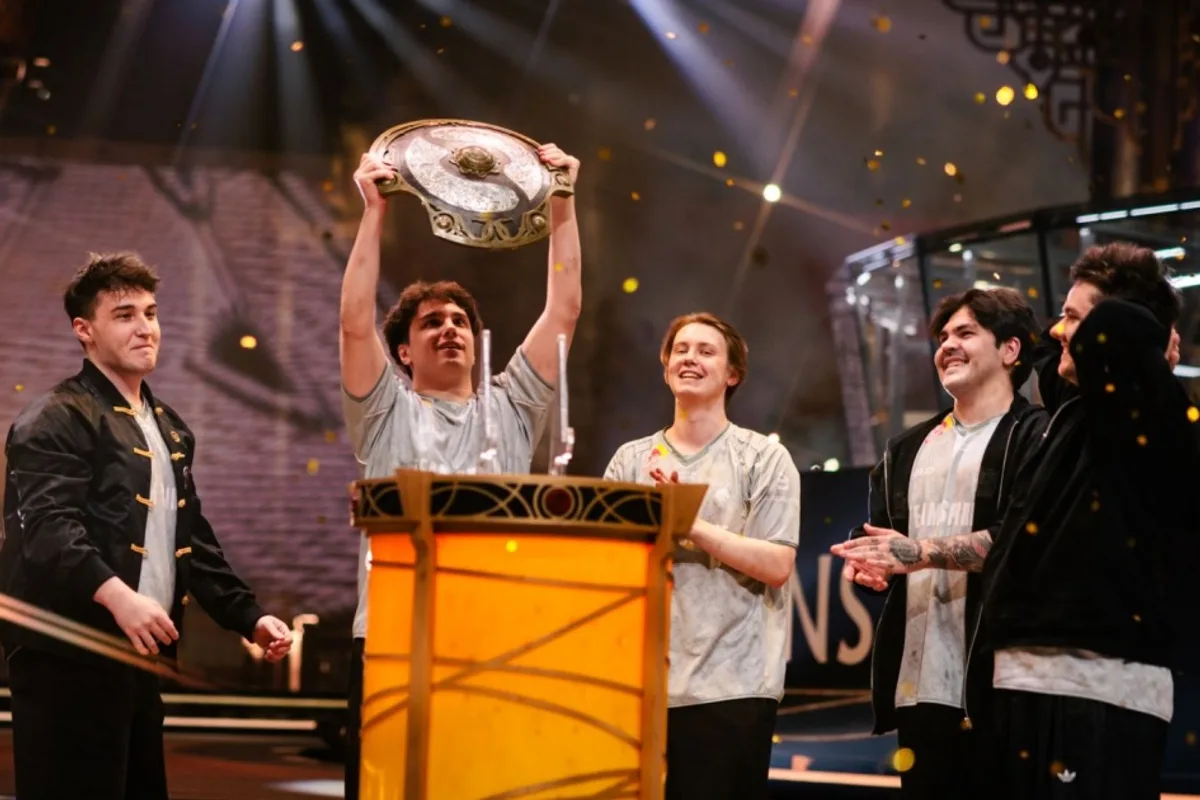
The organization's third Aegis makes continuity look even more valuable at a moment when several famous competitors are breaking apart.
Spirit leaves Shanghai at another historical peak while Falcons disappears, OG removes three players and Xtreme dismantles almost its entire lineup.
Leaving after winning is exactly what makes the Falcons decision significant
One organizational exit does not automatically represent a crisis for Dota 2.
Every esports company has costs, priorities and commercial targets that cannot be reconstructed entirely from public tournament results.
Falcons still makes one simplistic interpretation impossible: only unsuccessful teams leave.
This organization had a recent world championship, nine major trophies and one of the most stable five-player groups in the scene.
It still decided its resources had better uses elsewhere.
For the next Dota season, that may be the most important part of the shuffle. Building championship rosters will depend not only on which players want to compete together, but on which organizations still want to finance that ambition.