
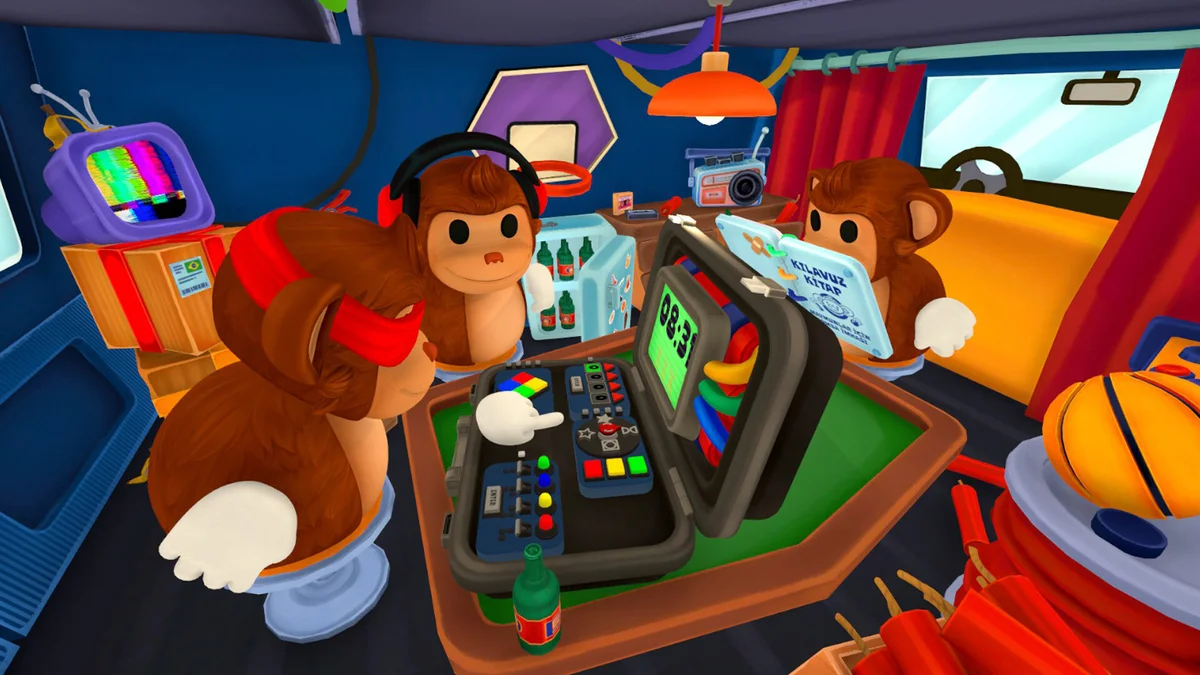
A cartoon built to survive failure
The visual design solves a structural problem before the first bomb even appears. Failure happens constantly, so failure cannot feel severe. BOMBANANA! surrounds the player with exaggerated monkeys, saturated colors, cluttered props and a van that looks more like a children's television set than a credible explosives lab.
That tone makes detonation funny. The bomb going off is not the destruction of a serious mission; it is the punctuation mark at the end of three people misunderstanding one another for several minutes.
The players provide the performances
There is barely any conventional character writing, but the roles generate characterization anyway. Mute becomes expressive because gesture is all they have. Deaf becomes the team's interpreter because sight replaces hearing. Blind is physically closest to the bomb while conceptually furthest from understanding what it looks like.
Different groups fill those silhouettes differently. One trio develops calm procedural shorthand. Another spends the entire evening pointing, shouting and blaming the one person who cannot hear them. The same level can consequently play like disciplined teamwork or an improvised sketch.
Timing creates the comedy rhythm
The countdown is effectively an editor. Early seconds allow explanation. Mid-run uncertainty shortens everyone's sentences. The final moments collapse language into gestures and panic. PC Gamer's hands-on impressions capture that escalation particularly well: even a group that develops a plan remains vulnerable to one badly relayed instruction.
The game wisely resists filling that space with scripted dialogue. Bananas, emotes and physical slapstick support the scene without taking ownership of the joke. The funniest line is usually something a player said because the situation forced it out of them.
Its theme creates a legitimate accessibility question
The three-role premise is intentionally absurd, not a realistic depiction of disability. The humor generally targets failed translation and group panic. Even so, the framing becomes harder to ignore when actual accessibility limitations intersect with the same mechanics.
Wanderer and GameBrief both identify the lack of text chat as a meaningful gap, while feedback from deaf and hard-of-hearing players raises concerns about audio-dependent tasks. Steam does list colorblind support and other accessibility categories, so this is not a game with no accessibility work. It is a game whose central metaphor makes the omissions unusually visible.
That tension does not erase the art direction's accomplishment. BOMBANANA! creates a stage where three simple cartoon figures can generate an evening's worth of stories without needing a traditional plot.