

The smartest narrative decision in Dune: Awakening is an absence.
Paul Atreides was never born.
Funcom can therefore use Arrakis, Leto, the Harkonnens and the Bene Gesserit without asking players to follow a protagonist whose destiny is already culturally fixed.
It borrows from Villeneuve without becoming an interactive film museum
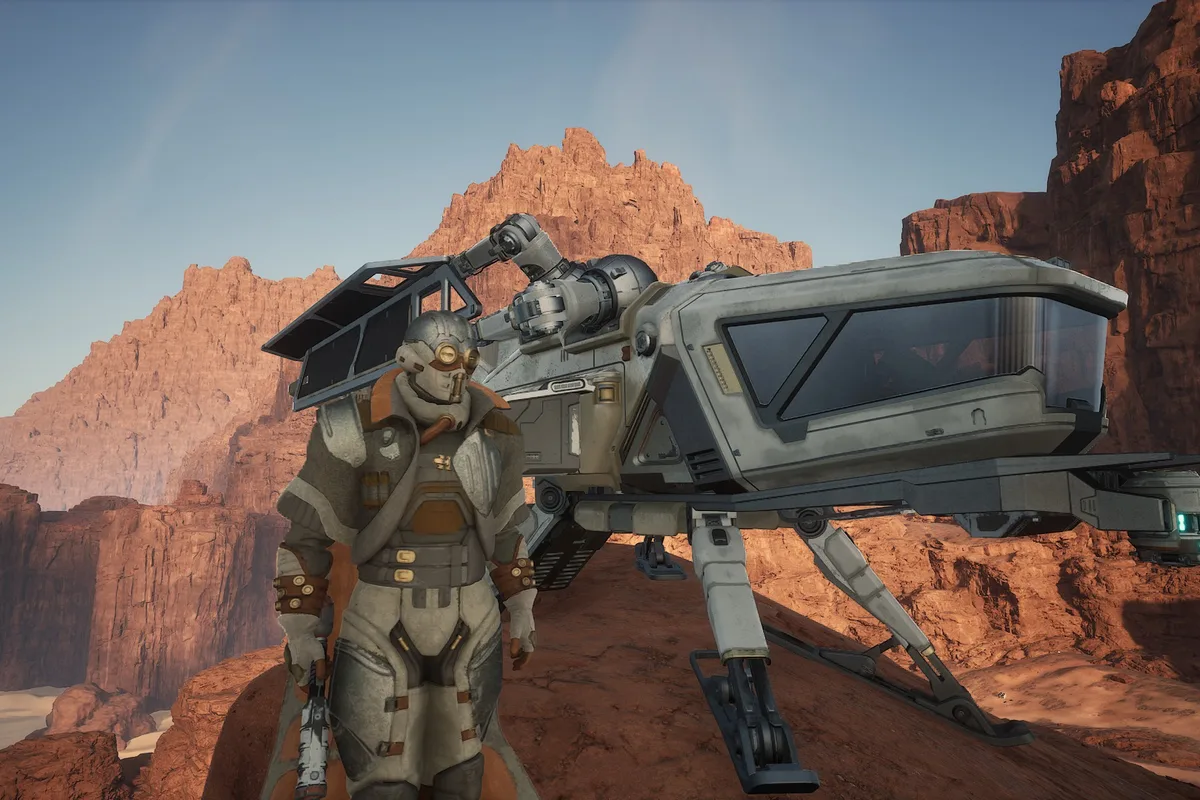
Ornithopters, Imperial architecture and the visual scale clearly draw from Denis Villeneuve's films.
GameSpot nevertheless notes that Funcom develops enough of its own visual language for the world to remain recognisably its interpretation.
Removing Paul destabilises familiar history
Jessica has a daughter instead of the expected son. Duke Leto survives. Atreides and Harkonnen remain locked in conflict while the Fremen have mysteriously vanished.
The divergence is large enough to create uncertainty without discarding the institutions that make Dune recognisable.
It is an unusually useful kind of alternate history for a videogame: preserve the world and remove the person who normally owns its future.
Arrakis works because its culture becomes mechanics
The sun causes lethal exposure. Shade changes routes. Open sand belongs to Shai-Hulud. Human blood can become water.
GameSpot, PC Gamer, TechRadar and Gamekult all respond strongly to this translation of environment into systems.
Dune terminology is not merely written over generic survival mechanics. Much of the survival logic actually feels derived from the fiction.
Technology becomes personal rather than iconic
A stillsuit, thumper or ornithopter carries different meaning when the player has gathered the materials required to build it.
PC Gamer particularly enjoys the gradual accumulation of recognisable Dune technology.
Familiar objects stop functioning as props and become possessions that must be crafted, maintained and potentially lost.
The landscape receives more character than many people do
Trainer quest lines and the main story contain the stronger character writing.
Many contracts fall back on text boards and familiar MMO objectives. GameSpot criticises the amount of busywork built around killing groups or retrieving items.
Funcom is consistently better at making a ravine or sandstorm memorable than an ordinary enemy camp.
The Landsraad originally compressed politics into chores
Its weekly faction structure allowed players to influence server-wide conditions by completing objectives for Atreides or Harkonnen.
PC Gamer found genuine fun in collective contribution, but also noted how quickly active groups could complete the board before less available players participated.
Chapter 3 has since substantially rebuilt the system.
The game's identity changed after its audience answered for it
Dune: Awakening originally pushed its high-level play toward competitive Deep Desert activity.
Funcom later said roughly 80 percent of lifetime players engaged exclusively with PvE.
The studio responded by separating PvE and PvP Deep Desert instances. PC Gamer subsequently noted Funcom's deliberate move away from describing Awakening as an MMO.
The audience effectively decided which half of the original pitch mattered most.
That may suit Dune better than expected
Awakening cannot reproduce the political, religious and philosophical density of Herbert's books.
It achieves something a novel cannot: materialising the daily logic of Arrakis.
Water has weight. Technology requires labour. Spice extraction creates physical vulnerability. The desert must be crossed rather than described.
Dune: Awakening succeeds most convincingly when it stops adapting the story and allows the player to inhabit the conditions that produced it.