
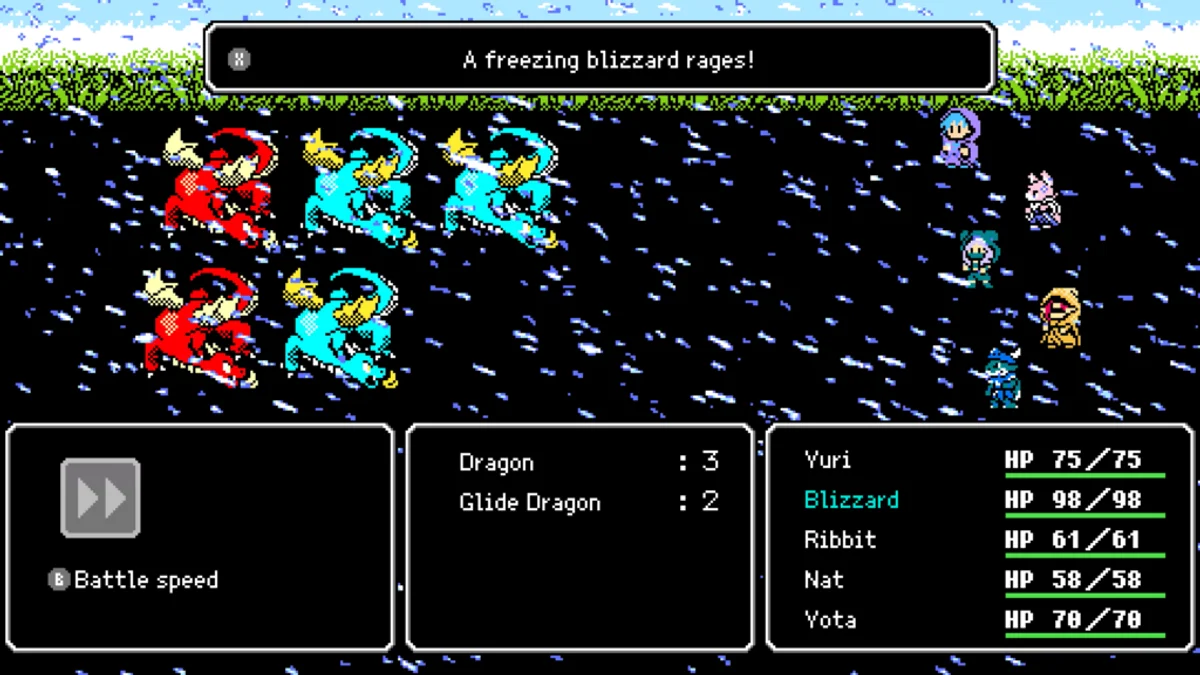
AMATA Games announced the Steam release of Crescent Tower: RISING on August 31, with indie developer Curry Croquette returning to the series.
The original Crescent Tower launched on Steam on August 19, 2025 and openly presented itself as an 8-bit-style dungeon RPG. Its Steam user reception is currently categorized as Very Positive.
RISING preserves that surface while expanding the structure underneath it.
An '80s visual language with a much newer build system
Battles still use simple turn-based command menus. Characters remain compact pixel sprites. Black interface panels and blocky lettering deliberately evoke older hardware.
Skill Blocks, however, belong to a far more contemporary design vocabulary.
Abilities learned through fourteen different classes become differently shaped pieces that must fit onto a limited character board.
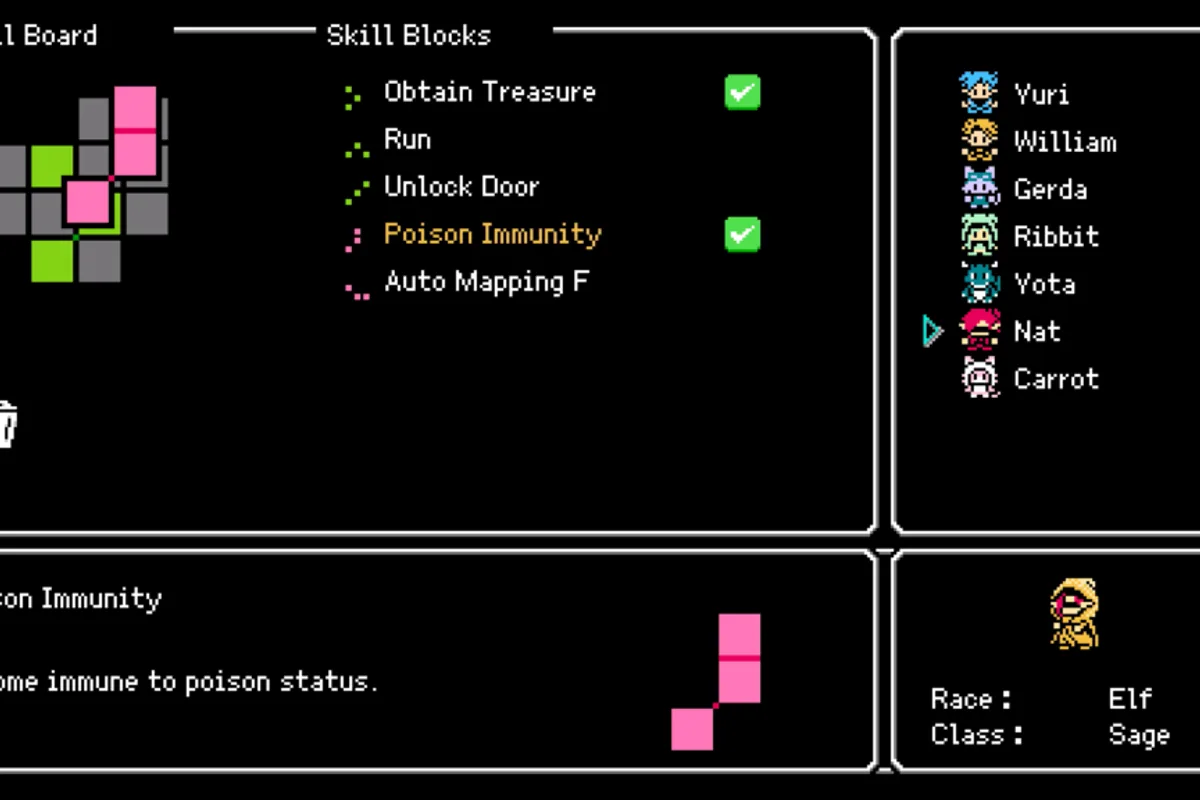
A character's history across multiple jobs can therefore remain relevant after changing class, while the board prevents every useful skill from being equipped simultaneously.
It is retro presentation being used to frame a build-crafting problem rather than simply reconstruct old limitations.
Mapping revives an older relationship with dungeon space
Earlier dungeon crawlers often expected players to understand or document spaces themselves, sometimes literally using graph paper beside the machine.
RISING brings that behavior into its interface.
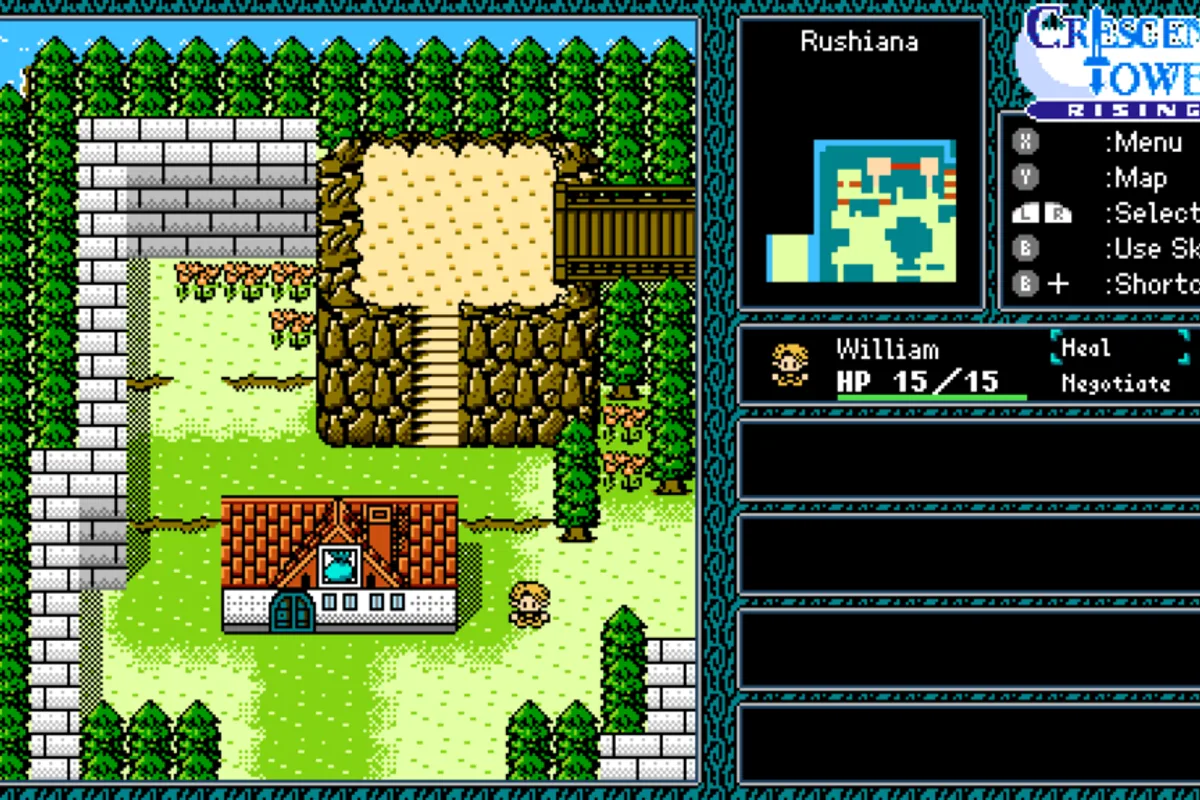
AMATA describes mapping the overworld and dungeons as essential to exploration and suggests that filling in maps may reveal additional discoveries.
Some class abilities even support that process alongside treasure hunting and door unlocking.
The nostalgic idea is therefore behavioral rather than merely visual: knowing where you are is part of becoming better at the game.
The first Crescent Tower deliberately operated on a smaller scale
The 2025 game revolved around a ten-floor tower, three races and nine classes.
RISING expands to fourteen classes and a five-chapter story featuring multiple protagonists and dungeons.
Those different lives eventually intersect around the Tower of the Arc Moon, the structure that appears in the Imperial Capital once every fifty years.
AMATA currently estimates the sequel at 15 to 25 hours.
Retro becomes a framework rather than a technical restriction
That distinction matters in an indie market where “retro” can sometimes mean little more than resolution and palette.
Crescent Tower: RISING absolutely uses those visual signals. AMATA explicitly advertises graphics and sound intended to recall the 1980s.
Its larger changes concern how characters inherit skills, how limited board space creates tradeoffs and how the act of exploring produces information.
The old aesthetic becomes a container for systems that are not obligated to behave like software from 1986.
Curry Croquette is still keeping the project's physical scale small
Despite the broader design, AMATA lists only 1GB of required storage and integrated Radeon 610M or Intel UHD-class graphics among the minimum specifications.
The game remains entirely single-player with no online functionality planned.
Curry Croquette is expanding Crescent Tower without turning it into a production that loses the compact identity of the first game.
Price and release date remain undecided. For a game obsessed with filling maps, those are currently the two blank spaces AMATA intends to keep.