Two centuries later, Atreia still carries its scars
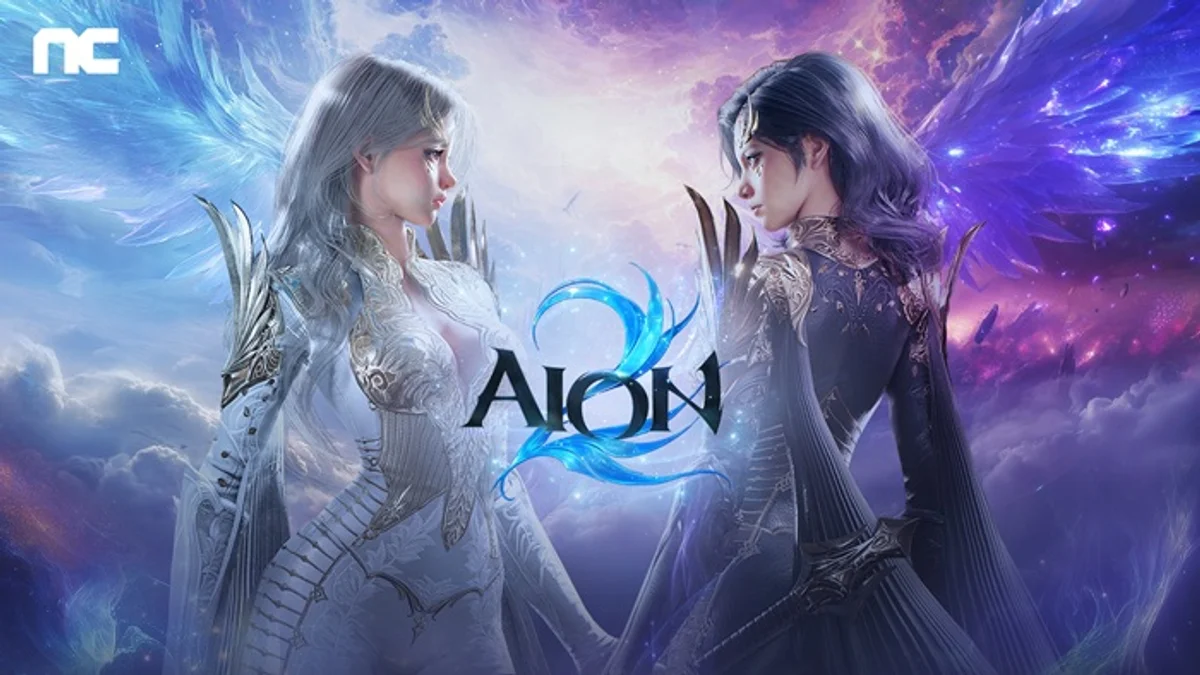
AION 2 returns roughly two hundred years after the original game. The Tower of Eternity has fallen, old balances have shifted and renewed conflict with the Balaur frames a rebuilt Atreia designed at a radically different scale.
NC describes the world as thirty-six times larger than the original. The number matters less than what the space enables: mountains, caves, vertical regions and aerial traversal give the setting depth that a sequence of flat maps could not.
4Gamer's 2026 hands-on impressions emphasize precisely that sense of moving freely through the air. It is probably the strongest expression of the game's fiction.
Elyos and Asmodians still tell different versions of the same world
GameChosun notes that the two factions begin with distinct stories, groups and threats. That separation carries forward one of the original AION's strongest cultural ideas: faction choice changes aesthetics, geography and perspective rather than merely changing a UI color.
Preserving that duality gives the setting an identity many modern MMOs lack.
The difficulty begins when those strong premises have to carry an entire campaign.
The main story lacks memorable faces
GameMeca is much more critical of the characters. After completing the main story, its reviewer found that virtually none of the cast remained memorable despite the potentially rich background involving Daevas, gods, Elyos, Asmodians and Balaur.
Quest design compounds the problem. Dialogue, simple investigation and monster killing repeat often enough that the narrative becomes experienced primarily as a progression route.
An MMO does not need to imitate a hundred-hour single-player RPG to tell a strong story. AION 2 simply needed more room for a few characters capable of surviving the checklist.
Customization tells its own stories
NC advertises more than two hundred appearance parameters, and GameChosun treats the creator as a direct continuation of the original game's social culture around distinctive avatars and shared presets.
That matters because the created model translates convincingly into the live world. Armor, costumes, wings and silhouettes become social language in a game where players spend hundreds of hours seeing their own character among crowds of others.
Here AION 2 finds something its campaign struggles to provide: stories created by players themselves.
Sometimes the best worldbuilding is another player crossing the sky
Flight is no longer a novelty restricted to isolated pockets. Exploration and combat are explicitly designed around verticality, and the global version now makes aerial play one of its central promises.
That turns landscape into narrative. A fortress on the horizon, a valley escaped through the air or another Daeva passing over contested territory immediately communicates what kind of world this is.
AION 2 tells its space better than it tells many of its characters.
The global chapter has not been fully written yet
The worldwide version launches October 5, 2026 on Steam and PURPLE, with this client being PC-only. It has been adapted after almost a year of Korean and Taiwanese live operation, and the recent Launch Scale Test already exposed multiple progression and balance changes.
This review therefore does not assume the global campaign pacing will be identical. It scores the game that has actually been live.
Its setting already has one valuable quality: Atreia is recognizable almost immediately.