
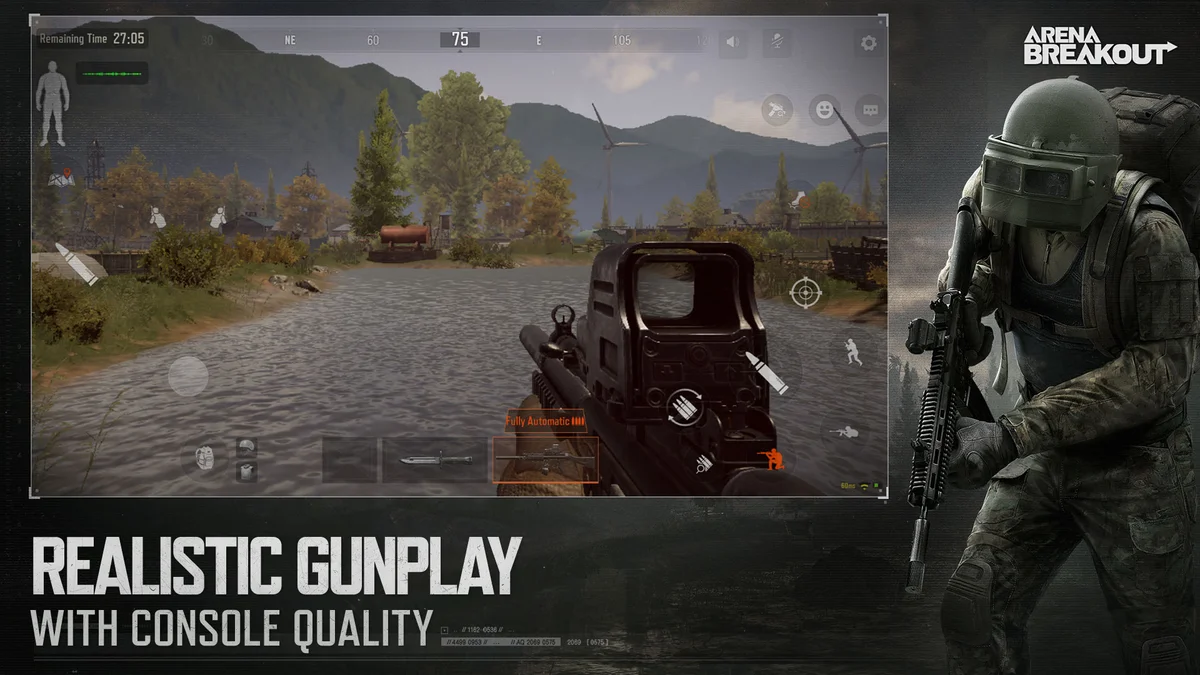
The radical part is not realism but the phone
Arena Breakout feels less surprising now that extraction shooters have become a recognisable genre. In 2023, seeing that design language arrive on iOS and Android with so little of its inconvenience removed was far stranger. A market built around short sessions and immediate rewards suddenly had a game where players could spend minutes preparing equipment only to lose it permanently.
MoreFun preserved most of the rituals that define the form. Ammunition is selected, medicine organised, weapons constructed and backpack space negotiated before entering a match. Death therefore carries a small material history: that lost rifle was purchased, modified and carried to the exact place where somebody took it.
Mobile inevitably changes the language around those systems. Visual sound indicators compensate for inconsistent listening environments, while a customisable HUD turns keyboard-scale interaction into touch controls. Arena Breakout is not a literal PC copy; it is a translation.
Kamona works better as geography than as drama
The fiction takes place in Kamona, a territory torn apart by conflict and populated by armed groups, militants and operators. It provides enough context for abandoned farms, industrial sites, military facilities and heavily contested locations.
That background rarely becomes the main attraction. Characters, factions and missions provide texture without developing into especially memorable dramatic arcs. Reviews tend to spend considerably more time discussing player-created raid stories than the authored plot.
That weakness suits the genre surprisingly well. An open door, an emptied container or a corpse that has already been searched can communicate immediate narrative information more effectively than a cutscene. Maps become evidence that another player's story has intersected with yours.
Sound carries much of the suspense
The official site advertises more than 1,200 sound effects. Their narrative function matters more than the count. Footsteps and gunfire imply activity somewhere beyond sight, creating tiny off-screen stories before the player knows whether they are approaching opportunity or danger.
Visualised sound cues make that information more practical on mobile and establish a distinctive compromise between simulation and accessibility. Arena Breakout is willing to display an explicit interface layer because phones are used with wildly different speakers, headphones and surroundings.
Season 13 pushes this relationship between perception and fear further. Mystic Fog Valley and Liminal activities use reduced visibility and horror-flavoured imagery to make familiar environments less trustworthy. The threat is no longer only losing valuable loot; atmosphere itself becomes part of the pressure.
Three years of live service have broadened the vocabulary
The same season also contains Team Trial, an 8v8 format closer to a conventional competitive shooter, while Hardcore Farm strips away several visual aids and conveniences. Arena Breakout can therefore move toward accessibility and austerity at the same time.
That flexibility is commercially useful and artistically risky. The more rule sets it supports, the less extraction remains its only centre of gravity. Seasonal experiments prevent stagnation, but some alternatives are less distinctive than the slow walk toward an exit with a backpack full of equipment worth losing.
The broader cultural shift is equally interesting. Mobile is no longer merely receiving simplified versions of PC genres. It can host their inconvenient conventions and then adapt those conventions around different hardware, play environments and audiences.
Its best stories still have no writer
Kamona's explicit fiction remains relatively thin. Three years of seasons and events have not transformed Arena Breakout into a major military narrative, and its characters primarily function as contacts, mission providers and contextual anchors.
A successful extraction, however, can easily generate a complete dramatic arc: preparation, rising tension, unexpected contact, the possible loss of a teammate, the decision to stay or leave and a final push toward safety. Arena Breakout tells better stories with an almost-full backpack than with a page of dialogue.
That may be its most interesting contribution to mobile gaming. It asks a phone not merely to render an impressive FPS, but to support a form of play where fifteen tense minutes can end with no reward beyond an expensive lesson.